5 elements behind Ferrari's shock Silverstone turnaround
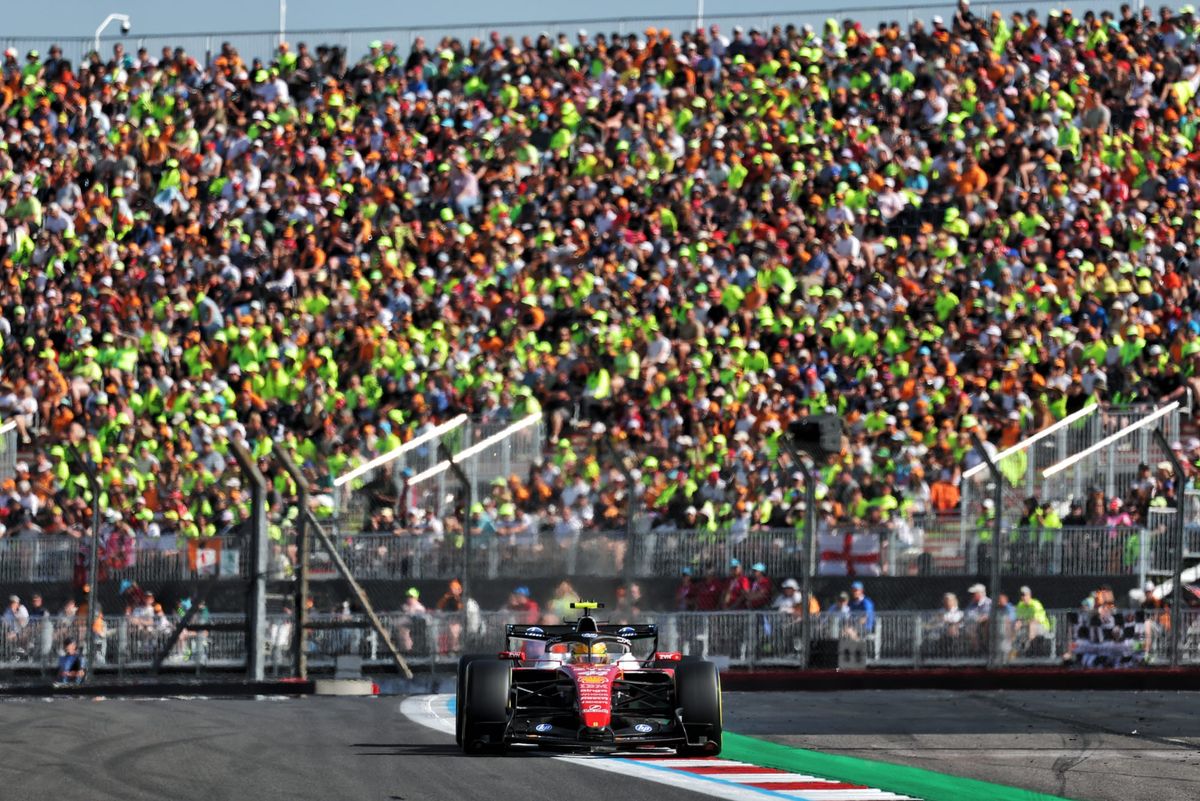
Lewis Hamilton had arrived at the British Grand Prix expecting a bit of a drubbing from Mercedes off the back of a difficult race in Austria.
A clear deployment deficit that had hurt Ferrari’s hopes at the Red Bull Ring was set to consign the Prancing Horse to an even tougher time this time out.
Hamilton reckoned that Ferrari was losing four tenths on the straight last weekend; and at energy starved Silverstone that gap was only going to grow.
“The deficit could be twice as big,” he lamented on Thursday, as Ferrari feared that even on a track that would suit its chassis they would end up six tenths adrift.
The reality turned out to be very different, with Austrian winner George Russell not quite understanding why Ferrari's deployment was so much better this time out.
“They've been on the back foot with the PU [power unit] and energy management, and here they look the best at the moment,” he said.
“So that's been a real surprise. We've always known they've had a great chassis, but yeah, I think some things aren't quite making sense.”
But while Hamilton’s surprise pole position was certainly against expectations, there are some clear elements that appear to have swung things in its favour beyond championship leader Kimi Antonelli not putting all his best sectors together.
Power unit not compromised
Ferrari’s ADUO (Additional Development and Upgrade Opportunities) update at the Austrian Grand Prix had flattered to deceive as the team found itself unable to match Mercedes around the Red Bull Ring.
But it has since emerged that its performance there had been heavily compromised by the altitude and heat. The Ferrari engine is known to run hot in normal conditions – so at the heat and with thinner air last weekend it was always going to face difficulties.
Ferrari had attempted to help things by opening up its car (and thereby compromising its aerodynamics), but even that was not enough as its engine and turbo still struggled.
This was highlighted by the "go to mode TS for temperature reasons” message as Ferrari battled to keep things under control.
With Silverstone both much cooler and at a lower altitude, the elements that held Ferrari back in Austria are not factors here.
So the full benefits of its ADUO upgrade may be more on display, and perhaps show that it was worth a bigger step than even Ferrari had dreamed of.
As Hamilton said: “Yesterday they [Ferrari] were scaring me, they were like, ‘you're going to be six tenths off in a straight line’ to these guys [Mercedes], and in the last race we were four tenths off in a straight line.
“Today, all of a sudden we're kind of there, and I was like, is this real? Are they going to turn up in quali? And we were right there competing with them.”
Preparation
Some teams are better at their simulation and preparation than others – and Ferrari has a bit of history in regularly hitting the ground running.
More often than not (and it does not get it right on every occasion) Ferrari finds itself in a good window on a Friday, with other squads sometimes taking a bit longer to chip away and close it down.
On a normal weekend, with three practice sessions and a single qualifying, the evolution of the race weekend disguises how the picture can shift as others make use of Friday night to lift their form.
On sprint weekends, however, being quick off the mark can be key to a Friday pole and at Silverstone will have helped Hamilton make the most of the opportunity that was put in front of him.
Also helping Ferrari is that Mercedes felt that it had not been as on top of things as much as it has been at previous races.
Trackside engineering director Andrew Shovlin said: “We've had a good run of landing the start set-up in a decent place in recent races, but it has felt like we've been on the back foot today.
“Over the course of the sessions, we've been making changes to put more stability into the car but even by the SQ3 of sprint qualifying, it still felt that the front was still too strong, which is not what you need when it's so gusty.”
Saturday's official qualifying will highlight just how much of a factor this preparation will have been.
Easier car to drive helps on the straights
One of the traits of the 2026 cars is that the interaction between how the car handles and how it uses energy has never been more interlinked.
While there are times when going slower through a corner can be beneficial for delivering a bit more energy for the following straight, the ultimate truth is that the best approach is still to be faster and smoother through the turns.
Doing that means the car needs to burn less power to get up to speed on the way out of the corner, and that means the energy lasts longer. Tiny differences in speed profile here can make big differences with lap time.
A well-settled car is also much, much better than one that is nervous and wheel-spinning coming off a corner, which can be disastrous for energy management. That was something that hurt Ferrari in Austria.
A look at Hamilton’s sprint pole lap shows that the car seemed very strong on some corner exits which then helped catapult him down the following straights.
The differences between a well-settled car and one that is sliding out of corners may only be about 1-2% of power, but in F1 2026 that can translate to tenths.
Everyone knows that Ferrari’s chassis is strong (even if some of its choices have compromised its power unit), but here the advantages it gets in the corners has outweighed any losses down the straights. That was not the case in Austria.
And Ferrari seems to be well on top of what its car needs, which is in contrast to 12 months ago.
Hamilton said after taking pole: “Last year we were kind of stuck in the rut, not a lot we could do.
“Now they're finding things, they're adding things to the car, and this weekend, every single weekend, we're bringing small little bits, and adding performance to this car.”
Tyre temperatures
After an Austrian GP where the tyre challenge was entirely about not overheating, Silverstone has so far been an opposite case.
The challenge has been, with Pirelli’s hardest compounds in play, to get them fired up.
Drivers like George Russell and Max Verstappen complained about difficulties in getting the fronts into the right operating window, and a lack of grip being the consequence of not doing so.
It is something that Ferrari has not struggled with this season, as it has often run with its rubber slightly warmer than rivals.
It explained why, for example, it was potentially so good in chilly Canada and it almost certainly played a part at Silverstone so far.
Hamilton's home advantage
One factor that also should not be underestimated is that Hamilton is a master of Silverstone.
And while home crowd advantage doesn’t transfer to much (if any) real benefit on track, what does is driving to the limit on a track you love where you know the quirks and tricks to be quick.
Analysis of Hamilton’s lap shows in particular that he made a lot of difference through the Turn 3 and Turn 4 complex, being much better on the brakes than Antonelli and carrying an impressive corner speed that was up to 10km/h faster at times.
Having arrived at the Turn 3 right-hander around 0.12 seconds behind the Mercedes, he briefly turned that into a 0.13s advantage before it settled down to a 0.05s edge on the run out of Turn 4.
These are the kind of moments that come from a driver who trusts his car and is in a happy place – which is something that can come from the kind of extra home support that Hamilton witnessed during an appearance on the fan stage on Thursday night.
As Hamilton said: “I got back to my room last night, after being on stage, and I'm like shaking with just pure adrenaline.”