

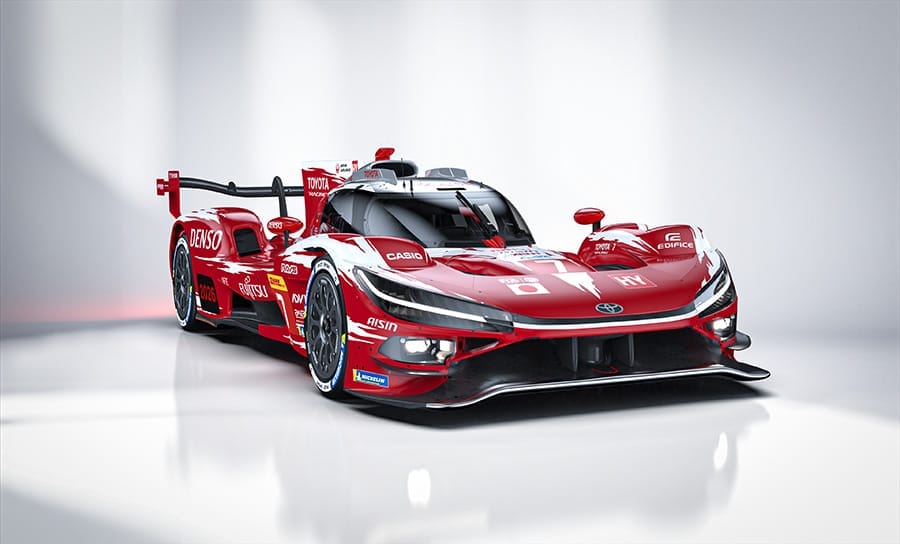
What has happened since Toyota first revealed an initial visual of its 2026 LMH on October 1 last year? The car was shaken down at Paul Ricard on October 8 and 9 in camouflage livery, giving The Race the opportunity to bring you the first images.
The Japanese Hypercar then returned to the Cologne windtunnel, followed by further work at Windshear in North Carolina, the facility used by the FIA and ACO for car homologation.
Another test took place on December 10 and 12 at the Lusail International Circuit in Qatar, which will host the opening round of the 2026 season on March 28. Further running is planned, including a return to Paul Ricard later this month.
But before that, Toyota has now released the first official images of its 2026 weapon, just days ahead of the Tokyo Auto Salon, which runs from January 9 to 11.
What have we learned?
Truthfully, not so much. The most significant news concerns a change of name. Toyota Motor Corporation and Toyota Racing GmbH have decided to rename the European research and development centre and subsidiary previously known as Toyota Gazoo Racing Europe GmbH (Cologne, Germany). From January 7, 2026, it will revert to its former name: Toyota Racing GmbH.
In addition, Toyota competed in the FIA World Endurance Championship under the Toyota Gazoo Racing banner from 2016 to 2025. From the 2026 season onwards, the team will race under the new Toyota Racing brand and will introduce the updated TR010 HYBRID Hypercar.
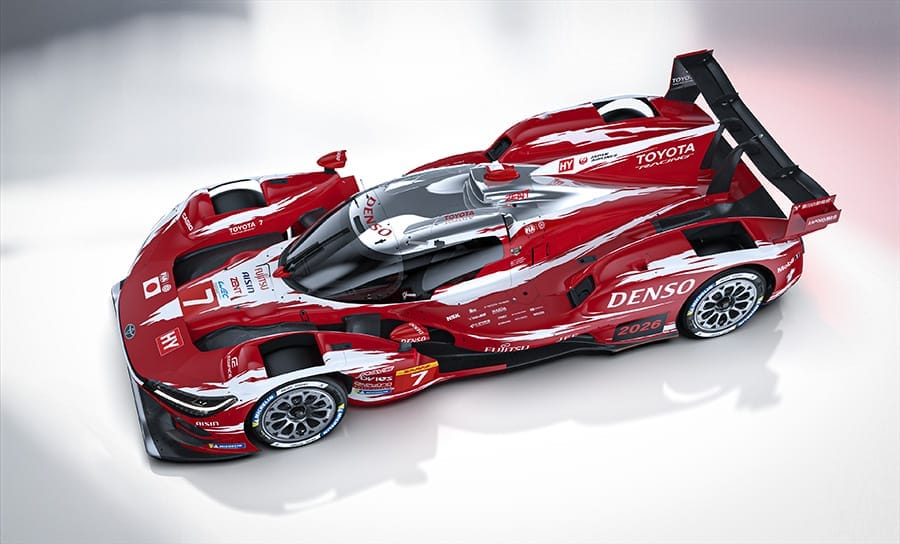
The car wears a livery closely resembling that of the Yaris WRC unveiled yesterday. The visual link between the two is nothing new, as it had already existed until last year, before the Yaris moved to a silver scheme.
The TR010’s colours are also heavily inspired by those worn by the #7 GR010 Hybrid at the Le Mans 24 Hours last June, a design that paid tribute to the iconic GT-One.
A third major evolution for Toyota’s LMH
Toyota was the first manufacturer to race a Hypercar, making its debut at the start of 2021. Its development path has been heavily affected by repeated technical regulation changes. At the last minute, the minimum weight was reduced by 70kg, forcing Toyota into a late rethink of the car’s weight distribution.
That explains why the GR010 has already undergone two major evolutions. During the 2021–2022 off-season, Toyota switched tyre sizes, moving from 31cm fronts to 29cm, and adopting 34cm rears. The following winter, further weight reduction and a significantly improved mass distribution were introduced. Aero, chassis and powertrain were also refined, leading to noticeably improved driveability. On that occasion, Toyota reportedly used its second permitted homologation joker.
This latest update therefore represents the third major evolution of Toyota’s LMH, which – despite a name change – is about to contest its sixth competitive season, a rarity in the Hypercar era. Unsurprisingly, Toyota will have used at least one of the five Evo Jokers allowed between 2021 and 2027.
Why make this change?
With the category governed by Balance of Performance, why chase outright performance gains? The focus instead lies on driveability, behavioural consistency, and positioning the car optimally within the regulatory window. Had the GR010 perhaps leaned too heavily towards downforce at the expense of drag? It’s a possibility.
A few months ago, The Race asked TGR-E vice president Kazuki Nakajima about this very subject:
“We’re looking for improvements in many areas, not just top speed. But Le Mans showed us that top speed remains a critical issue. It should have been corrected by the dual-band BoP, but there was still a gap. That’s something we need to work on, alongside the aero and making the car more driver-friendly.”
Originally, Toyota had planned to introduce these changes for 2025, but the timeline slipped after the governing bodies decided to move windtunnel homologation work from Sauber’s Hinwil facility in Switzerland to Windshear in North Carolina.
“This year’s Le Mans convinced us to go further,” Nakajima admitted.
How is it different?
While The Race had already outlined the most visible changes at first glance, Toyota has not released any further technical details today beyond the name change.
It is worth noting, however, that for the first time Toyota’s design department has played a role in shaping the Hypercar’s appearance. That influence is most obvious in the headlight design, which now echoes the styling cues of the brand’s road cars and concept models — though that is not where the real interest lies.
The front bodywork has been completely redesigned and slimmed down, likely in pursuit of improved straight-line speed. Similar refinements have been applied to the sidepods and the rear wing, which now features a distinctive gullwing-style shape.
For a deeper understanding, a little more patience will be required.
What is its mission?
For sporting reasons or otherwise, Toyota’s 2025 season was deeply disappointing. It remains difficult to explain how the Japanese manufacturer managed to finish second in the constructors’ championship, having to wait until the final race in Bahrain to secure its first podium of the year.
That Bahrain one-two, on an event carrying a 1.5 coefficient, allowed the reigning six-time champion to jump two positions and leapfrog both Porsche and Cadillac in one go. But that late surge was not enough to erase the bitter aftertaste of a season that saw Toyota lose a title it had held since the 2018–2019 campaign.
Meanwhile, its former title rival Ferrari dominated 2025, with a 1-2-3 in the drivers' championship and were first and third at Le Mans.
Toyota therefore has a point to prove in 2026. This revised GR010 is intended to be the spearhead of a fightback — one that must deliver an eighth constructors’ title and, above all, a sixth victory at the 24 Hours of Le Mans, the first since 2022. Anything less will be viewed as a failure.
