How MotoGP's brake masters are preparing for 2027's massive change
Presented by Brembo
MotoGP is bracing for one of the biggest changes in the championship's history in 2027, with the debut of the new 850cc bikes and the switch to Pirelli tyres from the Michelins in use right now.
Teams, manufacturers, riders and suppliers are all hard at work, day after day, test after test, in an effort to prepare as best as possible for the upcoming season. And this includes Brembo - which, as the exclusive brake supplier to all MotoGP teams, has to tailor its offerings to five all-new bikes from five different manufacturers.
The bikes, and the tyres they will use, remain a moving target. "We have to collect more data," admits Brembo's MotoGP Racing Market Manager Andrea Pellegrini - but by and large Brembo knows what to expect from the new formula.
"For sure the performance [of the bikes] will be lower - because the target is this. To reduce the top speed. So for sure the effort will be lower, less demanding on the brakes," he said.
"For the moment we keep the same configuration of disc. Maybe the 355mm [diameter, the largest on offer] finned disc will be not used - maybe not for next year but 2028.
"It depends on how the evolution of the bike will be in the first year."
The standard-mass 355mm carbon disc is still in the picture, and it is complicated to forecast how much braking demand will evolve between now and the end of the first campaign - especially as manufacturers are already showing they will push the boundaries of the new regulations.
"I know some teams have some ideas...there is a reduction in aerodynamics [in the regulations], but they are discovering other parts of the bike where they can put aerodynamic parts."
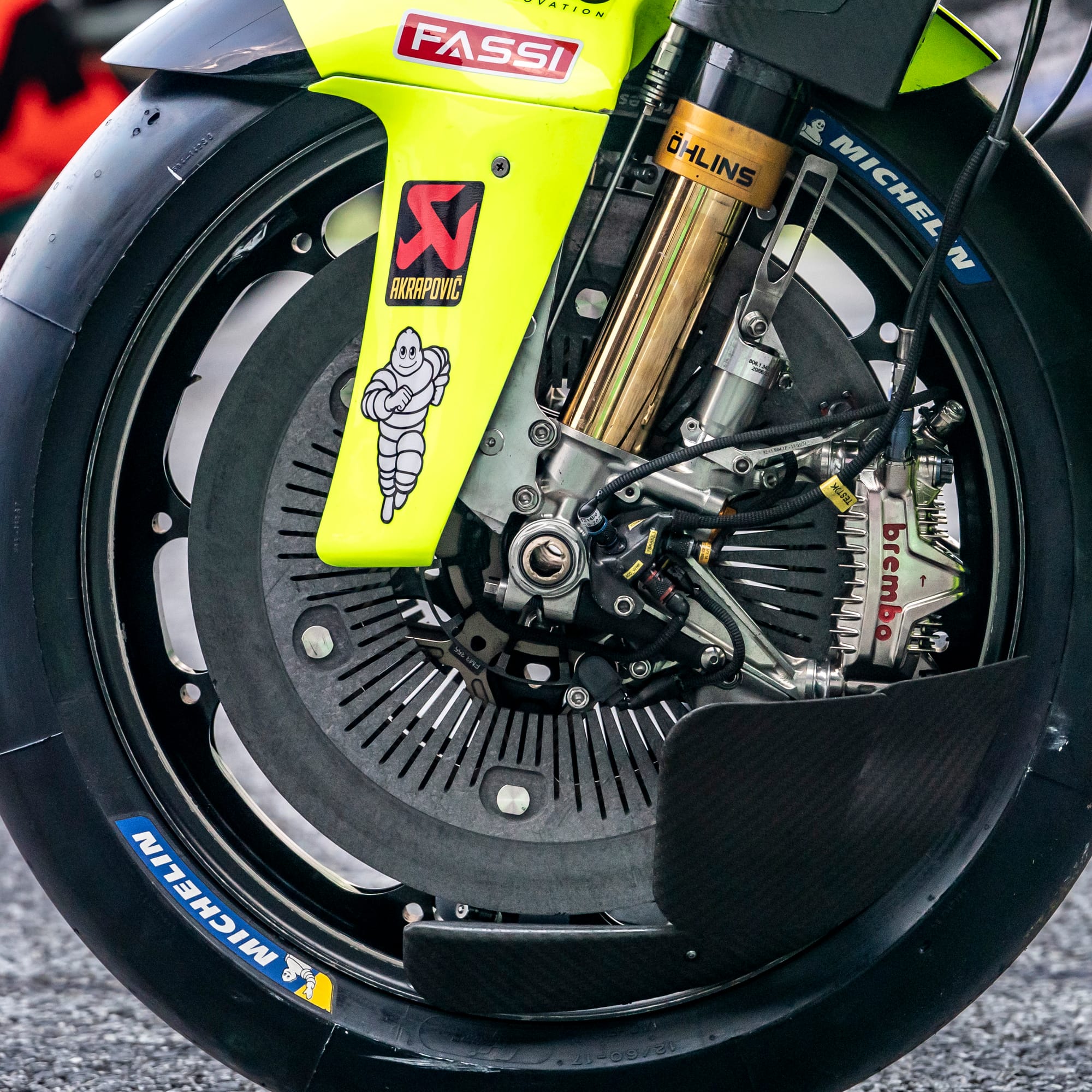
While the offering in terms of disc diameter will stay consistent, Brembo is also introducing a new, lighter caliper.
"I don't know if all the teams will choose this configuration - because the bike [overall] is lighter compared to this one," Pellegrini explained. "Let me say 90% of the teams are interested in this new caliper."
Ultimately, though Brembo is the supplier to all the teams, the target is to give all the participants as many options as possible. It is currently collecting data from each of the factories for the 850cc switch.
"And we don't share it with the others! So it's a sort of NDA we have with all the teams," Pellegrini laughed.
"It's just for our analysis and to understand how to develop the brake system for the future."
This also applies to race weekends. "We have a sort of remote garage in Brembo - so after every race weekend, we check all the data and we make a proper report to the teams in order to give the teams the right way to follow.
"In the past, OK, we gave some information not to go over 1000 degrees, for example. Now, we can suggest to the team, in each corner, the temperature of the discs.
"So we have a sort of map, a working map, for the teams - because the operating temperature is between 200, 250, 300 degrees to 1000, but it depends on the energy you are putting in. So we create a sort of map, and the team may learn a lot from this, how to properly use the discs.
"Now, if you are in the correct working map, the performance of the brakes is good from the beginning to the end of the race. It's important for the rider to get this feeling from the start of the race."
There's variance among the riders, too - crucially in terms of whether they brake with two fingers or favour the increasingly in-vogue one-finger technique.
"We also introduced other smaller things I can't tell you about but in order to help the rider - because we want to help every rider," added Pellegrini.
"We have a small solution that can help a lot the feeling of the rider [depending on how many fingers they use].
"So it's our target, our goal, to give every rider the best solution to customise the brakes to each rider."
Otherwise, though, the braking approach is increasingly uniform among the grid - and the preferred specification of brakes tends to be set in stone already before you hit the track.
"Now we're more or less on the same line," Pellegrini says of rider preferences. "OK, we have different master cylinder sizes, but just because some riders brake with one finger, so they can achieve less force.
"But let me say, now they are riding with the same style - but because it's also the bike that needs this sort of riding style."