Ducati's ace up its sleeve for 2027?
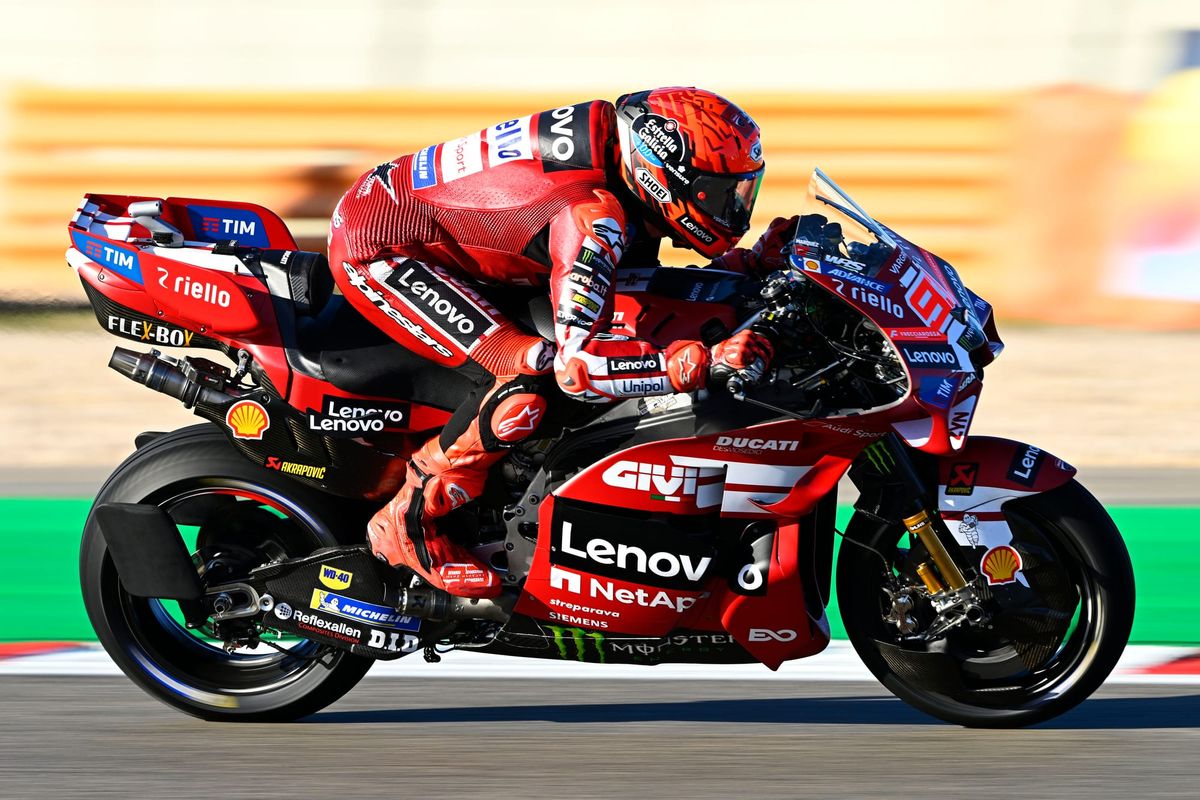
Presented by Lenovo
With new regulations for the 2027 MotoGP season now only mere weeks away, it's been a frantic time for all of the series' factories as they prepare their new 850cc machines for next year's switch to Pirelli tyres; the biggest shake-up to the championship in a decade.
Yet while every team might be flat-out working on next season while still staying focused on 2026, there's one squad that clearly believes that it's got something of an ace up its sleeve thanks to a rather unique partnership - namely, the Ducati Lenovo Team and its alliance with title partner Lenovo in preparing for a whole new era of MotoGP.
And, according to Ducati Corse technical director Davide Barana, that relationship will be particularly valuable as Ducati tackles the simultaneous demands of developing an entirely new motorcycle for 2027 while continuing to fight for the championship with its current machine.
Of all the changes coming to MotoGP in 2027, Barana identified the new engine regulations as the most significant when he sat down with The Race inside the Ducati Corse workshop in Bologna.
"The biggest change is on the engine side because we will lower the total displacement to 850cc, and this will need a complete redesign of the engine," he explained.
"Together with it, there is also a fuel consumption reduction - and we will move to 100% bio-sourced fuel, so also it is a big change for the engine.
"The current project is very refined. We work for the very last horsepower, and with the new engine there is almost an open white paper now."
However, while the engine development might be a significant task, it's perhaps elsewhere where we might see Ducati making the most progress - as it looks to wrestle back its MotoGP aerodynamics supremacy.
The collaboration with Lenovo has become an increasingly important part of that process, particularly as computational fluid dynamics (CFD) and other simulation techniques allow engineers to explore concepts that would previously have required extensive physical testing.
"It's very important," Barana added, "because it's also connected with the engine development. In general this year is a very challenging year because we have completely new projects that start from zero, and it's very important to have tools and capability to answer the classical question - 'what if?'.
"Now, when the design space is so big, it's very important to have a simulation tool that is able to answer to the many questions we have. And for this reason the computational power is a fundamental key to achieve this result, and the partnership with Lenovo is really important for this year in particular.
"I want to add that we also have two projects in parallel - because we have the new project and the project for this year that is continuing in development because we are fighting for the championship.
"So, this year certainly we increased our computational capability. We have roughly doubled the memory availability and increased our computational processing power by almost 50%."
And, with testing time more limited than ever before, that ability to try things out virtually before bikes even go near a track is yet another area where the Lenovo and Ducati partnership should help the project hit the ground running in 2027.
"The virtual development is one key factor in the capability to develop the bike," added Barana, "because we have very limited time to test with the official [full-time] riders.
"In particular for the new project that we have had two days this year - and then we will wait till the end of the year to have the next one.
"So, to have a possibility to run virtual testing, or a 'digital twin' if you prefer to call it that, is really a big advantage because we can in advance, without even producing any pre-op parts, start to answer the question: 'what if', what happens if we change these things?
"There are so many inputs and a lot of output to define that the virtual approach together with the amount of computational power to exploit it is fundamental."
There's another perhaps surprising area where Barana also sees a huge benefit from their ability to process data, though: helping 2027 new signing Pedro Acosta get quickly up to speed as he joins the factory team in the place of double MotoGP champion Pecco Bagnaia, a career Ducati rider.
"The interaction with the rider [in analysing data] has become more and more important," the veteran engineer explained, "and also, with the new generation of the rider that is even easier because they start their career with this type of working; for them it's more natural than maybe the older ones.
"But, for example, Marc [Marquez] is a very clever and open-minded guy so he also adapts to this new way of working very well and this is certainly important because we are trying to optimise everything. And also the riding style for the rider is very important, to analyse together the telemetry, to maybe discuss with him how we think there is some gain, where we can improve our manoeuvre. Every detail counts in a racing weekend."
And, while the proper debut of the 2027 bikes at the post-season Valencia test in early December might be in one way the conclusion of the 850cc bike's development, or at least its first phase, Barana says that there are still many more opportunities to come in the future as Ducati continues to grow its relationship with Lenovo.
Chief among them is "continuing to increase, certainly, the computational power, because also we are trying to use more and more AI - that is quite demanding also in computational power".
"But we want to do more and more," Barana continued, "because it's not just a matter of computing. It's a matter also of helping us find, for example, a hidden pattern within the data we collect that maybe we didn't discover - because human beings have limited capability and time available.
"So I think this is one of the more exciting parts of the Lenovo partnership in the next years."