What MotoGP must learn from terrifying Barcelona crashes
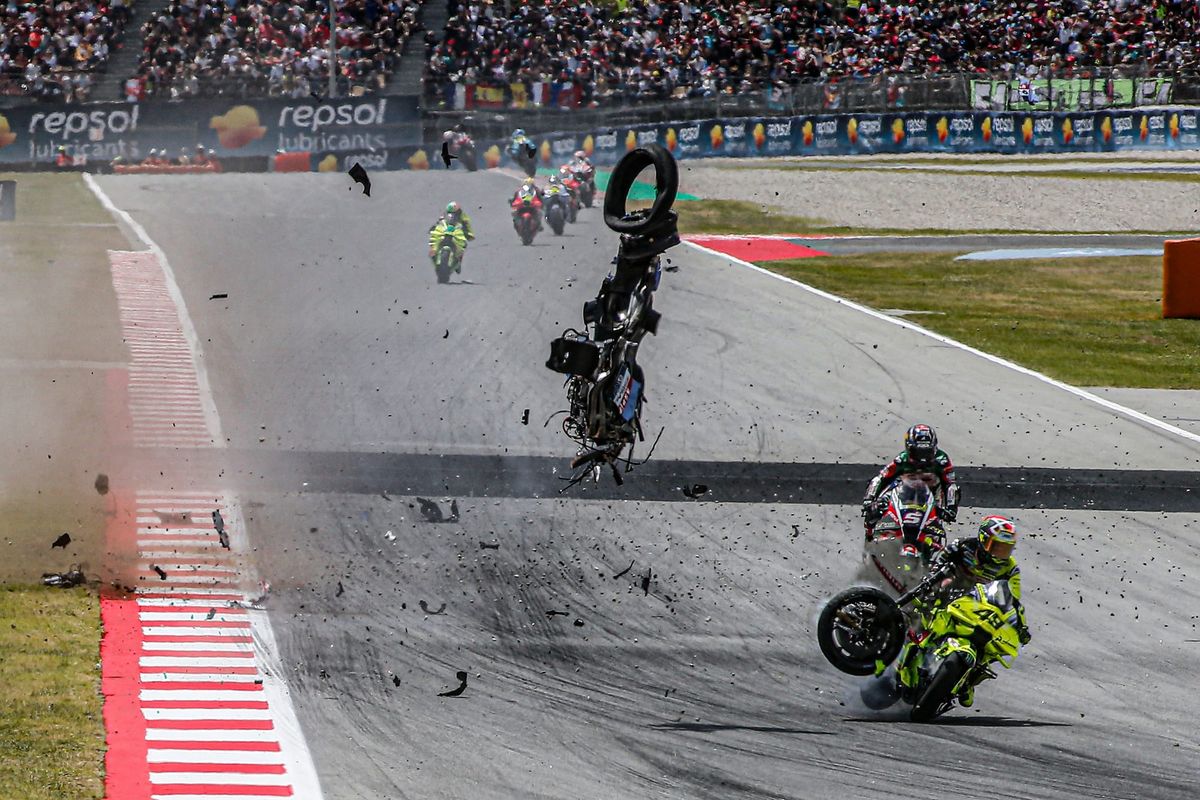
The outcomes of MotoGP's twice-red-flagged 2026 Catalan Grand Prix could have been so much worse, with Alex Marquez and Johann Zarco beginning their recoveries (albeit with Zarco facing a wait) from the injuries they sustained in their terrifying pair of crashes.
But it was a weekend that felt on the edge right from practice - so there's plenty for MotoGP - and the riders - to learn from and improve on.
Rider (and bike) fitness for restarts must be reviewed
Should everybody who took the restarts in the race have been allowed to do so?
The big question in-race surrounded the KTMs, which had been compromised with three separate technical failures - though KTM insisted at the time that they had been unrelated.
But the swift turnarounds between the race starts left a lot of room for questions up and down the grid, and led to things like speculation from Pecco Bagnaia about whether Johann Zarco's Honda was totally intact when it blew the Turn 1 braking and clattered into Luca Marini and Bagnaia.
By all other accounts, it was. Zarco himself has since told French outlet L'Equipe that it was him rather than the bike who was unprepared for the restart. Which is the bigger issue.
We know eventual race winner Fabio Di Giannantonio was "screaming" with pain in the aftermath of that first accident. Clearly, he was able to do a very good race afterwards - but what about Bagnaia, who had something wrong with his neck so was riding around "dizzy" in the final race. It was clearly worth his while given the resulting podium - but should he really have been out there?
In a way it is part of a wider philosophical question over riders riding in suboptimal fitness being celebrated rather than discouraged. Fitting into that picture neatly is the reporting from multiple Spanish media outlets that Jorge Martin had suffered a concussion in his Friday crash, yet rode the rest of the weekend and the test (ending up in five more crashes and a trip to hospital).
The circuit layout needs looking at
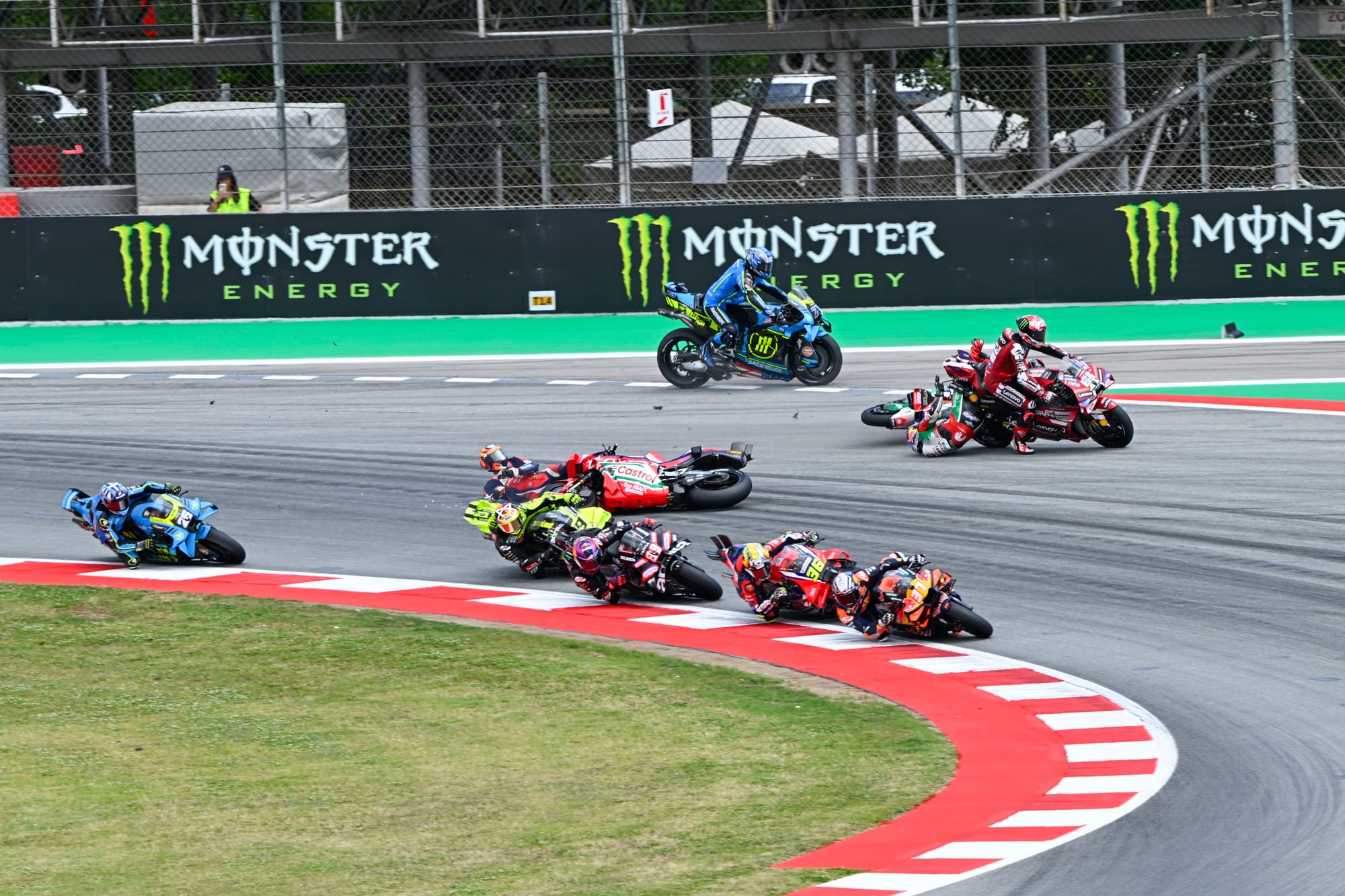
There's always something of a sense of inevitability at Barcelona when there's a Turn 1 collision, given the nature of the corner, and it's something that is going to need looking at going forward if MotoGP bosses are serious about safety changes.
The corner itself isn't the problem, mind you - and the change that is necessary is actually quite a small one in the grand scheme of things.
The run from the start line to Turn 1 is nearly half a mile long, more than double that of most circuits, which means that riders arrive very, very fast indeed to the braking zone - on the rev limiter in fifth gear and touching 180mph, according to some riders after Sunday's incident.
That’s a situation further complicated by ride height devices, which not only ensure higher speeds going into the corner but also act to unsettle the bikes when they are released again, making an already tricky situation doubly complicated. Double superbike world champion Toprak Razgatlioglu (a race winner on production machinery at Barcelona) was quick to point that out after his first experience on a prototype bike.
The solution is, in theory, simple. Part of the problem will be eased in 2027 by the removal of the devices, but the corner could be made safer for every class by simply moving the start line closer to Turn 1 and reducing the closing speed riders are arriving with.
Riders want number of restarts assessed
It's odd in 2026 to hear riders almost unanimous on a safety issue, but there was something close to it on Sunday afternoon after they'd first been forced to watch two of their fellow racers get badly hurt, then get sent out to start the race again not once but twice themselves.
Multiple racers felt that the second restart, after Zarco's Turn 1 crash, should never have happened and that a race result should have been called at that point. Under the rules, that would have been allowed, given the distance already completed in the first running of the race (albeit by awarding half points).
Of course, there's a belief from MotoGP management that the show must go on at all times - but there were strong words from a few of even the grid's toughest racers afterwards about the necessity of putting the riders actually on the bike through the stress of it.
"I see it really unnecessary, the third start, because after two red flags, everything was going on, two guys in the hospital, in the last crash there was three on the floor," explained Acosta afterwards.
"I think it's not necessary to make a third race. I understand and I always say that the show must go on, but at the end of the day we are the ones that make the show for this; it's not necessary to make a third start."
But riders do need a more united front
For all the valid questions about how aspects of the Catalan GP could and should have been handled, it feels inarguable that MotoGP riders have in recent years come across as increasingly passive in fighting their corner and pursuing solutions when it comes to safety and organisational matters.
It is easy to chalk up decreased attendance in the Friday safety commission meetings (between the grid and the organisers) to disillusionment with the process - but that's a charitable interpretation. A different interpretation would be that many of the riders just don't feel like going, regardless of the system's effectiveness.
And several riders during the Catalan GP weekend hinted that there's been difficulty in getting the grid aligned on common interests - or on how to deal with a difference of opinions.
"The safety commission is really great for us as riders to communicate with Dorna and to find solutions to some problems that we have," insisted Marini earlier in the weekend.
"During the years, everything has improved, Dorna has done a fantastic job, and the safety in general in the tracks has improved so much.
"In my point of view, the real problem with this is we cannot be all together as riders. It's really difficult to be on the same direction, with all the same ideas because everybody thinks on their own.
"I think that in every job it's a little bit the same - but it would be fantastic if in the future the riders can have better communication and a better relationship among each other.
"At the moment there is a lot of respect between everybody - but we need a more open-minded view.
"If we need to take some decision, the guys that are in the safety commission take the decision together with Dorna. But every time it's minor priorities. For big things, at the moment, we need more communication."
But Marini does not want compulsory safety commission attendance; he said it was more "chaos" with "20 inside that room" in the past than with a handful now.
"It's just that maybe we need, all together, to be all together, with one representative that can talk more with the organisation. But we tried many times to do this - and until now it's still not possible."
Perhaps the sheer fear and emotion of last Sunday will make it more possible.