Not just a Martin blunder? Three factors in MotoGP start pile-up
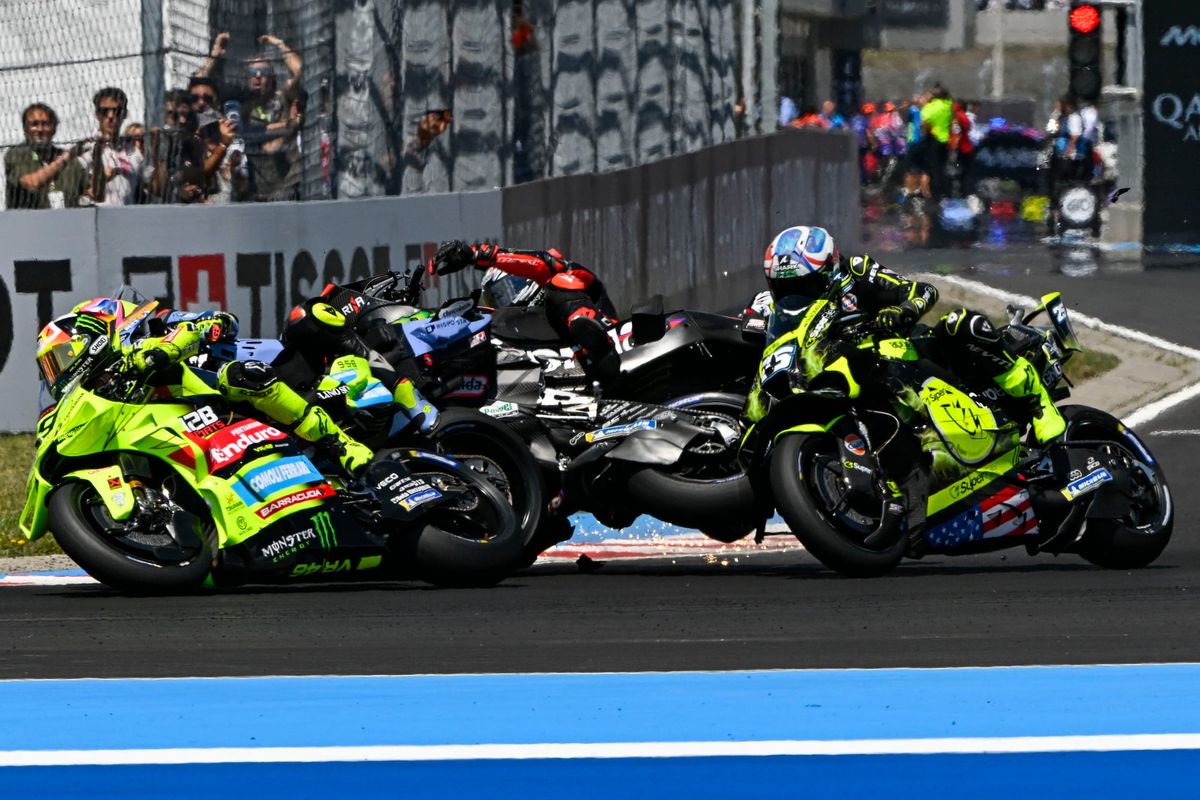
A whole weekend of clues had led up to Jorge Martin’s potentially MotoGP title race-changing mistake at the start of the Hungarian Grand Prix at Balaton.
This is not to say Martin's mistake was inevitable, but when every piece of it is laid out it is at least unsurprising - even though the fact that five strong contenders were taken out of the race on the spot was certainly a shock.
With everyone largely unhurt but Marc Marquez now just 72 points back in the standings and Martin set to suffer the pain of a double long-lap penalty at Brno, here are the factors that appear to have contributed to the calamity.
Adventures in resurfacing
In what is widely expected to be Balaton Park's last appearance on the MotoGP calendar - following a change of promoter, compromised ticket sales and openly-acknowledged plans to move the race to the Hungaroring the second that is possible - several riders were sounding the alarm over Turn 1 over the three days of action.
And that was not related to the layout. Instead, two parts of the track - one of them being Turn 1 - had been resurfaced between the World Superbike round earlier this year and the MotoGP visit, and stand-in Iker Lecuona, who raced in both events, said he had suddenly found "horrible" grip.
"It doesn't help that the new asphalt they laid is made of oil or something, f**k knows," KTM's Brad Binder quipped sardonically. "It's still seeping through."
So what happened? As the riders were told, there had been a "misunderstanding", in Luca Marini's words - seemingly related to the timing of the resurfacing.
"The guys explained to us that it was not to their knowledge that the track was being resurfaced there," Jack Miller said.
"It's a little bit close to the grand prix. Unfortunately asphalt takes time to bed in - and it didn't have enough time."
An unnatural braking motion
For Miller, the specifics of the Turn 1 resurfacing were less relevant than the fact MotoGP continues to persevere with ride-height devices. These will be banned in 2027, but Miller has been very vocal in feeling there are tracks still remaining on the '26 calendar that invite a more immediate ban on the start aids.
This is to do with both the speed bikes arrive into Turn 1 with, aided by the start devices - and the braking motion required to disengage the devices.
"I've been saying all along, since Barcelona, since we saw two crashes at the first corner for the same sort of thing - take them off! Everybody's at the same level,” said Miller.
"At the end of the day, we're making an unnatural manoeuvre, especially here in Balaton, where Turn 1 was quite slippery, with the new asphalt, that you weren't even really able, without locking the front, to really get enough [load] transfer to unlock the devices. So, I mean, another device-related crash, I believe.
"Everybody's even. We're all arriving, here in Balaton, probably an extra 15-to-20km/h faster, and then doing an unnatural braking manoeuvre.
“So, we take off the front device, it makes everybody's life easier, and everybody is in the same boat - because we're all in the same boat at the moment, except the boat is going 30km/h faster."
Not braking hard enough is potentially ruinous, especially at a track like this where the next opportunity to disengage the device doesn't come immediately - and so you ride around with the bike 'wrong', losing positions you won't recover, as happened to Maverick Vinales on Saturday and Diogo Moreira on Sunday.
"It's always difficult to stop the bike here - and it's even worse with the device, no?" said Moreira.
Overzealousness
Even with those factors in mind, not everybody was keen to absolve Martin himself of culpability.
Though he picked his words carefully, Fabio Di Giannantonio - the only rider involved in the crash to face the media afterwards - wasn't feeling so charitable.
"For sure, whatever happens to Jorge, we need to avoid it," Di Giannantonio said. "I think, and I'm talking also to myself in this case, we risk too much every time. We are not risking to just crash or lose the front. We are risking to put the lives of all the riders in danger.
"Because today could have again been much, much worse. And this is not good, at all, for our sport and then for our lives. So I think if we don't understand this with the good penalties, we need to do the bad penalties, for sure.
"I think it's crazy that I have to pray before the race not to do a good race, but to be safe after the first corner. I think it's completely crazy.
"It can be whatever [causing this]. I don't care. It can be whatever. I want to race, I want to fight hard for my place. But I want to come back home. And at the moment I think we are experiencing in the last years crazy things on the starts.
"I always try to pay a lot of attention to other riders and to myself - because I don't want to crash, I don't want to crash into other riders. So for sure, there are races more critical, that we arrive [to Turn 1] with a lot of speed or whatever - but I think we are the best riders in the world, we can handle the situation."
Martin has only outqualified Bezzecchi once in their time at Aprilia together. He has really struggled to maximise qualifying - and yet his title challenge has soldiered on, propped up in large part by continued excellence off the line and into Turn 1.
But on Saturday it didn't work out as usual. And on Sunday, with Martin again positioning himself to gain that crucial ground, it didn't work out at all.