McLaren 'surprised' by revived Mercedes engine trick it can't use yet
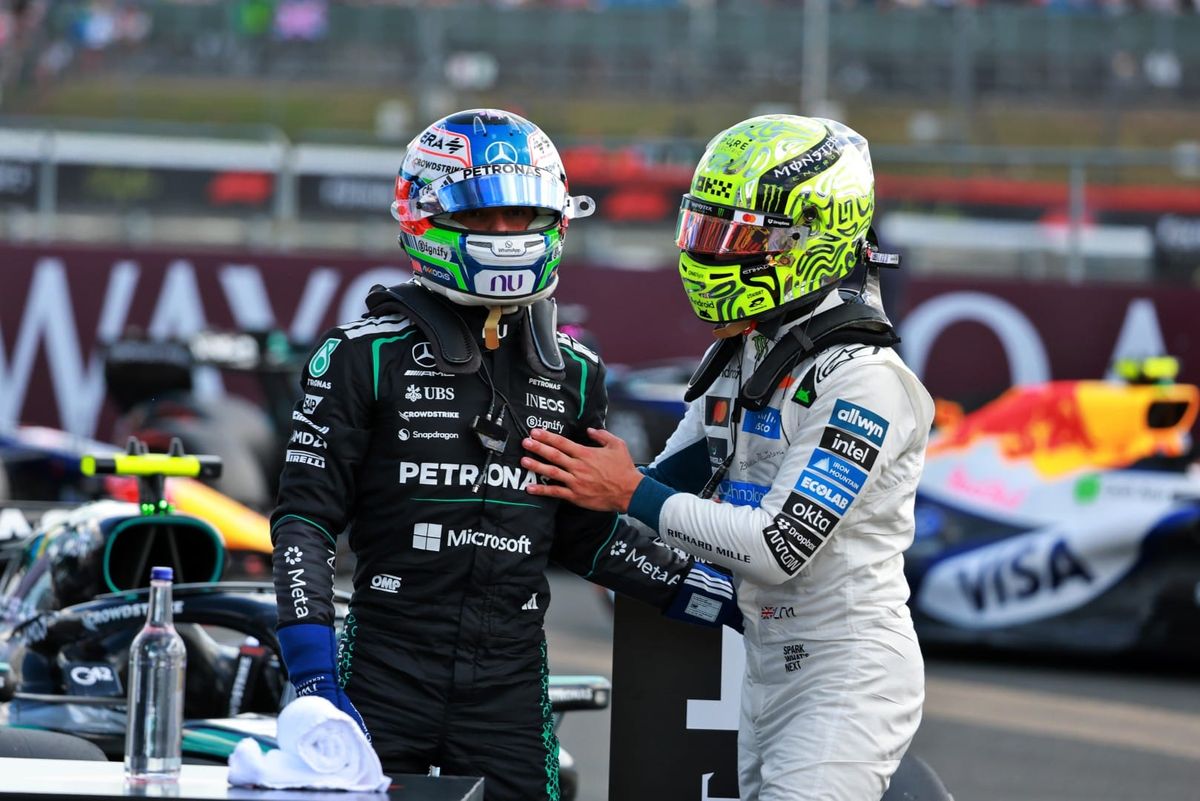

The revival of a Mercedes engine trick came as a surprise to its customer Formula 1 team McLaren - and was an important part of Kimi Antonelli’s route to British Grand Prix pole position.
The Race revealed on Saturday at Silverstone that Mercedes had found a legal way to revive the benefits of an engine trick that had been banned by the FIA earlier this year.
It’s achieved through drivers Antonelli and George Russell bizarrely lifting off the throttle just before they cross the timing line on the start/finish straight.
It’s all about ensuring Mercedes' drivers maximise power on the run to the line and avoid being in the ramp down rate – where power normally needs to be reduced by 50kW every second to avoid a sudden drop-off - for the run to the timing line at Silverstone.
Mercedes had been planning the somewhat counterintuitive method of driving prior to the weekend, so it came more naturally to its drivers.
“It was not easy. It's tricky because with this power unit you need to sometimes drive in a certain way that feels a bit unnatural,” Antonelli said when The Race asked him about the trick.
“Sometimes going on throttle later, so in high-speed you carry more speed, then you go on throttle later. Then you may lose a little bit on exit, but then you regain it because by delaying your throttle point, then you get more energy and a bit later into the straight as well.
“So, it's just tricky, you need to work your way around. That's why sim work has been extremely crucial, just to make sure that these kind of things become natural.
“Because in the first place, you're even like, 'Why do I need to lift?' So it's just tricky at times, but with the team we've done a lot of preparation and luckily these kinds of things have become kind of second nature.”
The difference it's making
With the help of GP Tempo we can see the difference the renewed Mercedes engine trick made in the battle for pole position.
Coming out of the final chicane there’s very little separating Antonelli’s Mercedes and Charles Leclerc’s Ferrari - in fact, Antonelli is only ahead by a slender 0.006s at one point.
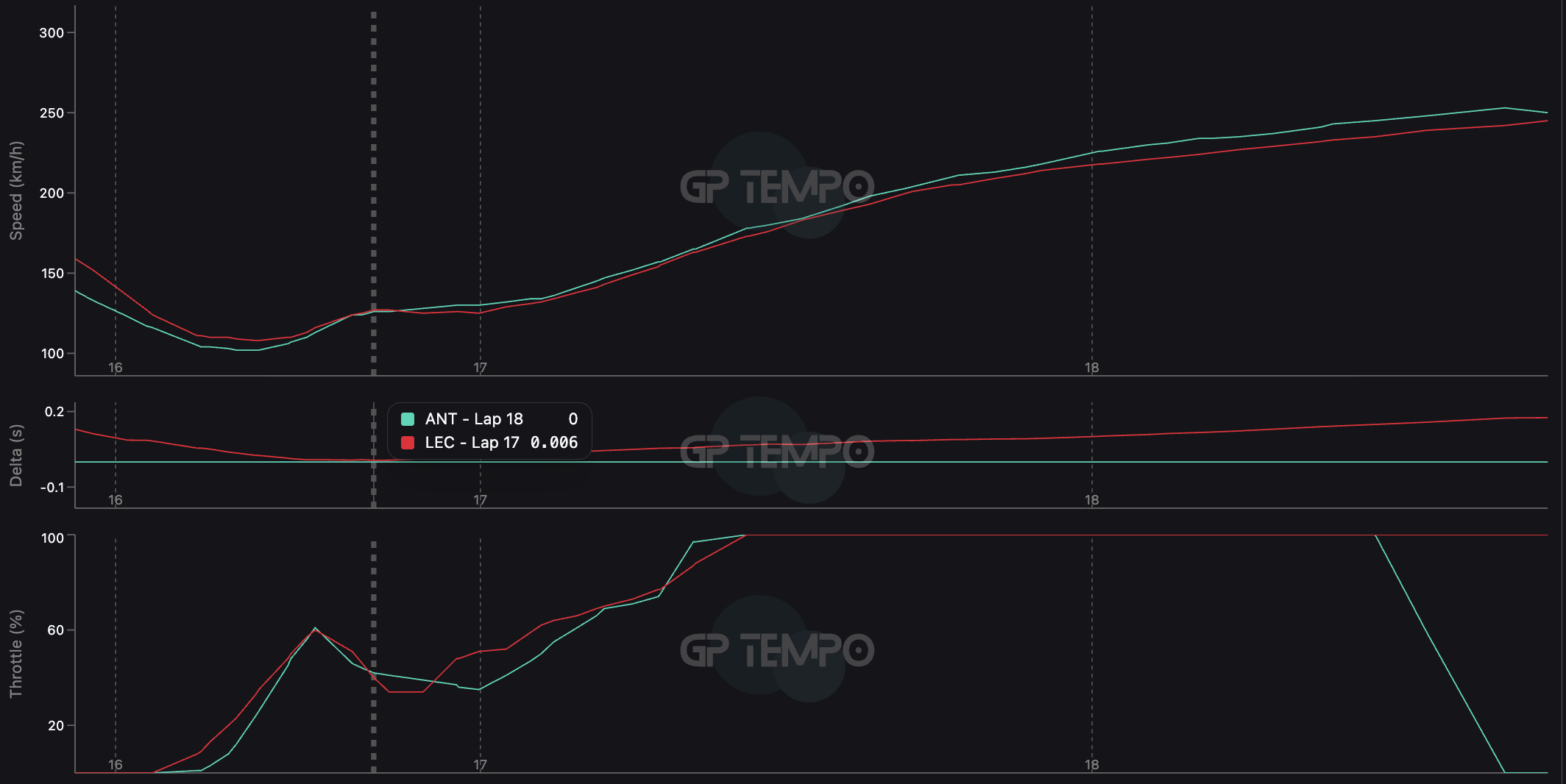
It’s the exit from the corner where the difference is made, with Antonelli rising to a top speed of 253km/h (157mph) - 11km/h or 7mph up on Leclerc.
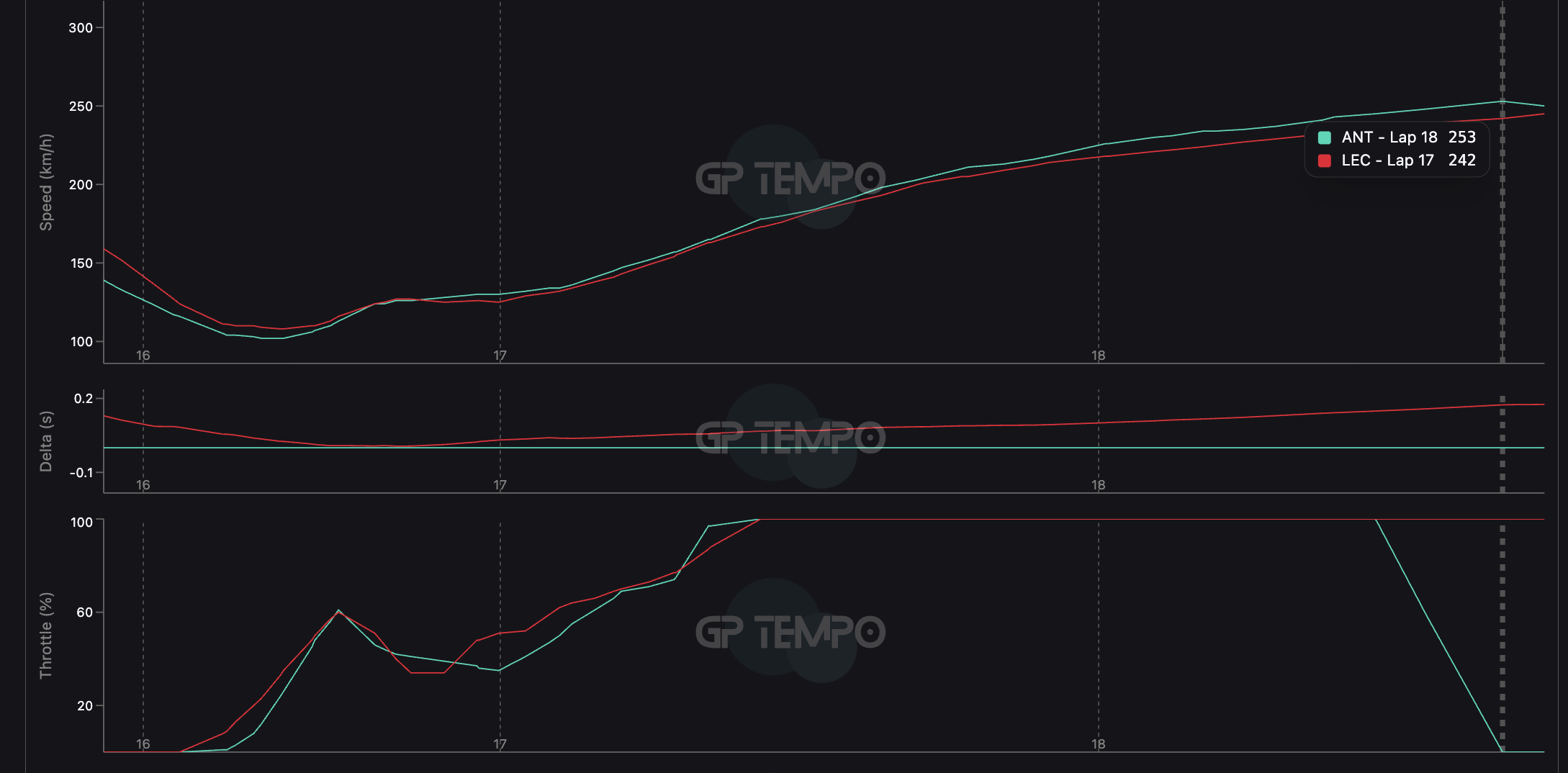
We then see Antonelli’s throttle trace drop from 100% to 0% as he lifts off approaching the timing line.
Their speeds converge towards the line (Antonelli 248km/h and Leclerc 247km/h), leaving a final laptime delta difference of 0.175s - meaning 0.169s of that came on the run out of the final chicane, where the Mercedes trick is deployed.
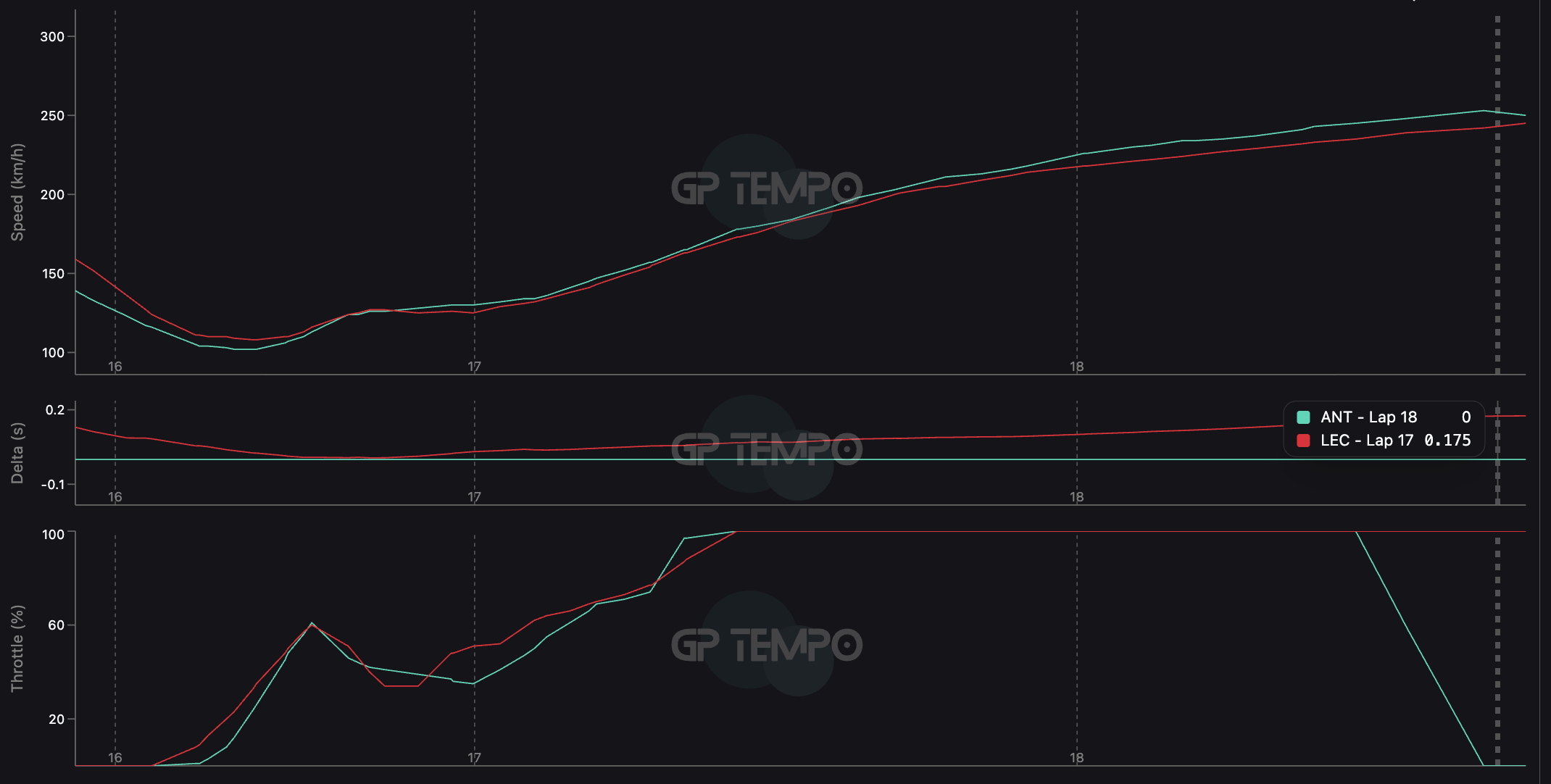
So the Mercedes trick made a big difference, but it is also worth noting that had Antonelli run a more standard, non-trick deployment pattern, he would have been deploying earlier in the lap, and that 0.006s gap at the chicane would have been larger.
So it made Antonelli’s path to pole position more comfortable, but it alone doesn’t explain the difference between Antonelli and Leclerc.
Why McLaren is surprised
The whole paddock was surprised by the revival of the tricks Mercedes has deployed at Silverstone - including its own customer team McLaren.
Oscar Piastri said "I didn't even know they did it, which probably says a lot" when asked about the trick after qualifying.
McLaren team boss Andrea Stella said: “It kind of surprised us a little bit, because it's not something that we discussed.
“I'm not sure at all that it's available to us, because it requires probably some further elements to use the power unit, let’s say.
“So, like I've said before, there's definitely conversations ongoing with [Mercedes] HPP [High Performance Powertrains] at technical level to make sure that we use what is available in this power unit, which is brilliant. It's really a piece of great technology.”
McLaren isn’t yet running the latest specification of Mercedes power unit but it’s hoping to do so from the Belgian Grand Prix onwards.
“There's a lot of performance, which is also in the details of the exploitation,” Stella continued.
“We are now waiting to see if we can upgrade our specification and if this helps exploitation somehow. It should be just a reliability upgrade, so I'm not sure that's the case.
“But definitely there's some other factors that we need to keep discussing with HPP, because when we look at the performance in the straights, even taking into account the fact that they may have less drag, there's still some question marks.”
McLaren wants to improve the optimisation of its Mercedes power unit in many ways versus the factory team, and this latest revitalised trick is further evidence of why engine manufacturers' works teams have an advantage in this still early stage of the current rules cycle.
This trick alone does not fully explain McLaren’s own deficit of over seven tenths of a second to Mercedes in qualifying, but getting on top of it when it’s expected to be even more potent in Hungary - as well as knowing of other inevitable tricks that will emerge - will be key to McLaren chipping away at some of that deficit to the benchmark Mercedes.