Gary Anderson's verdict on the real 2026 McLaren F1 car
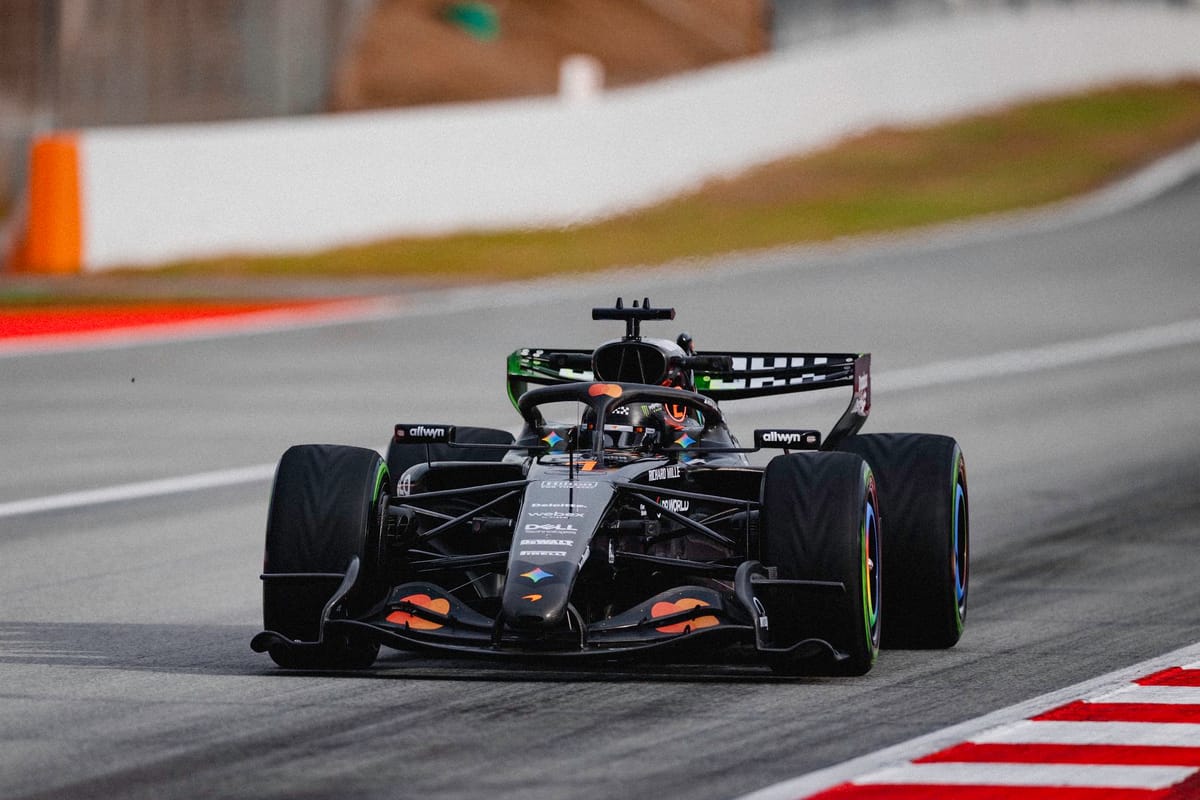
McLaren's 2026 Formula 1 car has finally hit the track at Barcelona. As expected from a pre-season test behind closed doors test, pictures of the real car are limited.
However, we are still able to pick out a few pointers from what we've seen so far.
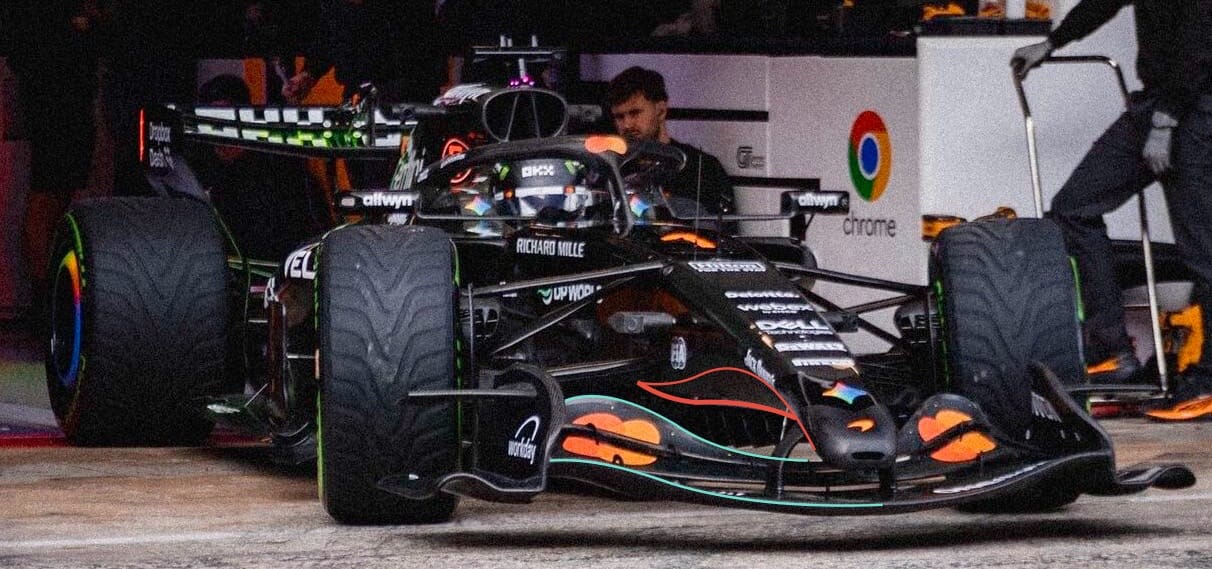
The front wingspan profile of the mainplane leading edge and the flap trailing edge, highlighted with the light blue lines above, are fairly benign. It doesn't change shape quickly across its span. I'm a fan of this as it reduces the potential of crossflow when the pressures on the under surface and top surface change quickly. This type of concept will produce a more consistent flow structure to the rest of the car coming along behind.
Also, although fairly difficult to see, the profile under the nose looks like it is fairly V-shaped - the thinner red highlight line being the breakpoint on the side of the nose, and the thicker red highlight being what looks like the lower floor section of the nose.
This opens up the area under the nose, giving the central section of the front wing more clearance to the nose, allowing better quality and more consistent airflow to the central part of the underfloor through this section.
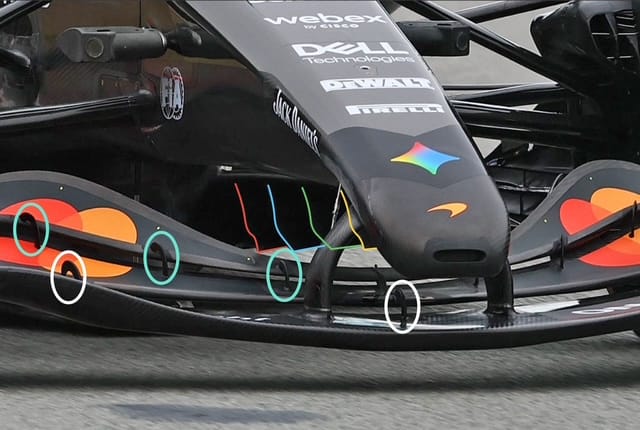
However, it's under the nose in this area where it all gets a bit more exciting and different. McLaren has these vanes coming down from that surface. I will christen them 'snowplough' vanes. I have put the edge detail in different colours: yellow, green, blue and red going rearwards. All of them look like they have a slightly different profile.
If they're V-shaped where they attach to the nose surface, they could be spilling airflow outwards prior to it getting turned outwards by the V-shape connection between the floor and the underneath of the chassis further rearward. The lower outer corner could also be to generate vortices, which could reenergise the airflow that actually goes underneath the leading edge of the underfloor.
Whatever they do, I'm pretty sure that a few other teams will be looking closely at it very soon in CFD.
By having three slot-gap separators per side between the front wing's second and third elements (light blue highlight), and two between the first and second elements (white highlight), I would assume McLaren will back off two elements for its low-drag mode (dubbed straight mode this year).
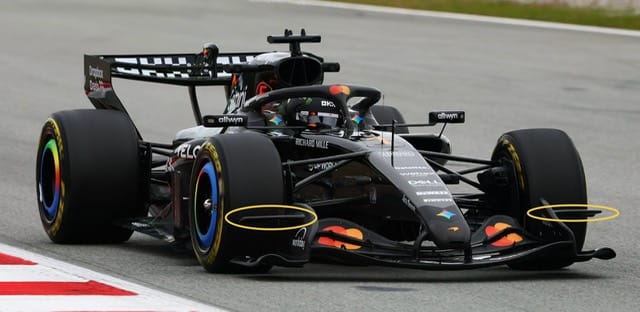
The front wing endplates are nicely sculpted, very three-dimensional and McLaren has this fairly serious horizontal fin mounted on the outer surface, which I have highlighted with a yellow ellipse.
This fin will help direct the airflow down into what is called the tyre squirt area, the area where the rotating tyre forces the airflow around its contact patch on the track surface. If allowed to go around the inside, it disrupts the airflow to the rest of the car.
The objective is to force as much of it as possible around the outside; these red arrows below show what I mean. That flow will then join up with the airflow coming through the tunnel in the lower footplate of the endplate, helping seal the underside of the wing, which will improve its performance. That airflow will then be pulled around into the void behind the front tyre.
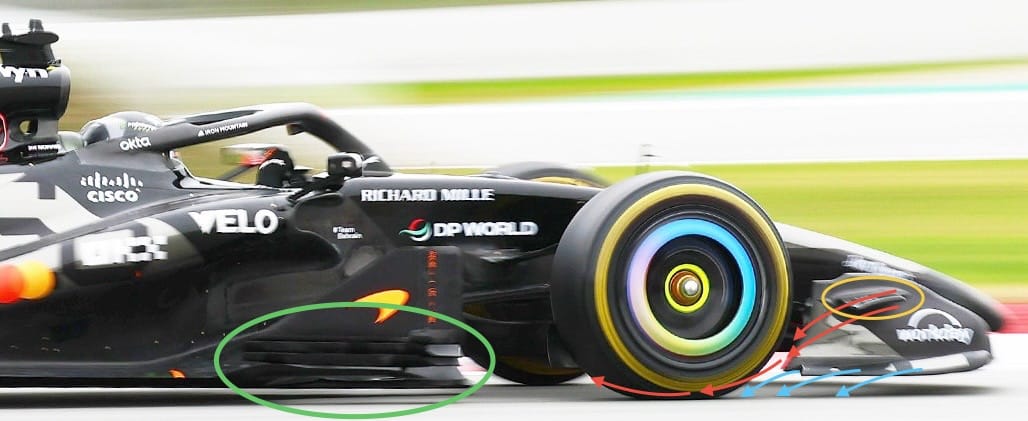
We can also see that the bargeboards are now more elaborate than on the render version shown on Monday. These horizontal vanes will help extract airflow from the bargeboard footplate.
The original style of bargeboard that the FIA believed it was proposing was to instigate inwash. However, from what I have seen so far, most teams have found a way past that and are now creating outwash.
Quite a few of the teams have a similar appendage on the endplates and similar treatment to the bargeboard area. So I'm keen to see where the FIA stands as far as these concepts are concerned. They clearly have an influence on outwash.
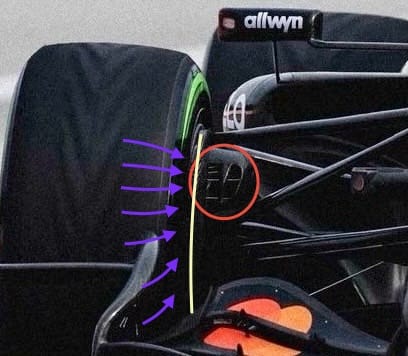
The inlet of the front brake duct (red ellipse) shows a lot more detail; it's divided up into areas to vary the cooling across the internal parts that need different levels of cooling. Last season, McLaren was initially the leader in this style of cooling detail and it helped it keep control of the tyre temperatures front and rear. When the penny dropped, some of the other teams caught up fairly quickly.
The inner surface of the brake duct, highlighted above in yellow, creates a wall to contain the airflow spilling off the front tyre, which is highlighted with the purple arrows. Managing this flow reduces the negative effect it would have on the downforce-producing devices coming along behind.
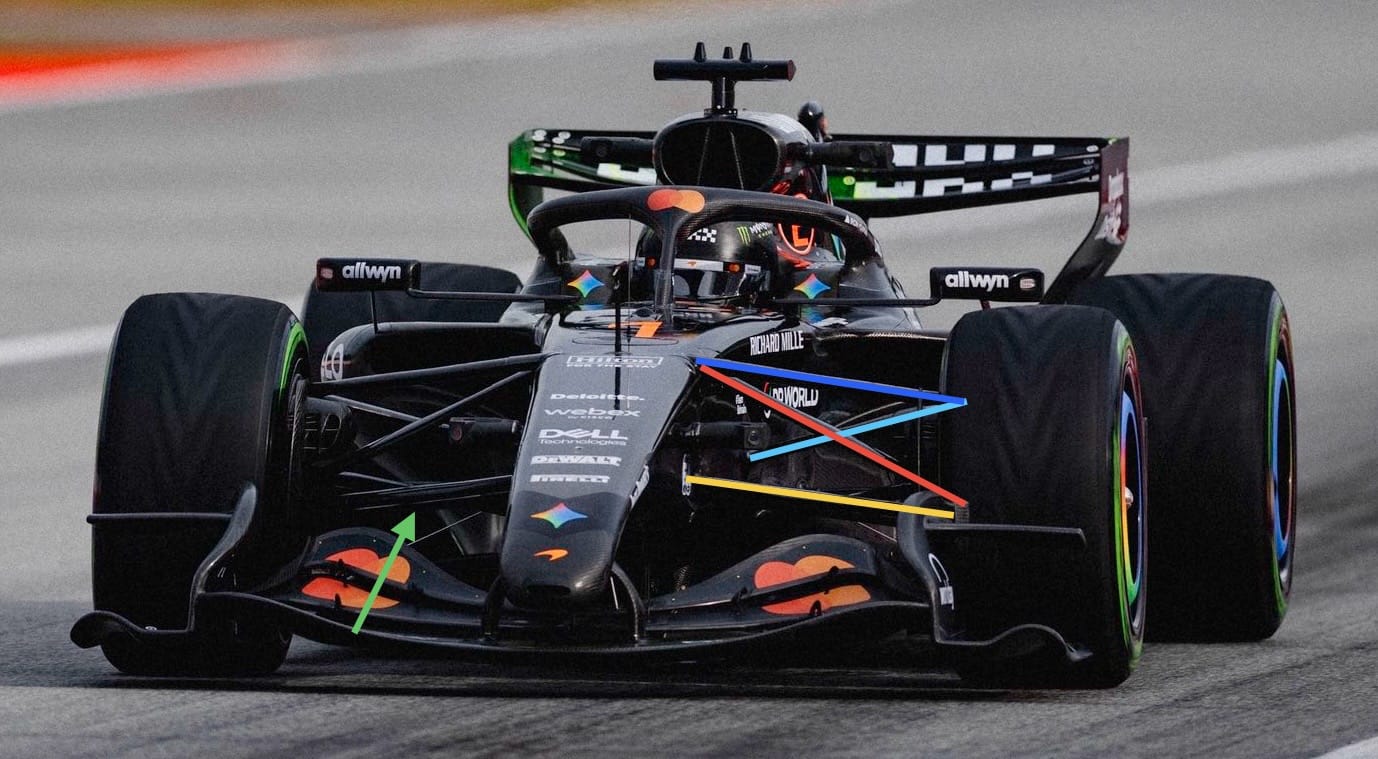
As for the front suspension, the forward pickup is highlighted in dark blue, and the rear leg is highlighted in light blue. The inboard height difference is what gives you the degree of anti-dive and with this height difference, it's a lot of anti-dive - probably even more than last year.
What I believe is the front trackrod is highlighted in yellow and on the other side, highlighted with the green arrow, is what I think is the forward leg of the lower wishbone. I can't really see the rear leg of the lower wishbone to comment on its influence on the overall dive characteristics of the front suspension, but it can have a significant influence.
Anti-dive is great to support the car when you have braking torque going through the suspension system, but as you come off the brakes and that torque reduces the car's ride height will get back to where it should be for the speed and downforce level you are carrying. That means that the front of the car could be moving more just at corner entry and the difference between turning in on the brakes and not being on the brakes could be significant.
We know that last year, around mid-season, McLaren modified its outboard front suspension pickups to give Lando Norris more braking and steering turn-in feeling. It seemed to work, but as it wasn't considered to be a performance advantage, just a driver-feel improvement, team-mate Oscar Piastri didn't use it.
As you never unlearn anything, I'm sure McLaren will have optimised that package to work with this level of anti-dive and both drivers will start the season with the package.
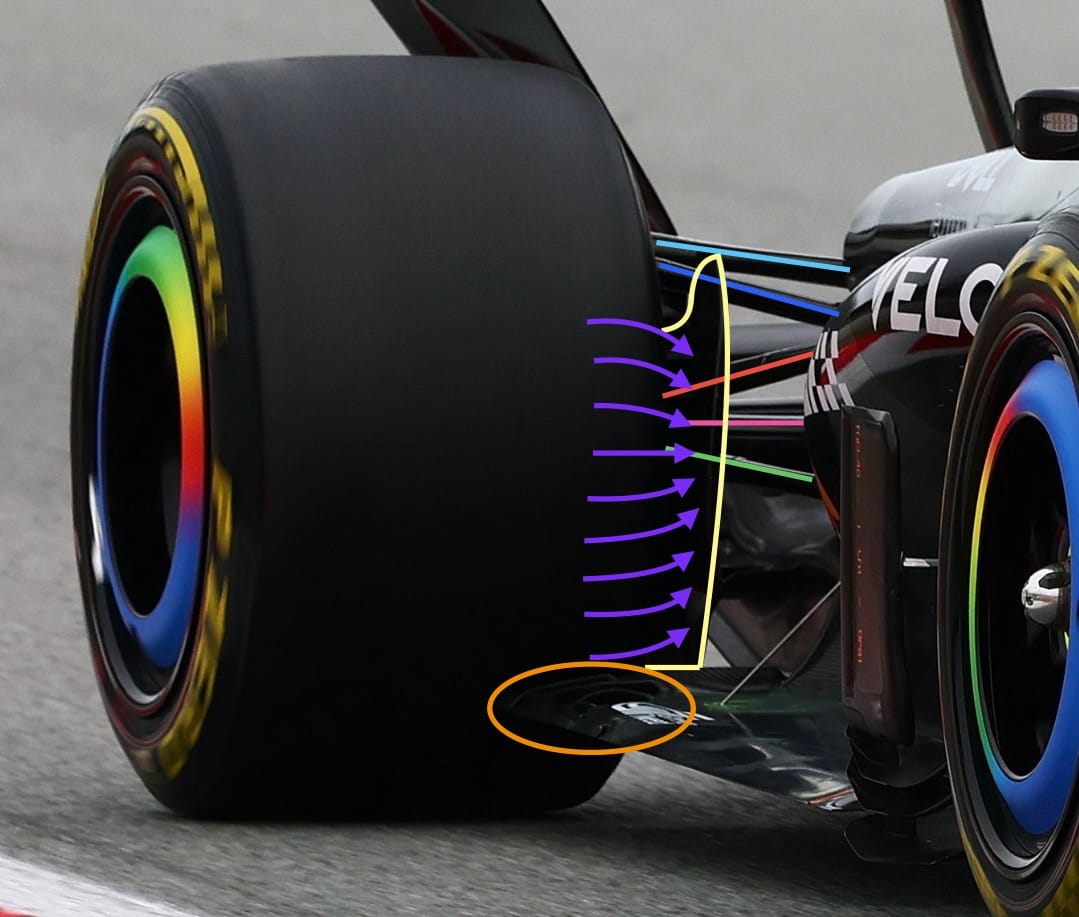
As for the rear end, the overall suspension layout is not dissimilar to last year, with a top wishbone forward leg (dark blue line), rearward leg (light blue line), lower wishbone front leg (green line), pushrod (red line) and driveshaft (shroud, pink highlight).
The brake duct inner surface, with the yellow highlight, is there to contain the airflow spillage highlighted with the purple arrows coming off the rear tyre.
McLaren does have some small louvres on the floor just in front of the rear tyre; they are highlighted with the orange ellipse. Again, these feed into the rear tyre outward tyre squirt to manage the airflow around the tyre contact patch.
This is a new season with very different regulations for both the chassis and power unit compared to last season, so all of the top teams and probably a few others will think right now that this is their big opportunity to claim top spot and knock McLaren off its perch.
From what I have seen of the top four, yes, they all have come up with something slightly different. The interesting thing is, who has got it right? It's going to be in Melbourne before we see any indication of that and, even then, it will still be early days - with plenty of time to see who can develop at a faster rate and who can take the right direction.