Gary Anderson on Hamilton's claim Ferrari is missing a trick
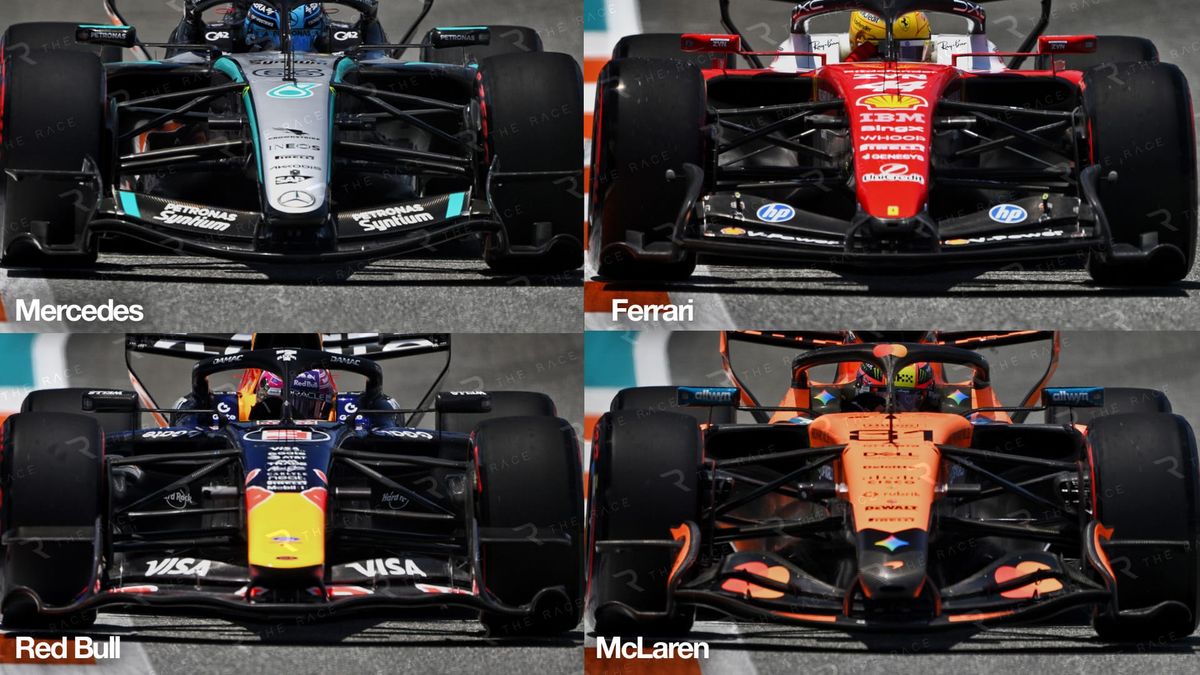
Lewis Hamilton recently raised some questions about the design choices of his Ferrari Formula 1 team when he suggested its front wing was an outlier.
As Ferrari's F1 rivals - McLaren and Red Bull in particular - enjoyed a step forward thanks to major upgrades that arrived as the season resumed in Miami, Hamilton reckoned that an explanation of the shifts in performance came down to choices made in one particular area of the car.
"They - Mercedes, McLaren, and Red Bull - are doing something different with their front wing [compared to us]," he said.
"So we need to look into that to see whether or not there's something we can improve on."
Asked by The Race if this was about the differences between straight and corner mode, or more an overall question of concept, Hamilton replied: "Concept, I think.
"If you just look at everyone else's wing and look at us, you'll see it looks different. So, I don't know if that's necessarily the whole thing, but I wonder what that's doing, because the others seem to have it and they've improved..."
So what has Hamilton spotted and could it be an area in which Ferrari needs to catch up?
It's always very difficult to assess the effects on airflow from what can be seen visually, but what that can do is generate some thoughts about what certain components might do.
Ultimately, every part of an F1 car is important to the performance of the complete package, but the front wing carries just that little bit of a higher priority.
It's the first thing to meet up with the airflow, plus the wake coming off the rear of it is what the rest of the car has to work with. Get it wrong and the rest of the car suffers.
Hamilton may well be correct in his suggestions that Ferrari has missed something with its front wing design, but teams also need to be careful as it's easy to waste your valuable windtunnel and CFD time on blind-alley visual impressions.
So let's look at the top four teams as a comparison, and I have added some highlight lines onto the images to show better where the differences are.
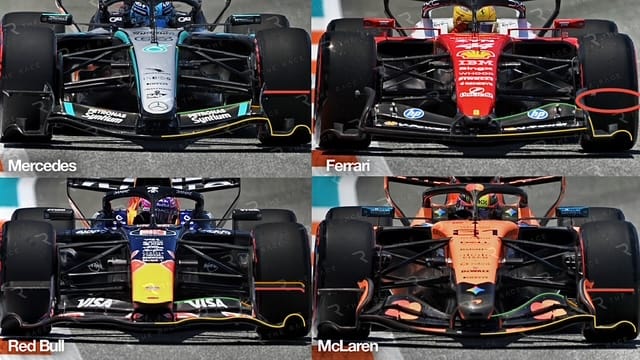
The yellow line is the separation point of the leading edge of the main plane and how it runs into the leading edge of the endplate.
The green line is the trailing edge of the flap assembly.
The small magenta line is the small area between the end of the flaps and the inside of the endplate.
The red is the leading edge of the more-or-less-horizontal vane, commonly known as the diveplane, on the outer surface of the endplate. Ferrari doesn't have one so I have added a red ellipse.
The yellow line is the flow's separation point. This is where the flow decides if it is going under the wing surface or over the top. It is the same with the endplate, where it also decides if it is going around the inside or the outside.
Red Bull has done a lot of detailed work on the integration of the front wing and endplate, and it has also got these two small raised profile sections further inboard. These will influence the airflow in that area to optimise it before it gets to the leading edge of the floor.
Mercedes and the McLaren are very similar, with a reasonable step to the inner lower corner of the endplates. So in reality they have a higher section wing profile further outboard, which should reduce sensitivity mid-corner when the car is in roll.
As for Ferrari, its design is basically the 'simplest' and, as the gap in the yellow highlight line shows, the leading edge of the endplate is further forward than the leading edge of the wing.
It's not as high as the Mercedes or the McLaren and it's not as integrated as the Red Bull, so it is in a bit of no-man's land.
This flow separation point is also influenced by the green highlighted trailing edge. The more aggressive the wing is, the higher that leading edge separation point will be, and basically the more flow will be pulled under the wing with higher flap angles.
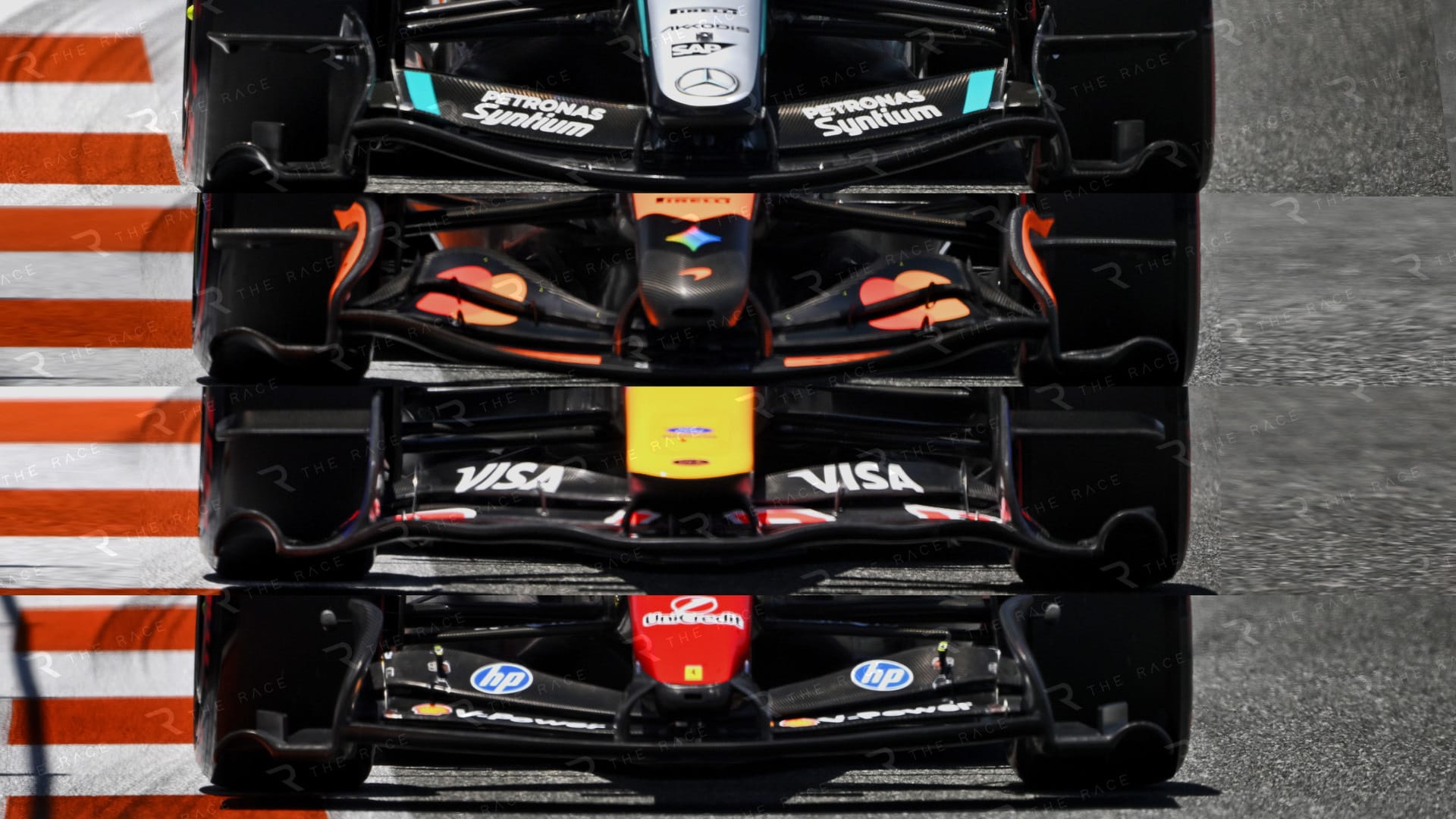
McLaren is the most aggressive in this area followed by Ferrari. However, I'm not sure the Ferrari's leading edge and trailing edge complement each other - so the car could be aerodynamically quite sensitive to mid-corner roll.
Mercedes is probably the most benign. The flow structure coming off the trailing edge of its wing will probably be fairly uniform and, with that, it is probably in the best place for finding improvements further rearward.
You could add Red Bull to that category as well, with nothing too dramatic in profile change to instigate any dramatic crossflow.
The small magenta highlight line is there on all of them and this area works in conjunction with the front brake duct. However, it is the smallest on the Ferrari. On the McLaren it is more inclined and integrated with the flap trailing edge.
As for the outer, horizontal-ish vane on the endplates, Red Bull's has more curvature in it - as highlighted by the orange trailing edge line. McLaren and Mercedes are again very similar and Ferrari doesn't have one.
So is this the main element that Ferrari is missing and that Hamilton is referring to, and could that be making a difference?
The answer to that can only come from understanding what the diveplane does.
As the front tyre tries to force its way through the air at speed, that air has to go somewhere. It either goes inside, outside or over the top, and this vane helps it make that decision as it separates the different pressures around the tyre.
Depending on those pressures, below that vane, the air will go inside or outside. Above it, some will do the same and some will be pulled over the top.
If you didn't have it, more of that flow would be pulled around the inside of the tyre, which is not good for flow management to the rest of the car.
This could then be a contributing factor to some weaknesses that have shown up on the Ferrari, especially with Hamilton having referred to the SF-26 having too much drag. But it's not a full answer for the overall package.
I'm not saying Hamilton is correct in his visual assessment, but looking at these four cars I would say that there is more room for improvement on the Ferrari front wing assembly than on the others.
However, as mentioned earlier in this column, it's the flow structure of the complete car that needs to work in harmony. No individual component will turn a sow's ear into a silk purse.