Gary Anderson's take on the upgrade Mercedes seems unsure of
It was a brave decision for Mercedes to introduce its first major upgrade package of the 2026 Formula 1 season in Montreal given how competitive it was in Canada last year, it being a sprint weekend and its early-season dominance. Amid all that, Mercedes could easily have tripped itself up when striving to improve performance.
Even though it locked out the front row of the grid for both races and won twice, this was not straightforward.
George Russell won the sprint with Kimi Antonelli third after what could only be called an adventurous race between them, and then Antonelli went on to win the grand prix after Russell’s retirement when they were running 1-2.
Team principal Toto Wolff admitted to uncertainty about whether the upgrade had delivered the expected performance gain.
The Mercedes pace advantage in race conditions was at worst about three-tenths of a second per lap. But Wolff is right to warn that it’s difficult to judge how effective the developments are given it’s a sprint weekend, the tricky conditions and the fact it’s a track Mercedes has a good handle on. While it wasn’t a bad day at the office for Mercedes, these question marks are why Wolff is right to be cautious in his evaluation.
“At times I’ve felt it didn’t bring the performance gains that we expected on paper, but it’s very difficult to assess,” said Wolff. “We didn’t see the McLarens today at all and we had the pace, we had the gap, but how much that is, is it what we have anticipated? I think it’s very difficult to judge.
“And also, Montreal was a sweet circuit for us last year, so is that shining a better light on our performance than it would be on any other circuit? Probably Monaco, we won't know it either, so we need to continue to monitor and to analyse.”
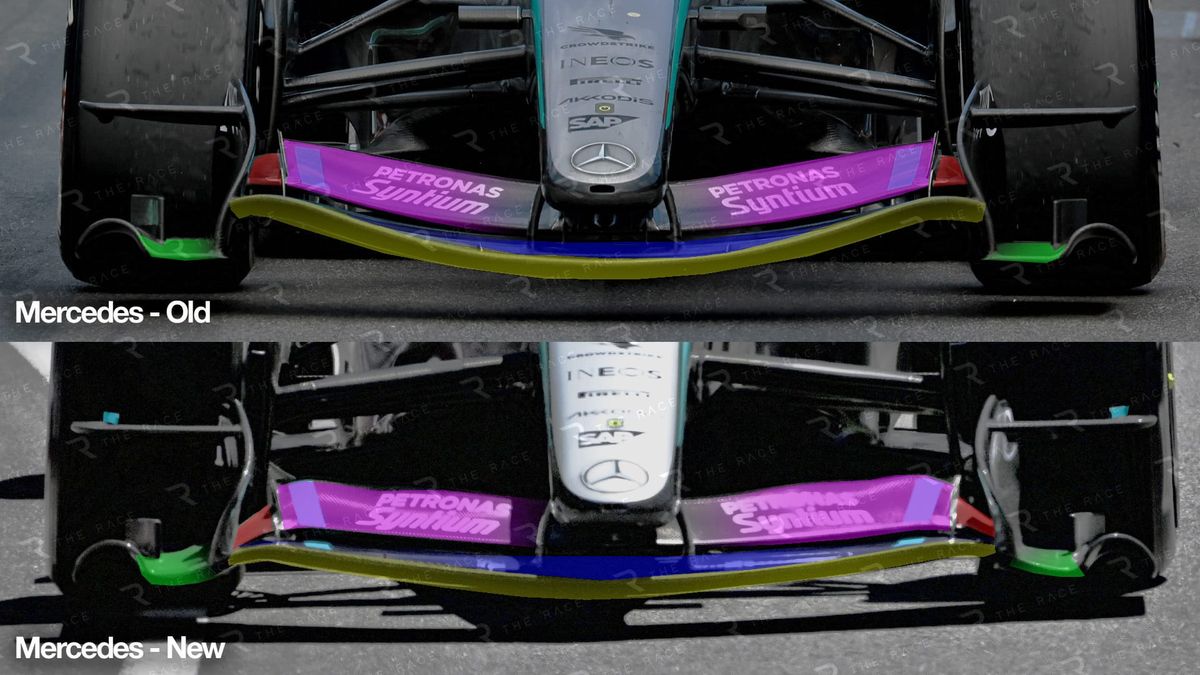
Looking in detail at the upgrade and starting from the front, Mercedes introduced a completely new front wing assembly and profile.
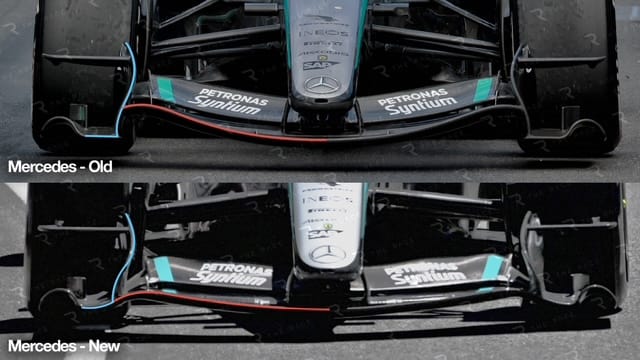
The leading edge separation point (highlighted in red) is now similar to what Red Bull has had since the start of the season. It is now much more integrated with the separation point (highlighted in light blue) of the endplates.
Being integrated like this means that the airflow structure on the undersurface of the wing is much more unified. As a result, there is less potential for transverse airflow, and because of this the inwash and outwash created as the front tyre rotates onto the track surface will be easier to manage and more consistent when varying degrees of steering lock are applied.
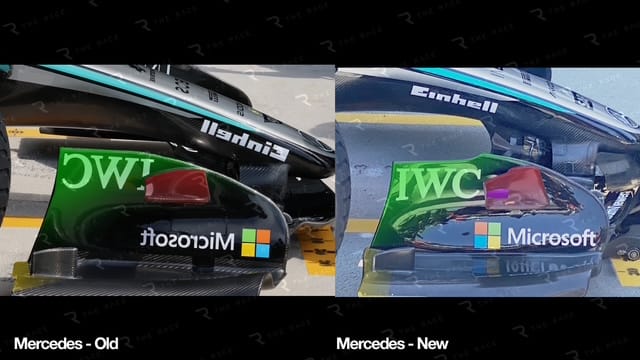
There’s a small change to the endplate fin and the upper-rear endplate side view profile in front of the tyre. There’s no big performance gain here and it’s likely just a consequence of the changes required to the footplate area explained above.
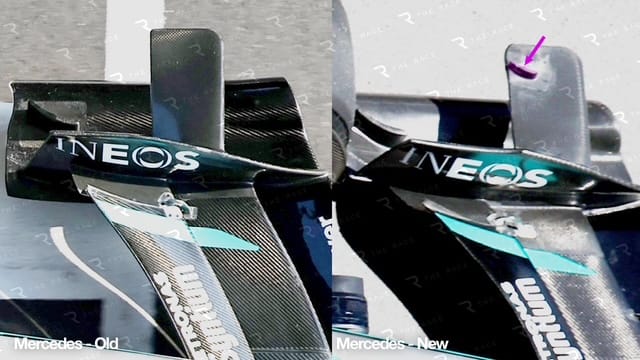
Another small fin has been added to the upper surface of that endplate fin. Its profile and angle of attack reveals that it is to increase the outwash going around the front tyre.
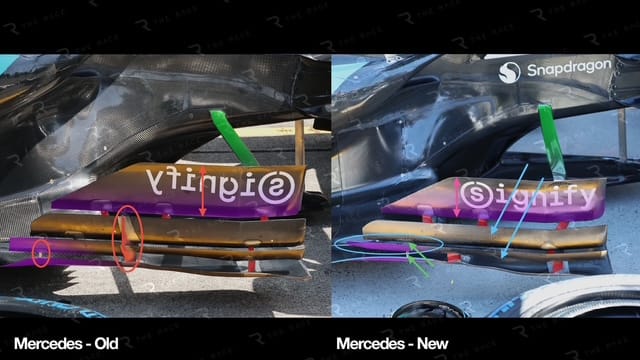
Like the front wing, the bargeboard area is subject to some fairly serious developments. When you get a change in the flow direction coming around the front tyre, everything else needs to be optimised around it. Mercedes has removed or repositioned the two element separators (highlighted with red ellipses) and moved them to where the green arrows point.
To improve the stiffness of the assembly and therefore remove or reduce the need for obtrusive slot gap separators, and looking from the floor upwards, the two-piece first and second element have been replaced with single piece components, which are stiffer and lighter.
Although the comparison is at a slightly different angle, it looks like the chord length (highlighted with the double arrow) of the elements is reduced. Also, the trailing edge angle and detail of the first element is less aggressive, as is the profile of the edge of the floor (highlighted in light blue).
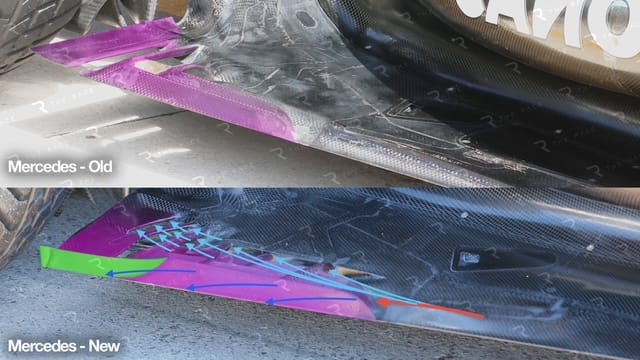
To go with those bargeboard developments, the edge detail of the rear part of the floor has also been revised fairly dramatically. This area is where you need to create some form of aerodynamic sealing, otherwise the low pressure underneath the floor giving you the underfloor downforce won’t be as low as it could be, which would mean less downforce and with that less grip.
The light blue arrows will team up with the inboard rear tyre squirt, and together that airflow will be pulled upward by the multitude of turning vanes mounted on the inner face of the rear brake ducts - circled below.
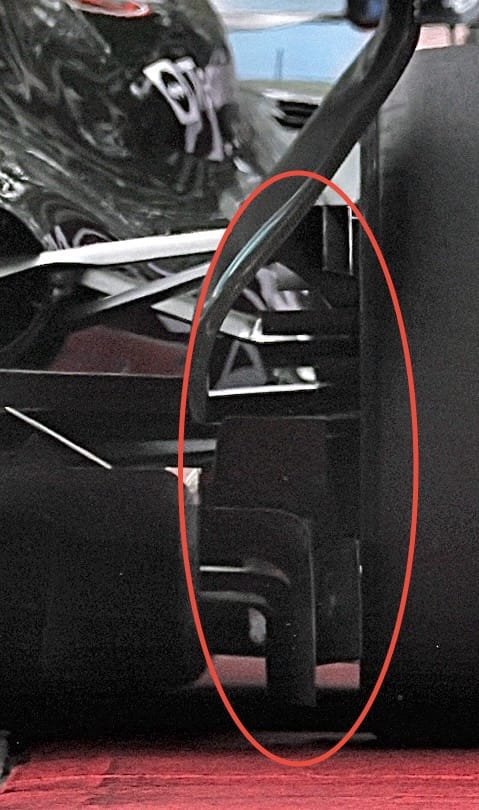
This generates downforce directly to the rear upright and wheel assembly, so basically on the unsprung mass, which means this load doesn’t suffer from time delays under braking when the rear suspension is moving to a new position due to the speed change.
These turning vanes also improve the performance of the diffuser by helping reduce the leakage into it by the rear tyre displacement.
The dark blue arrows will team up with the outboard rear tyre squirt. Any airflow you can get to go outboard means that the inboard airflow can be optimised and work harder and more consistently.
The changes make sense from the outside, and the performance in Canada suggests they have at least been reasonably successful, but let’s see how the car goes in Monaco and, more importantly, Barcelona before making a definitive judgement.