The $215million war that will decide F1 2026
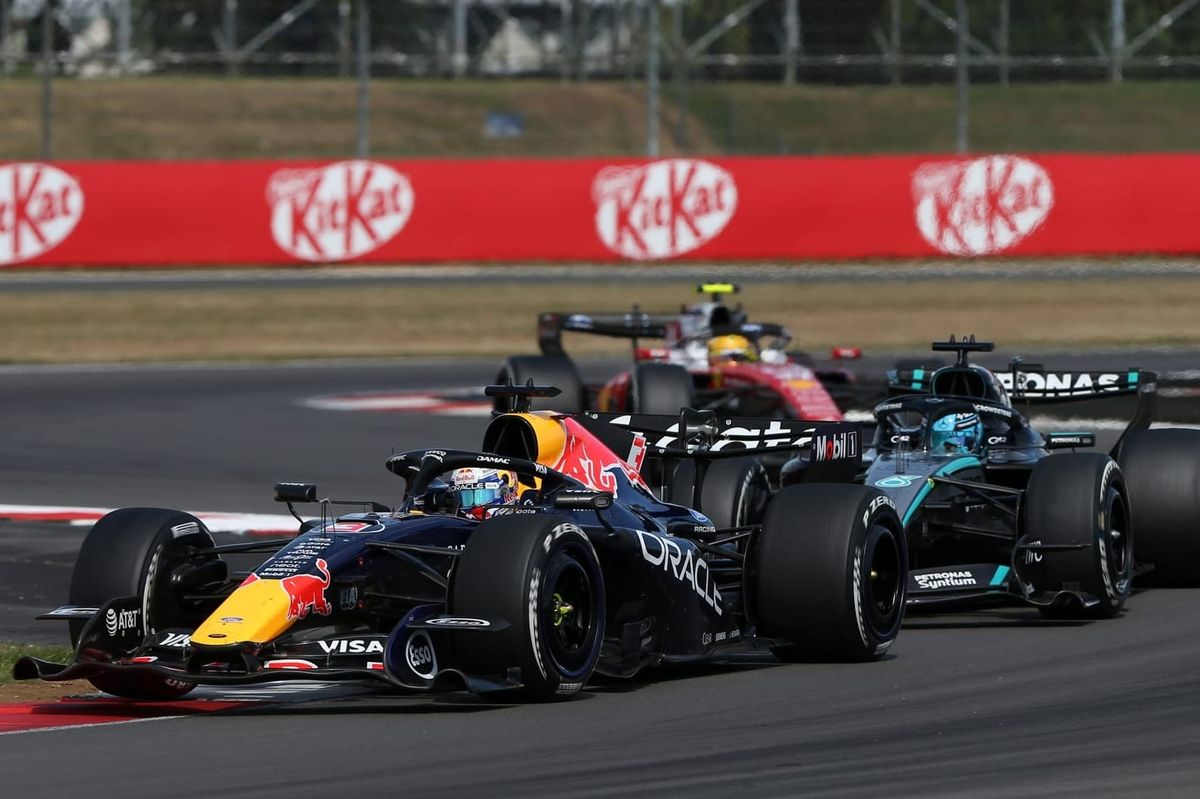
Formula 1's top teams agree on one thing: that the outcome of this year's title battle is going to be decided by the car upgrade war.
But there are several reasons why this year's development race is shaping up to be quite different from what F1 fans have grown used to.
The evidence from the first half of the season points to teams finding huge chunks of performance when they upgrade their cars.
Under the previous ruleset, diminishing returns at the end of the cycle meant new parts were bringing a few hundredths of a second each time. In 2026, the laptime boost, in a regulatory era that is still so immature, is proving much more powerful - delivering "two to three tenths of a second", according to McLaren team principal Andrea Stella.
Steps of that magnitude are proving to be decisive in the fight for podiums and wins.
Ferrari's Barcelona upgrade helped Lewis Hamilton beat George Russell to victory, while an extensive Red Bull revamp for Austria put Max Verstappen in the thick of the battle there.
Coming out on top in F1's development war has always been crucial to success, and has never been easy - but in 2026 is made extra difficult with a cost cap in place, plus complex technical regulations where the performance of the chassis and the power unit have never been so closely intertwined.
It's even led to a fresh war of words between Ferrari and Mercedes, over the impressive rate at which Ferrari has brought upgrades to its car - which led Ferrari team principal Fred Vasseur to call out his Mercedes counterpart Toto Wolff for insinuating that Ferrari is somehow cheating.
Wolff has described Ferrari as being a team that "seems to be limitless" in the way it delivers upgrades, a remark Vasseur interpreted as a suggestion his team is somehow circumventing F1's cost cap.
Vasseur said Ferrari is employing a deliberate strategy of upgrading its car aggressively early in the season so it can enjoy the uplift in performance for the greatest number of races.
Some teams, such as Aston Martin and Williams, are taking the opposite approach, because their initial cars are so slow and overweight that they need more time to develop the right parts at the right cost efficiency to make a material difference to their competitive situation.
Vasseur also feels the way the FIA classifies car upgrades officially in its documentation to the media can create a false impression of how much a car is actually changing based on how the different teams interpret that documenting process.
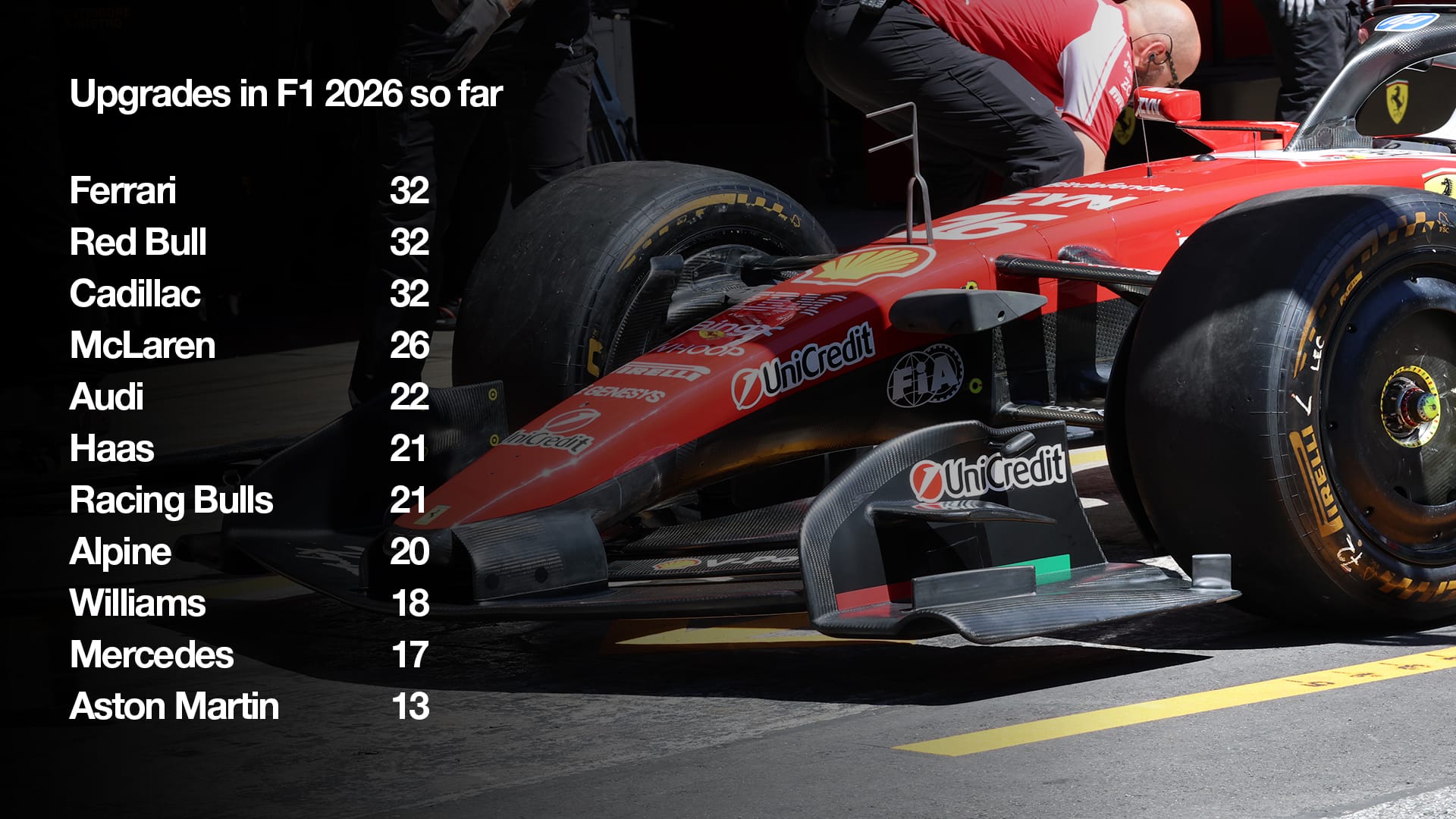
Since 2022, teams have been required to declare any changes to the shape of any aerodynamic surfaces publicly to the media, and it could be this has potentially created a system whereby different teams classify their changes differently and can give the impression they are either upgrading more parts than they are in reality or vice versa.
Cost cap domination
F1's cost cap means teams have to come up with a detailed upgrade plan before the start of the season: there's a finite amount of money to spend on improving the car, and it has to last the whole year.
Teams have to work to a $215million spending limit in 2026 and need to figure out how best to spread their resources over the full campaign.
You could opt to front-load your spending and develop the car aggressively early on, as Ferrari is doing, but then have to accept a reduction in upgrade frequency later in the season. Or, much like with the approach Aston Martin and Williams are taking with their overweight cars, hold off spending money early in the season to 'back-load' the spending on what basically amounts to a B-spec car.
Aston Martin's is due to arrive at the Hungarian Grand Prix, just before F1's summer break. Williams will bring its to September's Azerbaijan GP.
The budgetary considerations go hand-in-hand with performance gain targets, so it's now literally about how much bang for your buck you can get. Efficiency is the name of the game, and a successful upgrade plan requires a detailed understanding of the car and how specific parts will influence others.
Top teams used to be able to spend their way out of aerodynamic cul-de-sacs, as they once operated on budgets two or three times the value of the current cost cap. Now, you have to be much more considered and sure of yourself in the development path you choose. There's almost no space left anymore for trial and error, and so teams ruthlessly target specific areas where they estimate the most laptime can come from the least amount of money spent.
Bigger teams have still gained from investing heavily in their infrastructure and processes before the cost cap came in, but now all the teams have to trade off car development against factory development - as both are capped.
For a team such as Williams, which is still trying to recover from decades of underinvestment, the cost cap is critical for ongoing survival but makes the process of actually clawing back the ground lost to the top teams quite challenging.
As Williams chairman Matthew Savage told The Race Business in a rare interview: "We're still making trade-offs between: do we put in a new accounting system or parts of an accounting system, or do we put an upgrade on the car?"
When it comes to car upgrades specifically, there is a key performance indicator used that is based on cost versus performance. In simple terms, a formula will decide how much every dollar of spending should be worth in terms of laptime gain - and any aerodynamic, mechanical and weight-saving changes that fall on the right side of this equation are pursued.
So a super-expensive lighter floor that delivers one tenth of a second performance boost might have to be sacrificed for three minor winglet modifications that deliver four hundredths of a second each, because those three smaller developments adding up to 0.12s might prove more cost-effective.
Smaller teams might also be boxed in by their lack of relative sophistication and have to target smaller, incremental updates. Haas team boss Ayao Komastu said the scale of the upgrade Red Bull brought to Austria would be totally beyond his team.
But whether your F1 team is big or small, the ultra-discipline that comes as a result of this cost versus performance metric means you have to be strategic when it comes to choosing how to unleash upgrades - and especially what to spend the money on.
Simulators more crucial than ever
Simulation still doesn't beat testing in the real world, but simulators and dynos have progressed to such a degree that the cost efficiency of precise simulation far outweighs whatever inaccuracy remains compared to cost-intensive real-world testing.
Simulators are improving day by day, especially in this era of artificial intelligence that is helping teams make gains in finding more accurate models. They are also increasingly useful for assessing driveability and the real-world impact of tyre degradation. (Though some F1 drivers, such as seven-time champion Lewis Hamilton, will tell you simulators are still not as good as the engineers think they are.)
But there is a growing view that technological advancements, particularly in computational fluid dynamics [CFD], mean simulation is becoming even more accurate than windtunnels - especially because CFD can more accurately mimic the behaviour of cars when they are transitioning through corners, or experiencing changed tyre dynamics.
Though it must be said, even though CFD has taken on an increasing burden in F1 car development, teams are still committing to building new windtunnels.
McLaren and Aston Martin have both recently opened new facilities on their campuses, while Red Bull is in the process of replacing the ex-Arrows and Jaguar facility it's used throughout its life as an F1 team for an all-new tunnel at its Milton Keynes base.
Correlation matters more than laptime
What F1 teams dread most is an upgrade that hasn't produced what the simulation models said it would - because that means the correlation is off.
That is something engineers do not like at all. And we've seen teams run into trouble in this regard in 2026, with McLaren and Williams both bringing front wing updates that haven't delivered an immediate performance boost.
Correlation problems mean a mismatch somewhere in your development process that is leading to car parts promising more than they deliver or vice versa. Either way, that fault must be traced or else you will end up lost.
As one team member told The Race: "The main reason why something isn't working as expected is normally as the result of the accuracy of CFD, windtunnel and simulator.
"The priority then will be to go back and work out what has happened. You need to urgently understand what went wrong, fix it, and then you start again.
"If you keep going then you can end up walking blind. If you lose trust in your process, you are done."
This process can be further complicated by how you decide to implement your upgrades: either bringing incremental developments on a race-by-race basis to keep chipping away at improving the car, or hanging fire and delivering a major development package that brings a sizeable performance step in one move.
On face value you'd think the small incremental upgrades would be the low-risk approach, as a team can evaluate every new part that comes on the car to better judge if it's an improvement or not. But this approach has some big downsides, one of which is that bringing lots of new parts frequently is not that cost-efficient.
It also creates the risk of drift. Smaller upgrades are much harder to measure in terms of the amount of performance they can bring to the car, so you can end up changing too much in a short space of time and then lose a proper sense of what's working and what isn't.
As one F1 team member told us: "If you change things little by little, there is a risk you end up slower compared to the others than you were originally - and you don't know why.
"Do a big step all at once, you know if you are slower or faster. Do something 10 times that you cannot assess properly, it's a slow drift."
Energy starvation complication
There's a different reality F1 teams are facing in 2026 too, in that the speed profile of the cars through corners can have a direct impact on energy deployment on the following straight.
So a through-corner gain in taking a turn flat-out rather than with a small lift could end up costing you more laptime if it means you have not been able to harvest energy into the battery.
That means chasing downforce isn't only about the drag penalty it might bring, but also how it might change your entire power unit energy deployment strategy. Is spending money chasing that extra downforce actually going to be worth it?
The pre-season upgrade plan is only a starting point, and teams need to build in a degree of flexibility. Some of this will be linked to how quickly competitors have come out of the starting blocks and the usual thing in F1 of needing to evaluate alternative concepts or brilliant ideas from rivals that need studying.
Just think of how teams have subsequently introduced exhaust wings this season after Ferrari caught everyone by surprise with the design that appeared in pre-season testing.
Novel ideas are always more likely at the start of a brand new rules cycle, and the FIA will ban these particular exhaust appendages for 2027, so for some teams it won't be worth pursuing at all. But for those in the championship fight, it might become an essential unplanned spend that has to be given the green light even though it only offers a short-term benefit.
There can also be some unexpected external developments, like this year when the Bahrain and Saudi Arabian GPs were called off because of the US/Israel-Iran war. That forced a reshuffle of upgrade plans for a lot of teams.
The living process of the upgrade plan will also need to be adjusted heavily if a team starts the year with a clear and obvious problem. If the car is not working and has a particular issue, then the priority moves away from upgrading and instead shifts to sorting it.
As one engineer told us: "Until you fix it, the rest is irrelevant."
It's a complicated picture at the best of times, but uniquely so with the added complexities of F1 2026.