MotoGP's answers to six big safety and future questions
MotoGP's technical package for its new era in 2027 is long known, and so too is the make-up of the grid - in terms of both entries and the majority of the riders.
But the finishing touches are still being put on the '27 package as a whole, and decisions are being made in this current process - which has included something of a stand-off between the series promoter Dorna/MotoGP Sports Entertainment Group (and new owner Liberty Media) and the manufacturers, as represented by the Motorcycle Sport Manufacturers Association.
MotoGP's chief sporting officer Carlos Ezpeleta faced a select group of media, including The Race, during the Italian Grand Prix weekend at Mugello to discuss some of the most pressing matters on the current agenda - for '27 and beyond, but also before, given MotoGP is coming off a particularly 'heavy' round at Barcelona.
Here are some of the things Ezpeleta addressed.
'Not a negotiation anymore' between MotoGP and factories
The hashing out of the final agreements between MotoGP and its five manufacturers, which are due to cover the customary five-year period (in this case, 2027-2031), has clearly dragged on.
The most evident impact of this has been a relative lack of rider announcements - even as it is known that major commitments have long been made between many riders and each of the factories covering 2027-28.
News has also trickled out over proposals being fought over such as the introduction of mandatory reserve riders or a pivot to one-bike per rider.
Ezpeleta wasn't keen to go into details of specific proposals but insisted "the conversation is very positive".
"We're looking at any other ways that we can improve the sport, and let's say, targeting the investment of the manufacturers at what the fans want to see, and actually make sense for them also as bike brands that are then selling bikes.
"We're in the final stages of the negotiation - it's not even a negotiation anymore, because, I mean, we're all committed. The 11 teams, the 5 manufacturers in the championship, we're all committed for at least another five years, and we're just having dialogues about ways in which we can improve the sport."
The vacant bikes question
But Ezpeleta did, slightly indirectly, touch upon the topic of more permanent stand-ins - which has been thrust back onto the agenda by the events of Barcelona.
Two riders, Alex Marquez and Johann Zarco, have been ruled out for potentially a long-term spell.
With Marc Marquez's participation at Mugello uncertain until a few days prior to the weekend, Ducati wasn't definitively sure it would be able to commit its test rider Michele Pirro to replace the other Marquez, at satellite team Gresini. LCR, meanwhile, scrambled for a replacement, eventually settling on a recall for Cal Crutchlow - who hadn't raced in three years.
LCR partner Honda's replacement rider pool has been limited - it has three riders on the books outside of the main roster with substantial MotoGP experience, but Aleix Espargaro is injured after a testing crash and Stefan Bradl has effectively retired from racing.
Ezpeleta, however, insisted that it was "not true" that LCR and Honda were short on options.
"I mean, [Taka] Nakagami is testing now. Honda just decided not to bring Nakagami, to not risk [him being unfit for 850cc testing].
"Actually, we're very happy that Cal is here. So, I think it's great news for everybody. So, out of the terrible circumstances, I think the result has been OK."
And as for Gresini being potentially left rider-less for this weekend, Ezpeleta hinted that this was exactly the scenario MotoGP wanted to avoid in the future by getting teams to have riders permanently on-call.
"Is Cal going to win on Sunday? Is anybody who's not a current rider going to win on Sunday? So, then there's a question about, should riders be substituted, knowing that in 99% of the chances, no non-current rider is ever going to be in the top 10 or hardly be in the points.
“Maybe Pol [Espargaro] is the exception to that, last year in Australia, but that's the reality.
“And we think, and most of the teams agree that, whenever possible, riders should be substituted."
Ezpeleta also expressed his view that next year's bikes will be "more simple" and thus easier for stand-ins to just show up and ride, and that there's indeed an interest in echoing Formula 1's third-driver model.
He added that "substituting injured riders is unfortunately a part of this sport" and that "we do everything that we can to diminish that risk" - but, in a separate answer, hinted that a reduction in the number of sprint races was not on the table and not something in active discussion with teams and riders.
Don't hold your breath yet for China and Turkey
Ezpeleta was asked directly about the possibility of new races in China or Turkey (boosted by the hyper-popular Toprak Razgatlioglu joining the grid) as early as next year.
He replied by pointing to the fact two new tracks were already announced for 2027 - a new Australian Grand Prix venue in Adelaide and a return of the Argentine Grand Prix, in Buenos Aires - and that "the calendar is probably already close to being confirmed".
"You can only be so ambitious and you don't want to bring three, four new circuits into one same year because of the organisation, the teams, everything - I mean, every new event is four or five times more complex than an existing event.
"Both markets that you named we're interested in for the future - but I don't see them for the immediate [future]."
"Really confident" about Adelaide layout
On the topic of the controversial Adelaide street race, Ezpeleta said that he believed "fans and media will be pleasantly surprised" with the final layout of the venue - which he hopes to unveil "within the next weeks or a month".
"I think almost all the riders will like it. The riders have actually seen every iteration of the layout, since we announced it before the season started. And again, it looks good.
"We're really confident about this.
"And again, from the safety side, it's mathematical to us [in terms of the requirements]. It's not subjective."
The post-Barcelona action plan
Ezpeleta had earlier in the weekend mentioned four potential responses to the events of Barcelona - where both Alex Marquez and Zarco were lucky to escape without catastrophic injury.
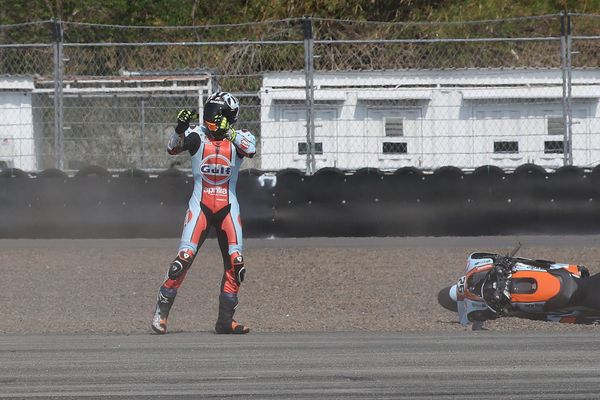
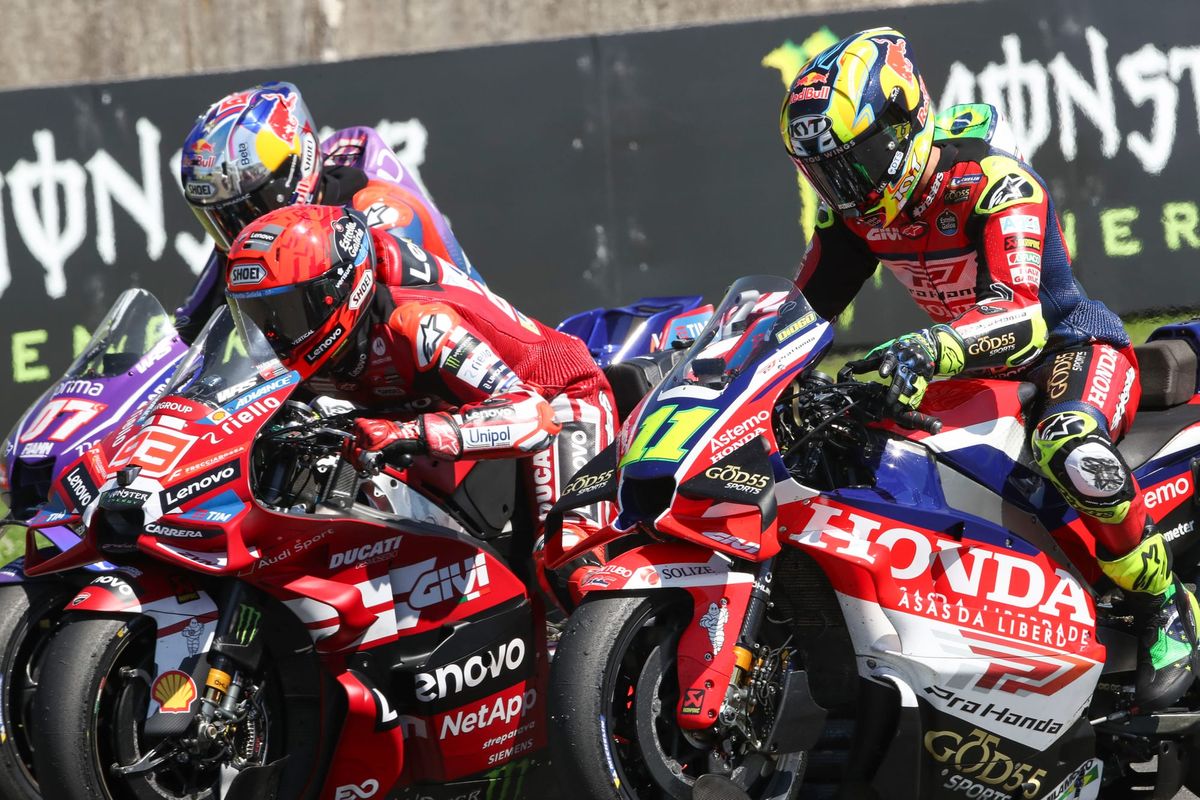
Marquez crashed into Pedro Acosta's KTM at speed as Acosta slowed with a technical issue, and Zarco was involved in a fairly typical Barcelona Turn 1 pile-up, but with the complication of his leg getting trapped in Pecco Bagnaia's Ducati and Zarco being dragged through the gravel.
Ezpeleta said that two of the aspects that would be looked at were "protection around the rear wheel, swingarm area" to avoid what happened to Zarco, and a "warning" system for failing bikes, though in the Acosta/Marquez case he admits it wouldn't have kicked in fast enough to help .
As for the Zarco's crash being part of a wider pattern of Turn 1 pile-ups, Ezpeleta said that there was a conversation to "leave more space between the riders" in their grid slots and bringing forward a ban on "holeshot" ride-height devices that will already anyway kick in for 2027.
But why can't that ban be brought forward on safety grounds, so through MotoGP bypassing a manufacturer vote? Ezpeleta insisted this ban is not something to be pushed through "unilaterally" because the implications are not fully worked through yet.
"Imagine we take them off and then on Sunday [without the device] somebody has a bad wheelie and turns the other way [off the line].
"So the conversation right now is to the manufacturers: 'can you prove that it is more safe with them than without them?' And by the way, as you can imagine, the conversation is not unanimous among the manufacturers."
What about a sixth manufacturer?
MotoGP had long eyed a new manufacturer under its current regulations cycle, but while the long-speculated BMW interest never truly materialised, there now appears to be a more concrete candidate.
Chinese manufacturer CFMoto is indeed evaluating a plan of entry into MotoGP, according to Jorge 'Aspar' Martinez, whose Aspar Racing team runs with CFMoto title sponsorship in Moto2 and Moto3.
Ezpeleta said he would not comment on any potential CFMoto project, especially as he himself has not spoken to Martinez about it.
But as for the wider idea of grid expansion and whether existing teams might be seriously opposed to it, he said: "I mean, that decision resides purely with the championship, not with the teams themselves.
"We like the 22 [bikes on the grid] number. We're not, let's say, convinced that having more bikes on the grid is actually better for anybody.
"There's tremendous value in the teams right now and it's something that we want to preserve. And, of course, new manufacturers are always welcome, but there's a pathway and a process into competing in MotoGP. As all of you well know, it's really hard to get to that level."