Why Citroen team's status causes so much paddock unease
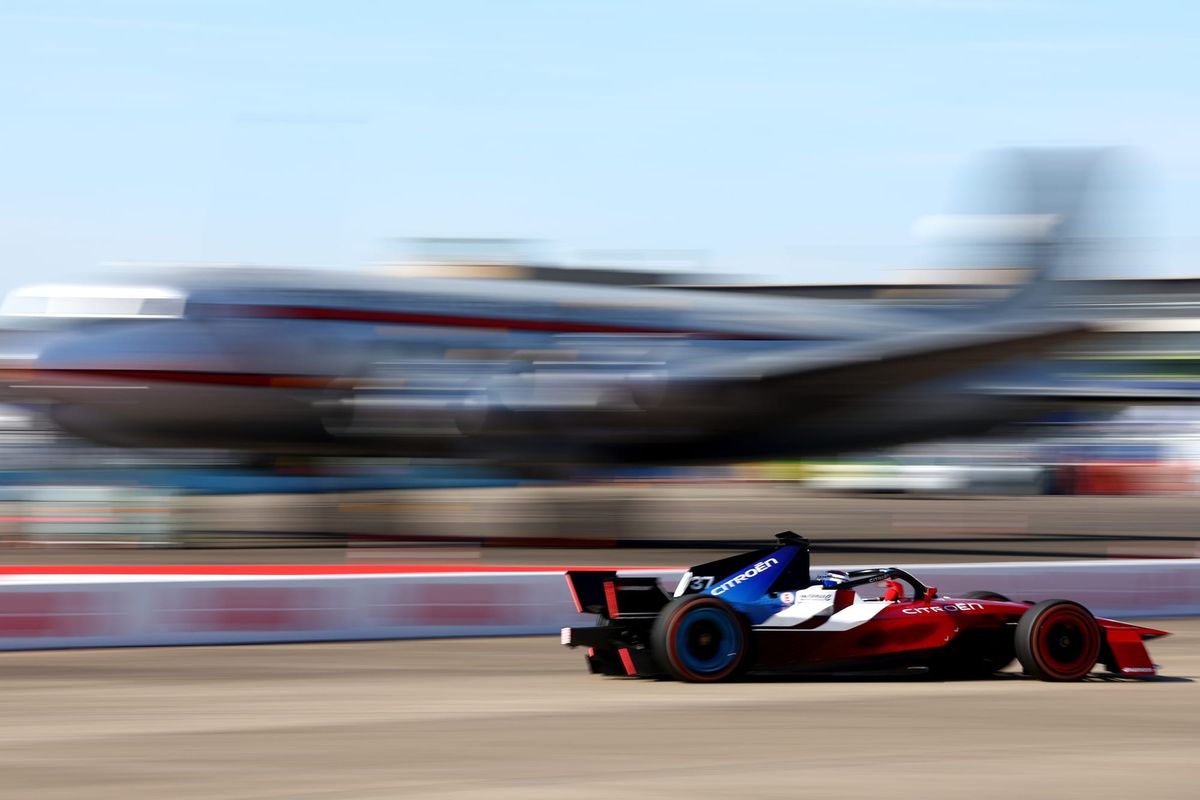
The latest chapter around the travails and 'on the market' future of the MSG company that held the licence for one of Stellantis's two Formula E entries has shaken up the paddock like a battery-powered, multi-kilowatt snow globe.
The Race revealed on Tuesday that Formula E Operations's former vice president of sporting, Beth Paretta, has been integrated into what is now the Citroen team as of last week and is to prepare and execute a plan for potential new investors to invest in or acquire it.
MSG has effectively been a shell for over a year in terms of its commercial and marketing functions, with its licence reverting to FEO - as well as some of its invoices. Paretta's appointment has been viewed by some as provocative after a plan for Liberty itself to rescue the team under a 'special purpose vehicle' business set-up dissipated amid paddock tension over potential conflicts of interest. This new plan B has still to be explained and it's prompted team and manufacturer discord.
The other teams are understandably protective of their investment and position in the still-nascent series, so there was little surprise when their collective antennae stood to attention when the original Liberty plans were outlined.
Why paddock noise got so deafening
The commotion around the initial Liberty plan for MSG started to become a full-on disturbance around February time. As a result, the alternative plan was hastened and involved Paretta's role as managing director at MSG being actioned and confirmed last week.
Andretti's Roger Griffiths, also the chair of the Formula E Teams and Manufacturers Association, knows better than most that conflicts between stakeholders and teams matter. Andretti has been occasionally involved in such matters in IndyCar where it races against the Penske behemoth that now runs the series as well as fielding one of its top teams.
Griffiths said while he understood MSG's plight and the clear need to try to improve its current situation, there had to be a line drawn.
"We have spoken up as teams - not with one voice, but as individual teams, I was one of them - and said we are concerned about the optics of the championship owning a team," Griffiths told The Race.
"Because we've seen in other series there's been some situations which haven't done those championships any favours and created suspicion, if you like, and we just want to make sure that things are done properly.
"But there is a big difference here in Formula E versus perhaps IndyCar where we have the FIA, which is an independent body that is in the middle of it all, that is overseeing the regulations, sporting, technical, financial, etc. They're completely independent of anyone else. So, it is a different set of scenarios.
"I think we're just all suspicious, so we're all going to think of the worst first off, and then maybe rewind a little bit and think, 'Well, actually, this is not as bad as it first appears'."
Griffiths's considered overview is backed up by some, but fought back against by others. While scepticism about Liberty owning a team had a point, there is support for the concept of nursing MSG back to health - including for the new strategy of that process starting with Paretta then investors/buyers.
"It's definitely a borderline move and in all of this situation, we just hope that the team gets sold as soon as possible to someone who is willing to invest in a championship and is not an existing championship stakeholder, to increase the number of companies engaged in the championship and supporting the growth of it," Nissan's Tommaso Volpe told The Race in Berlin last week.
Part of the irritation from the teams' standpoint over the FEO-Liberty-MSG topic appears to have been how full transparency could be presented to them, especially in commercial matters.
"We have no reason to think that there is an issue, but definitely it would be good to have full transparency like any other competitor, to be honest," added Volpe.
"We all can negotiate our own commercial deals with FEO when it comes to something which is outside the perimeter of the competitor agreement, such as the purchase of branding, purchase of space in the village, etc. It's natural that all of us try to get the best deal possible in the negotiation, so we must assume that this is going to happen the same way for Citroen."
Pursuing these guarantees seems fair enough. But those optics that Griffiths mentioned appear to have been too stark and troublesome for some to digest.
Volpe and others, some of whom didn't want to comment publicly on the matter, see the series' involvement with MSG as potentially taking the shine off the new Gen4 push to make Formula E bigger, seal streaming and new TV deals and push stakeholders into making a proper return-on-investment.
"I'm really hoping that in any case this matter is closed soon and they find an external company [that] comes in," said Volpe. "It would be great to have either another manufacturer or another racing company or another big brand just buying the team."
This is what the other teams want too because it will ultimately increase the value of their own licences. This is clear and a logical medium-term objective.
"But as long as there is still at least one available licence, we cannot really be comfortable on the actual value of our licence, so we really hope that Paretta will do a great job and will sell the team as soon as possible," added Volpe.
While the teams and manufacturers have to look out for themselves, there is also an even deeper feeling that the collective and collegiate spirit that Formula E's opponents have developed over the years is getting brittle right now. Or maybe not, according to Jaguar's Ian James.
"You've got to take a step back and look at it from a championship perspective," is the beginning of his summary.
"Are we stronger with having the number of teams that we've got [10] than ultimately having 12 teams? Do we at any one point in time want to see a team disappear if there's a route to getting it to continue? The answer is no, you'd rather it continue."
The McLaren wound that healed
James's insight is particularly illuminative, because the MSG ownership situation had a serious impact on him last season when he was trying to save his previous Formula E team - the now-closed McLaren project.
Although never publicly disclosed, a neat solution was believed to have been on the table whereby the McLaren licence could have been reborn with a Stellantis powertrain, only for it to be scuppered essentially because it was the MSG operation (then running as Maserati) that Formula E Operations was giving critical care to, while McLaren's life-support was switched off. Two teams needed rescuing at the same time, only one was saved by the series itself.
"You and I have spoken in the past about my thoughts going back from here about how things played out in the past," James told The Race.
"I have my own opinions on that. That's all water under the bridge. It's done. There's nothing I can influence on that at the moment and we move on.
"But is the current situation more complicated than maybe we'd all like? Probably. Is it set up in such a way to try and get a good outcome for the team and to keep the team in the championship? Yes."
Beyond the toing-and-froing, across from the occasional febrile paddock atmosphere, afar from the political scraps in secluded meeting rooms, that is the ultimate aim for any championship.
Despite its present strong ratio of manufacturer to customer teams (currently seven to four in manufacturers' favour for Gen4, when Porsche's new second team is counted), Formula E can ill-afford to lose any of its competitors irrespective of what shape or size they come in and whatever cranky history they may have lived through.