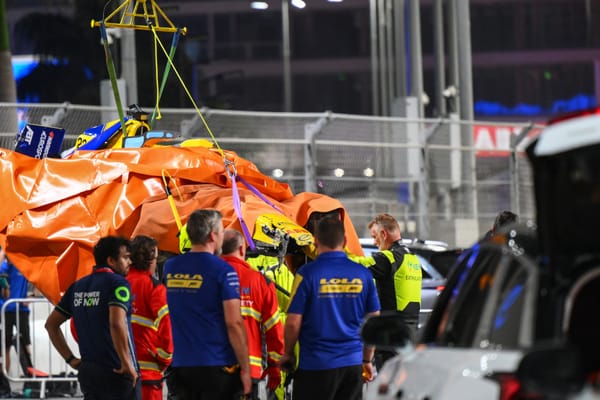
'We've tried talking' - why Formula E drivers made their incendiary move
One of the key architects of the letter sent by all 20 Formula E drivers to FIA president Mohammed Ben Sulayem has spoken for the first time on the motivations for sending the correspondence that has rocked the Formula E paddock.
Lucas di Grassi, who, along with Oliver Rowland, fronted the letter, outlined to The Race why the drivers felt so compelled to direct their suggestions and grievances straight to the FIA president.
"The real reason why we sent this letter is because we want the sport to be better," said 2016-17 champion di Grassi at Jarama.
"The letter said, 'Look, we think there are ways to improve the sport and all the drivers think that'. To have either more consistency or this or that is written in there. But the idea in general was: how can we make the sport better?"
Di Grassi denied that the letter intended to question the performance of any individuals, despite it specifically referencing race director Marek Hanaczewski and calling for the FIA to do an "internal evaluation" of his "understanding and reasoning of the sporting rules".
"It's not something against anybody," said di Grassi.
"We're not against the FIA and we're not against anything. We are not sabotaging, like you wrote in your latest piece, or self-sabotaging the championship. It's not at all this philosophy.
"We love this thing. We think the FIA is doing a fantastic job on the safety side. The FIA is doing a fantastic job in many areas.
"But there are areas that we also need to improve but there is not a formal way to improve this. We've tried talking and discussing and during the drivers' briefing saying, 'should we go this way' or 'should we go that way?'
"We're trying to talk and we're trying to move forward. And that's the general purpose of the letter.
"But in the end, it's a common will of all the drivers saying, 'OK, how can we move forward? We think there is a lot of areas that can be improved, so how can we work together to make it better?'"
When asked if Ben Sulayem, who is expected to be at the Jarama race this weekend, may ask for a meeting with the drivers and if that would be a cordial and progressive discussion, di Grassi replied "hopefully, because this is the purpose of everybody to go forward" before expanding on his theory.
"For example, there's a very interesting book you should read. It's called 'Black Box Thinking' by former squash champion and now media commentator, Matthew Syed," he continued.
"It uses two different examples of two different industries. One is the airline industry, where we have 20,000 flights a day and there is one crash a year. So why is flying so safe?
"The other is medical procedures. There are a lot of medical mistakes during procedures and there's a lot of people that die during or after medical mistakes, and it doesn't seem to improve over the years.
"The [rate of] aeroplane crashes tend to improve massively over the last decades or so.
"In the end, when you look at it, it's the process. One process is able to verify the errors. Change the process. And then try to correct these errors to make it better for the next time.
"So, they don't judge the pilot itself. It's not the pilot. They are not bad pilots. But if the pilot does make a mistake, how can we change the process that avoids or reduces the chances of the pilot making the mistakes?
"This is what we want to construct. We want to change some of the process, so that there are less mistakes done. But the process doesn't change."
Di Grassi emphasised that a lot of the stewards' processes have remained unchanged for many years and are protected and managed by FIA statutes. He then suggested that some reform is needed to ensure fresher processes within the stewarding and decision making.
"It doesn't matter if we find errors or not, as you cannot change the process," he added.
"One of the things in the letter is clearly that we said, 'Look, is there a way to fine-tune this process?' We don't want to blame anybody personally for the errors that they commit. But how can we improve this process, so that in the future, there are less errors. And at the moment, there isn't a method for this in the whole of FIA.
"And we all think it's positive that we could correct these errors without judging the people in particular. And then trying to make this better over time. They do that in safety."
Di Grassi on team bosses' frustration
Di Grassi also admitted he "understood the frustration from the team principals" after it emerged that they were unaware that the letter had been sent directly to the FIA president - although he said he did personally inform his Lola-Yamaha Abt deputy team principal Frederic Espinos.
"Why would they be against a letter that wants to improve the sport?" said di Grassi when asked if it was regrettable that the team principals were unaware.
"It's a letter that wants to improve the sport. So why would they be negative about it?
"Second, I think then it's up to the drivers themselves to inform their own team principals if they want to or if they have it in their contract. I don't know. In my case, specifically, when I signed the letter, I told Fred that I'm sending a letter, or I'm signing this letter, envisioning how we can make the sport better."
Nissan team principal Tommaso Volpe told The Race that the drivers sending the letter was "not ideal, but drivers are drivers".
"I think the positive is that they were all together," added Volpe.
"It's not ideal not to warn the teams, but they're all together on this.
"If there is something we can probably suggest, it's that it would probably be a good initiative if they were creating their own association, similar to [teams' group] FETAMA.
"This could be a big improvement of the governance of this sport, having also an association of drivers with a representative. This would make any conversation beyond this more structured and with a better process. More of a process between FETAMA, drivers, [promoter] FEO, and the FIA."