Why Newey's 2026 Aston Martin is so far behind already
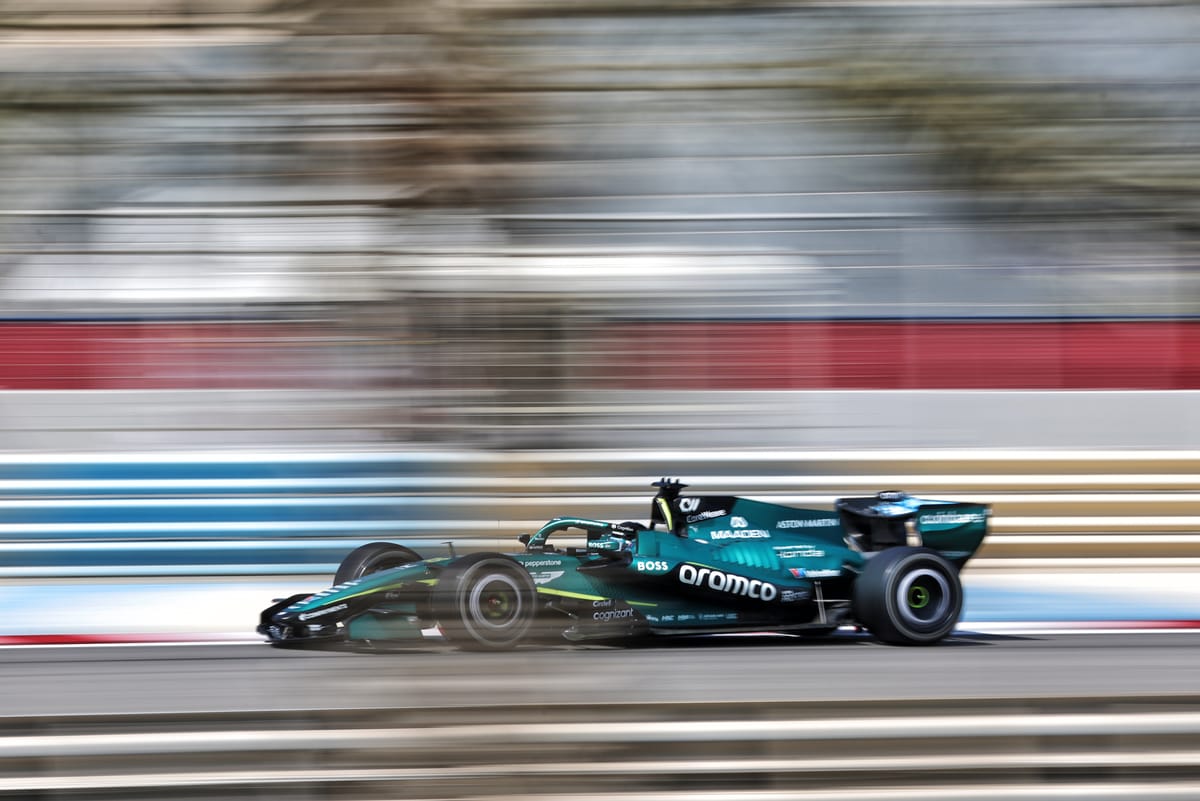
Aston Martin is "clearly behind" at the start of its new Honda-powered era under the leadership of Formula 1 technical great Adrian Newey.
Newey, F1's pre-eminent design genius, joined Aston Martin in March 2025 to spearhead the team’s development for the new 2026 car rules alongside a new works partnership with Honda off the back of the Japanese manufacturer's title-winning seasons with Red Bull.
But the new AMR26 has had a troubled start. It was late joining the Barcelona test and struggled for mileage on the only full day it ran there, which continued into the start of this week's test in Bahrain.
Days two and three have been more productive but the car looks difficult on track and Lance Stroll claimed on Thursday that Aston Martin is four seconds adrift. Team representative Pedro de la Rosa said on Friday "no one is happy when you are a second slower than what you were expecting" – indicating Aston Martin already thought it was in for a difficult start, and it is worse than that.
How this could be possible for a Honda-powered Newey design has been the obvious question given that combination, along with further big recruits like ex-Ferrari technical chief Enrico Cardile, the construction of a brand new factory, and a state-of-the-art windtunnel, has led to grand expectations for the team and F1's new 2026 rules were meant to be the first step towards the success demanded by such significant investment.
Asked this by The Race, de la Rosa indicated it is a consequence of Newey not arriving until March last year – something Newey himself said put aerodynamic development four months behind rivals – and the 18 months Honda spent in the wilderness between technically abandoning its F1 project and then agreeing to a 2026 Aston Martin deal.
"Looking back is always easy, in terms of how we should have, shouldn't have – it doesn't work in motorsport," said de la Rosa.
"But if we had possibly started earlier, if Adrian would have been here not March 2, but a few months earlier, if Honda wouldn't have gone and then come back - it's ifs and buts.
"Bottom line is we are slow, we're not where we want to be, let's get a plan together. We know exactly what's wrong, and work on it.
"So let's look ahead, not look back at what went wrong, what we didn't [do]. It's very easy to blame the time and that we started late. It was many reasons.
"The important thing is that we know what they are, really. That's what gives us the confidence that slowly, gradually, the difference will shrink."
As previously explained by The Race, while Honda is the same manufacturer that grew to achieve massive success in recent years, this Aston Martin project is a fresh start beyond just being based around new rules.
Honda technically withdrew from F1 at the end of 2021, and though its engines continued to be used by Red Bull through to the end of last season with Honda assembling and maintaining them based on frozen specifications, the F1 research and development programme was gutted.
Resources were diverted to other projects within Honda, as that was the whole point of quitting F1, which meant it had to effectively start up again from scratch.
In addition to Honda’s development issues, it is working with an unproven (in F1) fuel supplier in Aramco, at a time when the championship switches to more complicated advanced sustainable fuels.
Plus, Newey has joined Aston Martin when it has yet to prove itself capable of designing and then sustaining a frontrunning car – so while his arrival and Cardile's are undeniably positive, they cannot address an entire organisation's shortcomings immediately. Any existing weaknesses in tools or processes still have to be identified and ironed out.
The result, based on Bahrain so far, is a car and engine that are far from optimised – tricky to drive, overweight and down on power and efficiency. The two sides are intrinsically linked in this new rules era given the need to charge the battery to power the 300kW MGU-K, which is providing almost half the engine's total power output.
What the car and engine does under braking is critical to charging the battery, for example, but the Aston Martin has been constantly locking up at both axles and looks very unpredictable in the hands of both Stroll and Fernando Alonso.
- Read More: How the Aston Martin looks trackside
How much of that is down to the Honda engine, to the first Aston Martin-designed gearbox, or the car's mechanical platform is impossible to determine at the moment.
"We are clearly behind," de la Rosa said. "And as Lance said, we are four, three or five [seconds].
"We are clearly behind and when you are losing or you're missing that amount of time, it's clearly the overall package.
"You cannot say it's this or the other, because a lot of areas where we have already identified clearly and we are already working in Silverstone to address them.
"It won't be an overnight fix, it's not a five-minute job, it's obviously a lot of work involved, a lot of learning, a lot of optimising.
"But we have the confidence that we have the team, have the resources, we have everything in place.
"So yes, we are not where we want to be, but we have the people. And this is the most important thing."
Being late in building the car, then suffering reliability issues, has also left Aston Martin further back in its understanding.
Asked by The Race if the mileage limitations at least meant there was some low-hanging fruit to make bigger gains in the short-term, de la Rosa agreed and highlighted examples like the car not even completing a proper long run yet, and only doing a representative run on the C3 compound on the third day in Bahrain.
"We are on this steep learning curve," de la Rosa added. "Obviously we were, until yesterday [Thursday], the team that had completed, less laps between the Barcelona shakedown and Bahrain.
"So we are behind schedule, clearly. We are catching up. We are learning. And we are basically in the part of the process where you are starting to learn about your package and about the new rules.
"That's where we are. Clearly, we are behind other people. We are not in a stage where we are changing the set-up to learn, to see what the car has, optimising the set-up.
"We are just keeping the car as it is and just trying to achieve as many laps as possible, doing aero mapping, learning about deployment, about harvesting and all the usual stuff."
De la Rosa said he can "can't imagine how difficult it has to be" for Stroll and Alonso, given the expectations for the project, but backed the team at Silverstone to improve the car significantly under Newey.
"Since Adrian has arrived, his leadership is unquestionable," said de la Rosa.
"The biggest difference I felt is, for example, yesterday, after a very difficult day testing here in Bahrain he spoke on the technical briefing: his leadership is so strong that all the team knows exactly what they have to do.
"This is very different from previous years, where everyone would have their own theory about things. Adrian is very clear what has to be done. And no one raises the hand to question it.
"Therefore you have this massive amount of resources working in one single direction.
"I know it might not sound convincing to you, but believe me, sitting there and listening to these comments was very inspiring for us. Especially when things go wrong.
"When things go right, we don't need a leader. It's when things go wrong."