

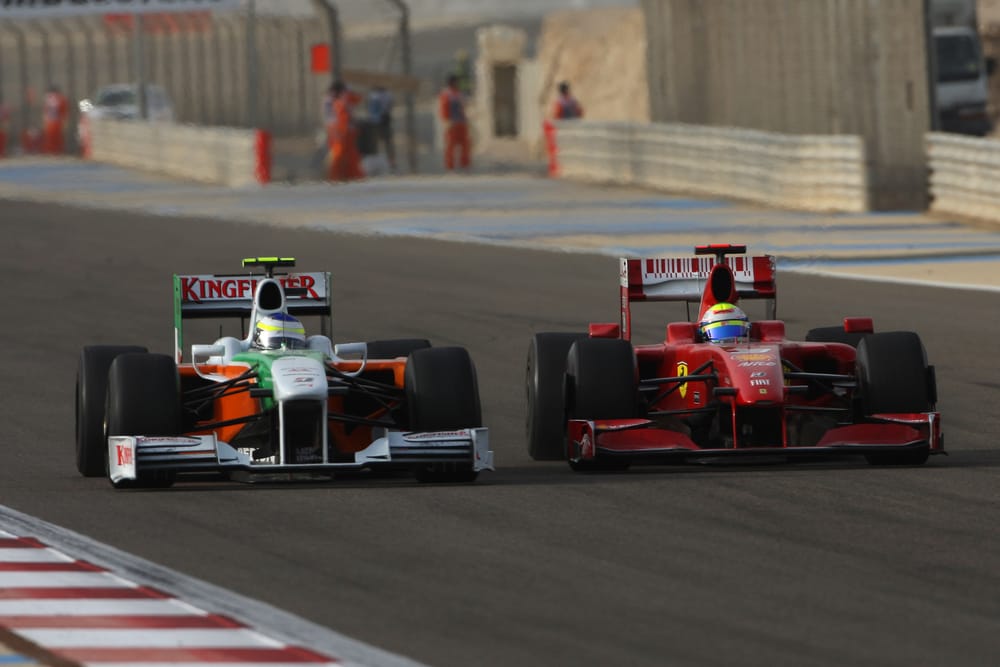
When drivers switch between straightline and corner mode under Formula 1’s 2026 active aerodynamics regulations, one part of the change will be to the angle of the front wing. But it’s not the first time a driver has had the ability to make such an adjustment, as it was permitted in 2009-10.
The ‘skinny’ aero regulations of 2009 emerged from the Overtaking Working Group’s research. Formed in 2007 and made up of McLaren’s Paddy Lowe, Ferrari’s Rory Byrne, Renault’s Pat Symonds and the FIA’s Charlie Whiting, the OWG was charged with understanding how to formulate regulations to make overtaking easier.
This was F1’s first fully collegiate approach to understanding such problems, with each of the 10 teams contributing a five-figure sum in the project and testing in the Fondtech windtunnel running two car models together. It yielded a narrower, higher rear wing, the ‘snowplough’ front wings and dramatic restrictions on the geometry of the car to curb the use of complex aero devices.
The 2009 rules also introduced ‘driver adjustable bodywork’. This permitted the angle of incidence of the top flap of the front wing to be adjusted within a range of six degrees to allow a move of +/- three degrees from its default. It could only be “commanded by driver input” at the push of a button, with changes only allowed twice per lap.
The OWG’s studies revealed the extent of the downforce loss when following another car to be 20-30%, so the idea was that this would allow a car following in another’s wake to crank up the front wing to mitigate that.
Multiple possibilities were evaluated to reduce performance loss in the wake. There were even discussions about outlandish solutions, such as suction fans working dynamically in proportion to the downforce loss as captured live by sensors.
However, it also had downsides in terms of the design, with the actuation mechanism usually housed in the front-wing endplate and, to a greater or lesser degree, depending on the exact configuration, inhibiting design freedom.
The effect of the front wing adjustment was negligible in terms of improving following. The mechanism was primarily used as a balance-adjustment device during stints in 2009. It proved even more useful for this when refuelling was banned in 2010. Despite it being little-talked-about, McLaren driver Jenson Button was disappointed that the adjustable front wing was dropped at the end of that season.
“It’s unfortunate that we're losing the adjustable front wing, that's going to make the balance very difficult,” said Button in late 2010.
“We're running 150kg of fuel at the start of the race and 5kg at the end, so we're going to have a very different balance and it's going to be tough for us. You’ll see a lot of cars oversteering and understeering, and not being able to change it."
The adjustable front wing was scrapped for 2011 to allow for the introduction of the drag reduction system (DRS). This allowed drivers to increase the size of the slot gap between the top and bottom elements of the rear wing and slash drag in allocated zones in races when within one second of the car ahead at the defined detection points. This was used until 2025.
That the short-lived adjustable front wing is little-remembered reflects how ineffective it was in achieving its objective. And stands as a reminder that the rulemakers have been working for a long time to tackle the problem of downforce loss when in dirty air, a laudable objective but one akin to pushing water uphill given the stubbornness of the laws of physics.
