How much did Williams really lose from missing first F1 test?
Having had what should have been a valuable head start in pushing on early with its 2026 Formula 1 car, Williams’ absence from last week’s first pre-season test undoubtedly squandered some of its advantage.
As competitors racked up valuable miles on track, Williams missed out on a first opportunity to check reliability, understand correlation and start getting its head around the energy management headaches that lie ahead for everyone.
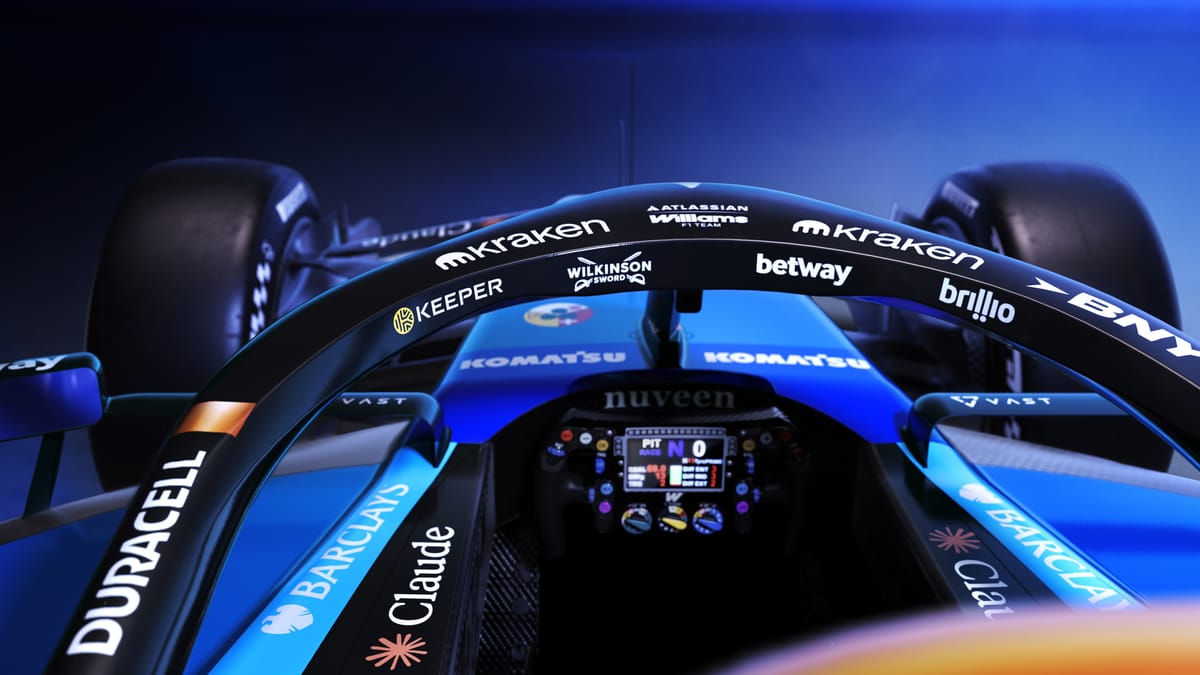
Williams team boss James Vowles conceded on Tuesday, as the team revealed its 2026 livery, that there were some big-ticket items that needed ticking off as soon as the next test in Bahrain gets going.
“The top of the priority list for me is we have not got a characterisation of our aerodynamic package or our vehicle dynamics package for suspension,” he said.
“You can do everything in a rig world, in a simulation world, but you need to have it properly characterised and correlated in order to be able to ensure that you haven't taken a wrong turn somewhere. That's the biggest missing piece.”
Live data boost
It would be a mistake, however, to think that Williams is heading to the first Bahrain test starting from zero.
The Virtual Track Testing simulation work it did last week, allied to having Alex Albon and Carlos Sainz running on its driver simulator, meant it was far from learning nothing at its factory.
Its progress was helped by Williams being fed data from engine supplier Mercedes that added to its data bank of knowledge.
On the driver front too, in getting Albon and Sainz up to speed, Vowles believes that the pair got more than enough of an early understanding from driving in the virtual world.
“[We were] using a correlated package from HPP [Mercedes High Performance Powertrains], correlated to running in Barcelona," Vowles explained.
“Whilst there's many things that will help us on track, and definitely for the drivers they need the forces, what we're replicating is pretty much there in terms of them playing around with energy management.”
Another factor too is that while Williams does not have as intimate knowledge of how energy management works around Barcelona compared to those teams that ran there with real cars, the demands for each track are so different that everybody starts again with their learnings in Bahrain.
“Every track is so different that the specifics of Barcelona don't necessarily carry on through into Bahrain or Melbourne,” added Vowles.
“We are just making sure that there's no nasty surprises. And if there's not, then it probably won't be too nasty. But if there is anything, then it puts us on the back foot by a week or so.”
Real-world answers
But despite all Williams did manage to do last week, Vowles is well aware that simulators cannot completely replace knowledge gained in the real world.
There are some aspects of understanding its FW48 that it will not be able to make a start on until it gets out there on track.
“The power unit is reliable, and the gearbox is reliable, and the VTT testing flushed out a lot of the demons that are buried in the car,” he said.
“What's missing is there's a lot of knowledge for the drivers to inherently perfect what's going on track.
“What's missing is a correlation for where aerodynamics really are and a correlation for where our vehicle dynamics really are. So track data is the only way of establishing that.”
While missing Barcelona was not ideal then, Vowles believes that the two Bahrain tests will offer it plenty of time to catch up.
This is especially true because of Mercedes getting so much mileage done over last week.
“We were fortunate to the fact that Mercedes has sufficient runners that [meant there] was quite a bit of information coming back on both the gearbox and the power unit that enables us to get ahead when we come to Bahrain,” he said.
“It means I do not believe, with six days of testing, we'll be on the back foot.”
But for all the reasons why Vowles thinks Williams can still recover what has been lost, he knows that the extreme pain of what it has been through must show why there can be no repeat let down in the future.
“If we just skirted the issue, it doesn't hurt enough that you really get deep into the wound and fix it,” he said.
“This will never happen again, because we are going to dig into it properly and make sure that we learn from absolutely every one of these issues.
“You've got to deal with failure. If you just leave it aside or put your head down, you won't learn from it. You have to let the pain of that failure drive your change.”