What's got F1 drivers so worried about Brazilian GP spectacle

The Brazilian Grand Prix has been witness to many famous charges from the lower reaches of the Formula 1 grid because overtaking has historically been easy.
But there are genuine fears among F1 drivers that the peculiarities of the 2026 regulations will neuter the spectacle at Interlagos on Sunday afternoon.
Only one week ago in Mexico, Lewis Hamilton and Lando Norris were both bemoaning the energy deployment ramp-down rates that kick in once F1 cars clear a certain threshold of speed. Hamilton called them "stupid" and Norris said they "kind of ruin racing".
And the 2026 rules are why drivers including Hamilton and Max Verstappen, who have both tasted success in Brazil when starting from lowly grid positions, feel their chances of coming through the field are much reduced.
Hamilton, who will start 20th after picking up a 10-place grid penalty, suggested "overtaking will be very, very, very hard. I'm not sure you're going to see the same sort of races that you've seen in the past".
Hamilton himself won the 2021 Brazilian GP from 10th on the grid, having come from the very back in the sprint race with a new engine fitted, but he feels the fact every car will shed drag in straight mode, rather than being offset like they were racing under the old DRS rules, means the 2026 race is likely to be more static.
This reading of the situation was echoed by Verstappen, who won the 2024 edition of this race from 17th on the grid.
"Now we don't have DRS anymore and the overtake mode is very limiting around here because of the long straight, everyone is draining the battery," he said.
"So your speed difference on the straight is going to be a lot less, a bit like Mexico really. So it will be quite a lot harder, I think, to pass [on] the long straight."
That overtake mode gives any driver following another car within a one-second time threshold an extra 0.5MJ of energy, but Williams driver Carlos Sainz estimated that to be worth only "one or two tenths", which is unlikely to be enough of a pace offset in of itself to encourage overtaking.
"Anyway I'm not expecting to look forward too much with the amount of penalties that are happening and everything," he said.
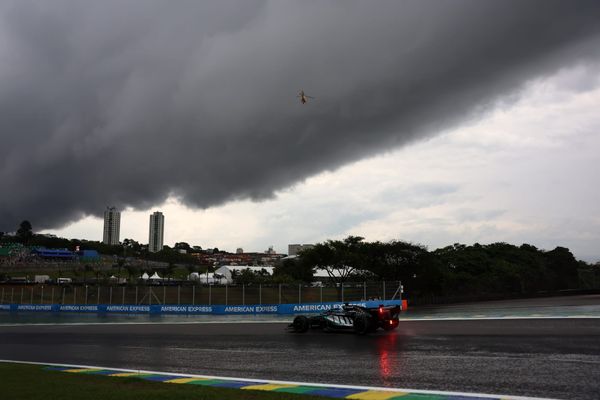
But the weather is the massive curveball here because the limitations of overtake mode are only really relevant in the dry.
In the wet, active aero can be disabled too - so the slipstream effect becomes bigger.
McLaren team principal Andrea Stella said he "would be surprised if we have a dry race", which would be a venture into the unknown for F1 considering the Bahrain GP in Malaysia had almost dried out by the time it got under way and in Singapore the wet race was a sprint on a track where overtaking is pretty much impossible regardless of the ruleset.
"At the moment in the forecast, there's quite a lot of rain, so I would be surprised if we have a dry race," Stella said.
"It's unclear how much rain, what the intensity is going to be. It could be steady, but not too heavy.
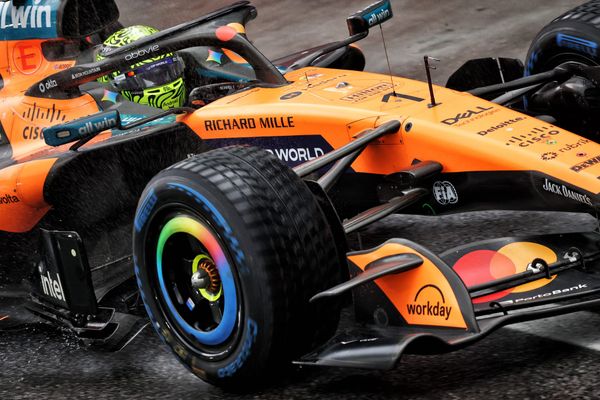
"In some conditions, the visibility is just the fact that the tyres and the cars, they just lift a certain amount of water, and there's nothing you can do, you just have to stop the session because of the visibility and the aquaplaning.
"I think if the visibility can be somehow acceptable, then I think we can have a race, and I hope, like I said, that based on the forecast, even if the rain will be steady, it should be lower class, a lower level of rain.
"And we have seen in qualifying that actually the cars, from a visibility and tyre grip point of view, they can tolerate a certain amount of water. So I'm optimistic that we should be able to have a race. I'm not that optimistic that it will be in dry conditions."
From Pirelli's perspective, the success of the wet rubber in qualifying means that both rain tyres are viable options no matter the conditions.
In the dry, a two-stop race is on the cards because degradation is high.
The most likely route is soft/medium/soft or medium/hard/soft. The hard will only come into play if temperatures drop - which fits perfectly with its lower working range - but a one stop is 10 seconds slower so not ideal.
Key though to the type of race F1 geta will be what the weather does by 2pm local time, and if the expected morning showers have blown through.
If they haven't, there is a chance things will be very wide open.