How a 'stupid' speed limit stopped Mexican GP overtaking
Formula 1 drivers have got used to many quirks with the 2026 regulations, but the Mexican Grand Prix exposed one that Lewis Hamilton openly labelled “stupid”.
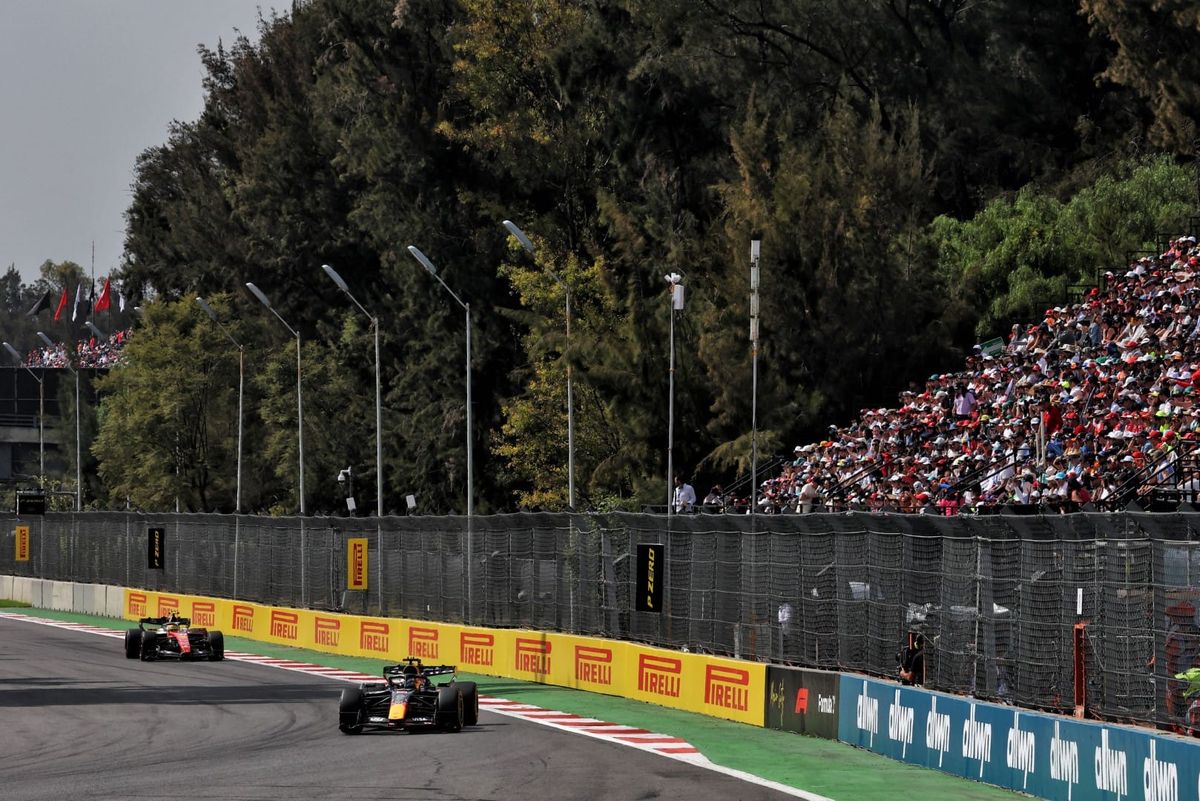
On a track that has historically been very difficult for cars to overtake at - because of the aero and cooling compromises caused by the thinner air - things were even harder this year.
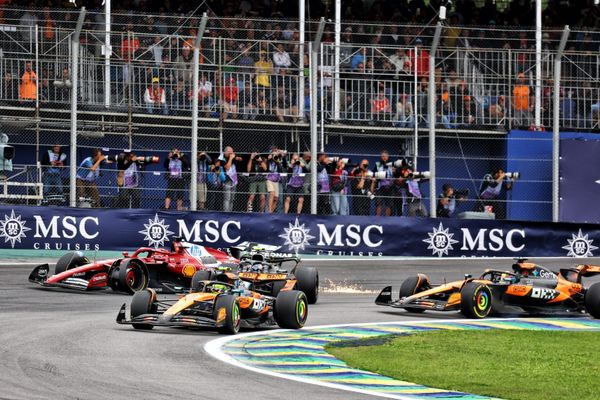
The final laps of the race highlighted that sufficient speed offsets were simply never there, as Hamilton tried his hardest to pick up leader Max Verstappen’s tow and make a move into Turn 1, plus further back Lando Norris was aiming to do the same with Charles Leclerc.
Even with the benefit of the extra 0.5MJ of energy a driver gets for overtake mode, and a slipstream of the long run down the start-finish straight, neither Hamilton nor Norris could get close enough to make a pass stick.
The main factor holding them back was not the high-altitude venue weakening the slipstream effect in a year when the DRS advantage has disappeared for the car behind. Instead, it was the consequence of an under-the-radar 2026 rule that has effectively seen F1 operate with a speed limit.
As part of the regulations to help manage the performance profile of the energy-starved cars down the straights, the rulebook imposed a deployment limit for the end of straights.
It was supposed to help ensure an offset of power (and therefore speed) to help overtake mode, but in Mexico it proved to be more of a hindrance.
How it works
To help manage deployment usage, energy deployment gets restricted for cars without overtake mode once they hit a certain speed.
The rules are part of C5.2.8 of F1’s technical regulations and impose what is at first glance a complicated formula to limit energy deployment.
It's stated that when overtake is not active, the maximum deployment (capped at 350kW) can be 1800 minus 5 times car speed (km/h) below 340km/h.
Between 340km/h and 345km/h, the maximum deployment can be 6900 minus 20 times car speed (km/h), while anything above 345km/h must be zero.
When overtake is active, the limit is 7100 minus 20 times car speed (km/h) when the car is below 355km/h, and zero when the car speed is equal to or above 355km/h.
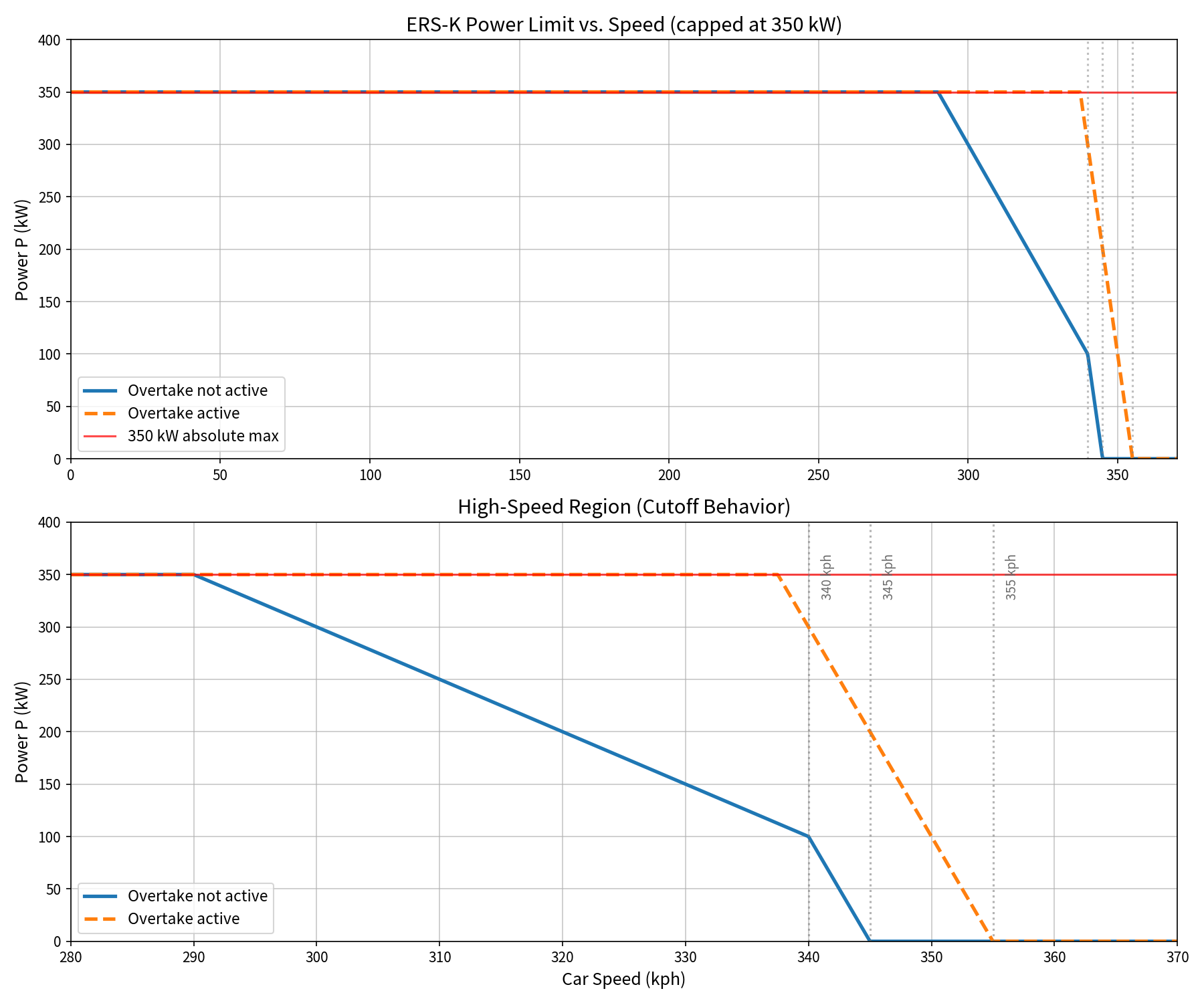
It sounds complicated but, as the graph above shows of the maximum power allowed, it means that for drivers without overtake mode, above 290km/h the energy deployment must start tapering down from 350kW until no battery usage is allowed at all from 345km/h.
For drivers who have overtake mode, the full 350kW has to start ramping down from 337.5 km/h until it hits zero at 355km/h.
At most tracks this limit has not been that influential because cars have either not hit those upper limits very much, or the energy has run out long before then. Mexico, however, was a different beast.
The layout of the track, with the stadium section at the end of the lap, meant cars were bursting onto the super long main straight energy-rich.
Rather than only hitting the speed limit and winding down deployment at the end of the straight, they were running near the speed limit restriction very early on.
So very early out of the final corner, rather than the pursuer being able to maximise the benefits of overtake mode, they were seeing their power reduce.
The end result was gaps between cars being pretty much frozen very early on the straight once the speed limit zone had been entered.
If the pursuer started gaining speed on the car ahead of them, they would find deployment automatically reduced.
Under the ramp-down rates declared in the rules, for every 1km/h of speed gained above 337km/h for a car with overtake, a driver lost 20kW of deployment.
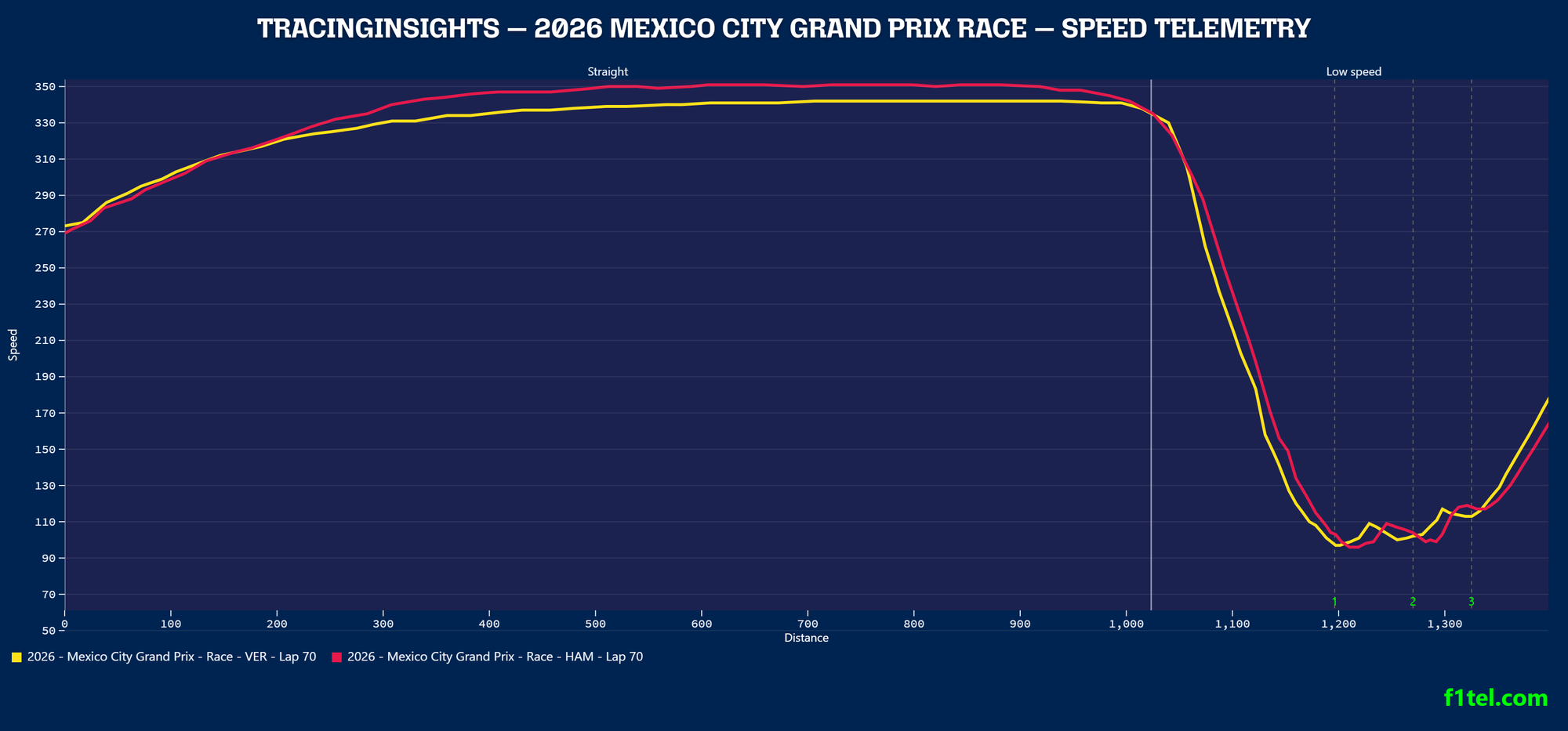
As the telemetry traces of Hamilton and Verstappen down the main straight on the penultimate lap show, their speed differences barely fluctuate once they are halfway down the straight.
At 500 metres, Verstappen is doing 338km/h, while Hamilton with the benefit of overtake and a tow is doing 349km/h so already losing power.
At 900 metres, while both are still at full throttle, the speed offset between them has reduced. Verstappen is doing 342km/h while Hamilton is doing 350km/h - so he is closing less than earlier on the straight.
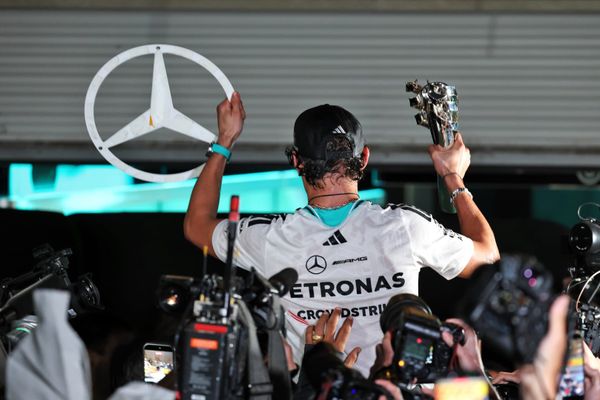
It was the characteristic that Hamilton bemoaned in the cooldown room after the race when he said to Verstappen: “It’s so stupid, the clipping…I don't understand why...it's like they have got no sense.”
Elaborating on the matter later on in the post-race press conference, Hamilton said the speed limit was a bit nonsensical from a racing perspective.
“We have this clip at the end of the straight where you can't go past a certain speed, so everyone just follows,” he said.
“It's the silliest thing when you are behind and you have a little bit more power in the slipstream. You should be able to go past that to have a chance to overtake.
“The engine can go faster. It's just they have these silly clips. I mean, it's the worst engine profile setting that I think they've probably ever had in this sport, and it doesn't provide great racing.
“So today you probably didn't see much overtaking, unfortunately, because of that.”
Hamilton was not alone in his criticisms, with Norris saying that the speed limit restriction “ruins racing” because pursuing cars have no chance of getting past those ahead.
“The main thing with overtaking is you just have the limiter on,” he said. “You literally have a limiter that stops you from going over a speed, so it doesn’t matter if you come out of the final corner behind the guy, you just have the limiter on, the same limiter as them, and then you cannot do anything. It kind of ruins racing.
“It’s something that they need to improve for next season.”
Gone for 2027
The good news for Norris and Hamilton is that the rules relating to this speed limit have been deleted from the 2027 regulations.
The increased fuel flow and improved turbo boost pressure that are coming, allied to extra allowance for harvesting, means cars will not be so energy-starved so the speed limit is not needed.
In races, drivers running without overtake mode are capped at 300kW for as long as they are able to hold that, while with overtake they can deploy 350kW.
Some speed-based restrictions are still in play for certain track sectors where the FIA does not want maximum deployment, but it should mean battles on the straights are no longer neutered by a speed limit that Norris felt made no sense.
And F1 drivers should be able to look forward not worrying about speed limits down the straights.
As Norris said: “Especially when motorbikes go 370 and you don’t have a seatbelt or anything, we should easily be able to go quicker than a motorbike."