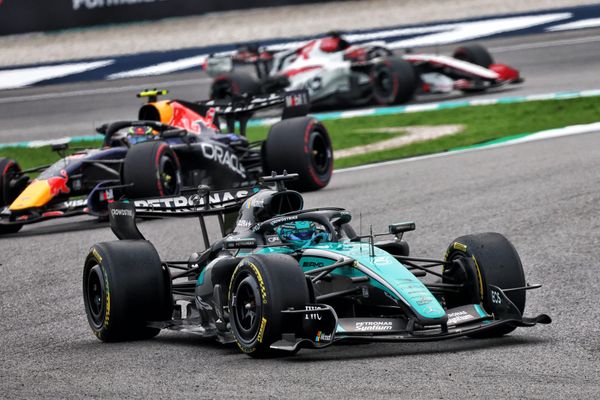
The under-reported factor in Red Bull's F1 surge
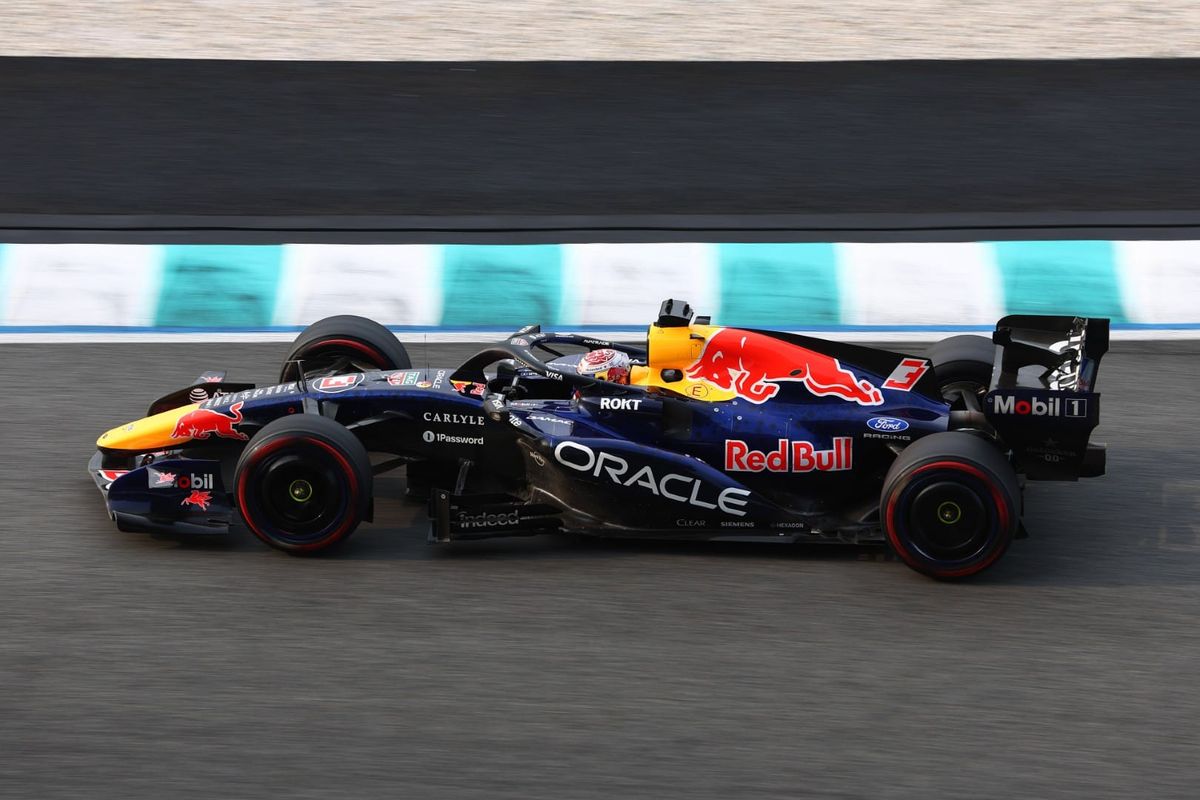
While Max Verstappen's triumph in Formula 1's Bahrain Grand Prix has highlighted the progress Red Bull has made with its car, there was another intriguing aspect to its performance in Malaysia.
It is that much of the foundation of Verstappen's pole position and win - as was evident when comparing his speed traces against Ferrari and Mercedes, as seen below - came from straightline performance.
Q3 speed telemetry: blue (Antonelli), yellow (Verstappen), red (Hamilton)
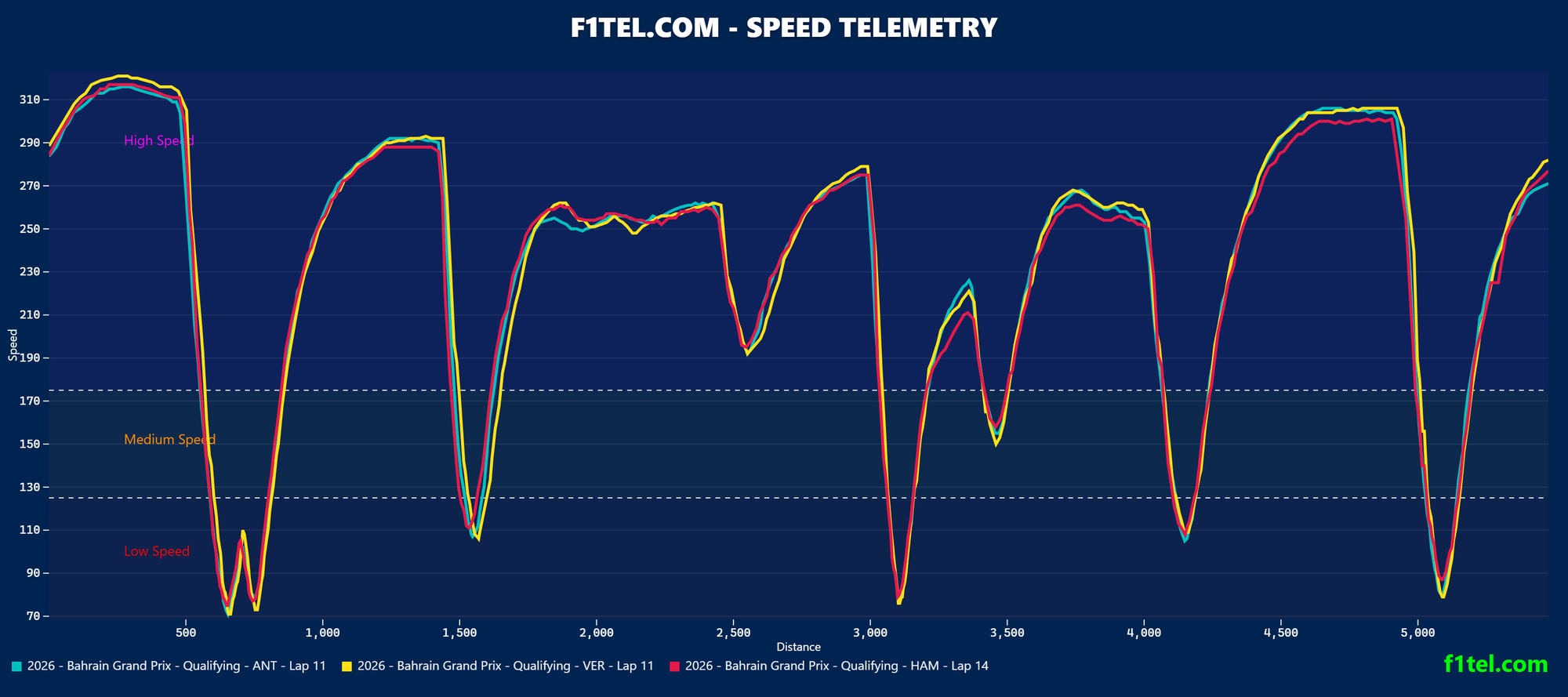
So while a lot of the talk was of Red Bull's leap forward having been helped by its Baku aero upgrade, there are indications of serious progress on its power unit as well.
It is known Ferrari is lacking power, plus the higher-drag consequence of the Mercedes upgrade may have played a part in pulling George Russell and Kimi Antonelli's top speed back.
But even with the caveat that energy deployment patterns can skew pace over a lap, a look at the speed figures certainly showed the Red Bull power units regularly towards the top.
Sepang qualifying maximum speeds at three points (km/h)
Speed trap
1 Bottas 329.5
2 Bearman 325.3
3 Lawson 325.3
4 Gasly 324.9
5 Ocon 323.1
... 8 Lindblad 317.5
... 17 Hadjar 311.6
... 18 Verstappen 310.7
Finish line
1 Hadjar 285.2
2 Verstappen 284.8
3 Sainz 282.1
4 Albon 281.6
5 Colapinto 281.4
... 13 Lawson 275.7
... 20 Lindblad 270.4
Intermediate 1
1 Colapinto 298.9
2 Lawson 296.4
3 Verstappen 296.3
4 Hadjar 296.2
5 Gasly 296.2
... 6 Lindblad 295.0
It leads to the conclusion, especially off the back of Red Bull's form on Baku's main straight, that it is not as far behind in this area compared to where things were at the start of the season.
So, in spite of the restrictions Red Bull and its partner Ford have faced under F1's ADUO rules in not being allowed to bring an engine upgrade this year, gains have still been possible.
Team principal Laurent Mekies claimed this week that, while there remains annoyance at the FIA judging that Red Bull's power unit was clear of the rest so it was alone in not having development opportunities, his engineers in Milton Keynes were not deterred by that situation.
Instead, it was heads down to work away in the areas where extra laptime could be found.
Seeking improvements
The strength of the Red Bull power unit has been clear since pre-season testing, with Mercedes team principal Toto Wolff famously claiming in the Bahrain test that its rival was the "benchmark" in terms of its energy deployment.
Things didn't turn out quite that way at the start of the year, though, with it accepted in the pitlane that Mercedes had the best overall power unit.
But for Red Bull, like with its chassis, it was a case of chipping away in being able to unlock more performance through areas where it felt it was lacking.
Mekies said: "While ADUO is trying to somehow estimate the peak power of the ICE [internal combustion engine], there are a huge number of other performance factors that can be developed and improved, especially in the first year for us as a power unit manufacturer.
"So, of course, the guys have been doing a huge job at developing the package for driveability, for the operating windows, for the launches and many other things.
"There is a huge development work in the background, even though you cannot change the hardware."
Mekies felt what the current rules play to - as was perhaps highlighted by Mercedes' top speed slipping back in Malaysia because of drag - is that the power unit and chassis performance are more integrated than they have ever been.
"We felt the engine is a strong part of the package, and it has certainly helped us in races like Baku and Malaysia," he said.
"But there is a lot more to the business than peak power or peak downforce. It's about integration. It's about extracting everything out of the package in all conditions - in wet conditions, in dry conditions - as there are many areas where we need to work on."
The role of the Baku upgrade
While there has been a lot of discussions about the step that Red Bull made with its Baku upgrade, Mekies did not think it was a revolutionary change.
Instead, he saw it as another step in what has been a consistent development push to close down the one-second deficit that was there at the start of the year.
It is just that the Baku upgrade was noticed more because it was the final bit of progress Red Bull needed to get itself properly on terms with Mercedes.
"I don't think there was anything too specific about that upgrade compared to our previous ones," he said.
"Of course we started on the back foot, but equally nobody was going to wait for us. Starting from more than one second [off] and being where we are now, I think it's very much a Red Bull Racing trademark to have this strong in-season development.
"At some stage we felt there would be a possibility that we would get stuck in that three-tenths [off] mark compared to the best cars. In the end, the guys have been doing an amazing job on chassis/PU [power unit] side to eat up those last three tenths, which we felt would be the most difficult.
"The Baku upgrade played a role with that, but it's part of a more global effort.
"But we have our feet on the ground, and competition will react. They will have more upgrades, and we have seen big variation in pecking order track to track. We were in the right range within the last two races. Let's see what's happening next."
Questions remain
For Red Bull, its Malaysia win was an unexpected one because it came at a track that the team had not anticipated to be strong at.
The RB22 has appeared to excel more in low-speed corners compared to the medium- and high-speed turns that dominate the Sepang track.
So its best hope of getting a win, Red Bull felt, would come at Singapore this upcoming weekend because of the layout of the track.
What Red Bull does not understand yet is whether what happened in Malaysia was the result of its Baku upgrade and improved power unit having genuinely put it on terms with Mercedes, or whether the Bahrain GP performance was a one-off caused by the unique track surface.
"Is there another factor that has influenced what we have seen in Malaysia, or several other factors? Possibly," added Mekies.
"Obviously, with the extreme heat and the track roughness and the layout of the track, I'm sure most of the cars out there were out of their ideal operating window.
"Did that affect the pecking order? It's possible. Does it change anything in the way we approach the next race? Not really."
Problems still to solve
While the Malaysia win is proof of Red Bull's progress and that its recent trend of fighting near the front is genuine, it does not mean that the team has solved all of the headaches that have dogged it this season.
As recently as Monza in early September, Verstappen was complaining about an aero degradation problem that had impacted performance over the first half of the year.
Mekies said that while a lot of progress had been made in curing this issue, Red Bull was still not completely on top of it.
"It's going to be a long road to get it to the point we want it to be," said Mekies, when asked by The Race if the degradation problem had been sorted. "Is it a finished job? No, but are we progressing.
"In Malaysia, Baku and Madrid we certainly have managed to give Max and Isack [Hadjar] a package with which they feel more at ease.
"Does it mean that they have removed all of these aspects that you're mentioning? No, but it's certainly confirmation that little by little, small steps after small steps, we are managing to give them a more consistent platform and something they can push with.
"But it's not something that will stop now. It's something we know we need to do more steps to be able to cope with more different situations, with more different layouts, and it will take us more effort, undoubtedly."
And while its power unit performance is improving, that has not stopped Red Bull's push to change the ADUO rules to stop its hands being tied with development going forward.
Mekies said: "We were surprised, and a bit more than that, at the initial evaluations from the FIA [on ADUO].
"We made our case. We showed them why we felt it was not capturing the right picture.
"We are having discussions with them on what can be improved in the methodologies for next year, with them and with the other teams. That's where we are.
"But at some stage we like to say in Red Bull Racing, we like to reduce the noise and concentrate on pure racing. So you concentrate on yourself and you keep pushing with what you have.
"And ultimately we prefer to be in position to have a strong engine and no ADUO, rather than a weak engine and claiming ADUO!"