F1 still 'very small' in US - Domenicali
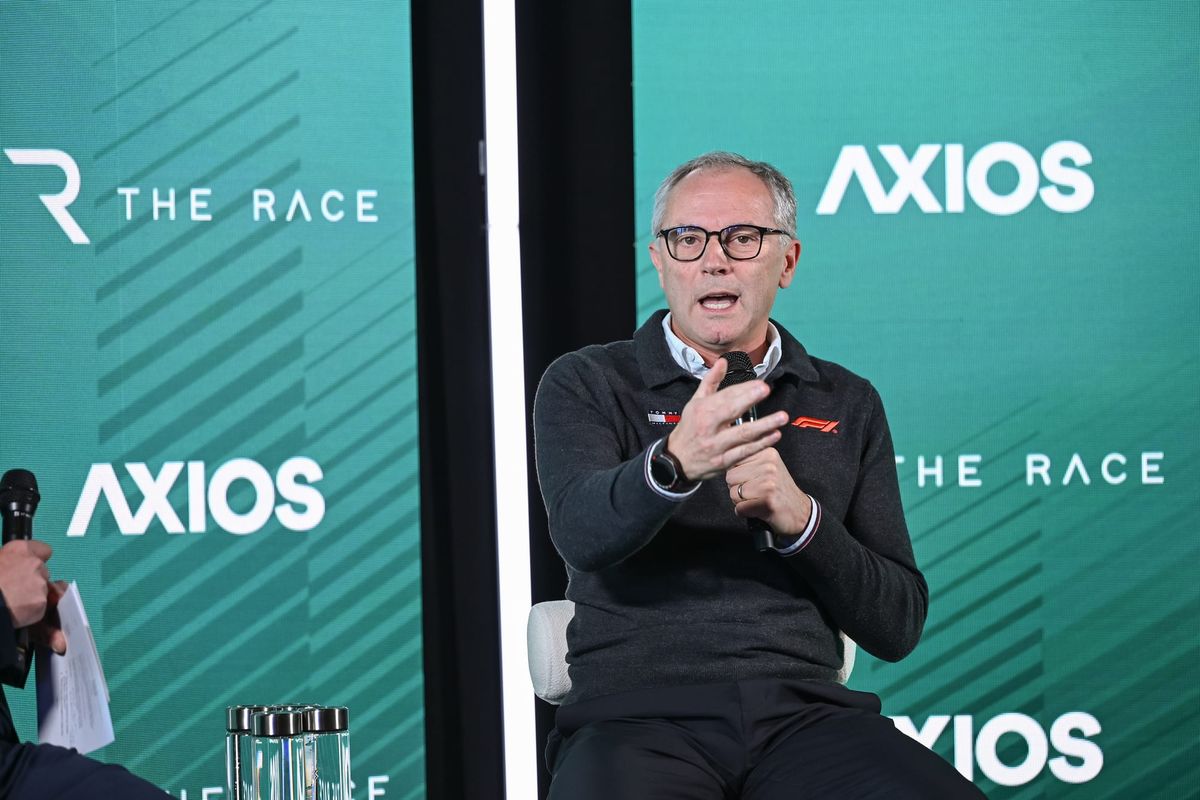

Formula 1 CEO Stefano Domenicali believes the championship is still “very small in the US” despite its huge growth in the region in recent years.
Domenicali was speaking to The Race co-founder Darren Cox at Axios and The Race’s Beyond the Race: Investments in Innovation and Leadership event in Las Vegas - one of three US races on the F1 calendar.
When Liberty Media completed its takeover of F1 in 2017, there was only one US race and American interest was lagging behind other key markets.
But now, according to F1’s own figures, it had 52 million fans in the United States as of the end of last year, an 11% increase on the year before and a totally different picture to a decade ago.
F1 also struck a five-year deal with Apple as its new broadcast partner in the US too, something it said back in August had increased viewership 13% year on year - even if there’s debate around its impact. US fans were also able to watch this year’s Canadian Grand Prix on Netflix in a special streaming collaboration.
But despite that multi-pronged growth, Domenicali still feels there’s lots of untapped potential compared to other sports in the US.
“Today I said to my people, we are very small in the US, but we are growing at quite a high speed,” Domenicali told The Race co-founder Darren Cox at Axios and The Race’s Beyond the Race: Investments in Innovation and Leadership event.
“But we’re going to crush the market when, every day when you wake up, you have the news of Formula 1, on top of the news that you have, on top of the interest in the NFL, the NBA, in all the other sports that the country loves, because it’s part of the culture. It’s part of the sensibility that you were born with.
“We need to get into the schools, we need to get into the universities, because behind the scenes, and the ones that know this sport know very well, there is an incredible opportunity to talk about technology, talking about the level of complexity of this sport.
“Our focus is to attract people and talk about us as a sport, as an industry. I’m talking about the industry, because behind every team there is an incredible line-up of supply chains, a line-up of incredible technology, that everyone wants to be involved in.
“So for us, there are so many angles to attract the interest of people. It’s fascinating. And I would say there are not so many platforms that can do that.
“Therefore this is something that, through the collaboration of our partners, we need to keep making sure: that everyone is attracted for whatever reason, but then goes into the knowledge of who we are, because that’s fundamental, to be credible, and to stay long-term attractive to the people, who maybe came in because of an interest that was not really related to our sport specifically.”
Netflix’s Drive To Survive has also been key to F1’s growth in the US.
“At that time, when there was Covid, when people needed to be connected to a computer or TV or whatever it was, [Drive To Survive] was instrumental in growing the awareness of the sport in markets where we didn’t have the chance to be so relevant at that time,” Domenicali added.
F1 used to have an exclusivity problem
The Liberty era has been a monumental departure from how F1 was run under the old Bernie Ecclestone-fronted regime.
Domenicali paid tribute to how Ecclestone was able to build F1 up but highlighted an exclusivity problem that he’s been very keen to pull F1 away from.
“The evolution of what Formula 1 was before and what Formula 1 is now, in the last couple of years, is definitely different,” Domenicali said
“It was absolutely the right strategy, under the leadership of Bernie Ecclestone, to do what he did: to build something that was not there. To build a community that was passionate about technology, passionate about racing, passionate about travelling around the world.
“But it was a community that was just focused on motorsport, full stop. With a negative term of exclusivity. Exclusivity in terms of: the first answer was ‘no’, instead of ‘yes, and how?’. And under the Liberty change of control, we had to do a different paradigm if we wanted to be relevant.
“A lot of people... and life is beautiful because a lot of words can fly around the air, but a lot of people wrote it. A lot of people thought that our sport was dead, not so many years ago. That is an incredible opportunity for the people that are racing inside, who love the competition, to show what the people were saying at that time. Not everyone, of course. They were wrong.
“But in simple terms, the reason why we thought it was a great opportunity for us to be relevant is because we thought that we have all the elements to be really good, in terms of keeping the sport at the centre of our strategy, but trying to evolve with the social media content.
“Trying to make sure that the engagement was done by our heroes, the drivers, the teams, the people. Explaining what is behind the scenes. Trying to give the opportunity not only to the real hardcore fans to talk about the sport, but using our platform to connect with an audience that didn’t know anything about the sport.
“That’s the reason why now we are relevant in that respect, because F1 is giving an opportunity for the partners who believe in us to do what they believe is right for their interest.
“And I have to say, today the biggest compliment that we receive is: ‘Formula 1 is the place to be’. When you say that, it’s something big.”