

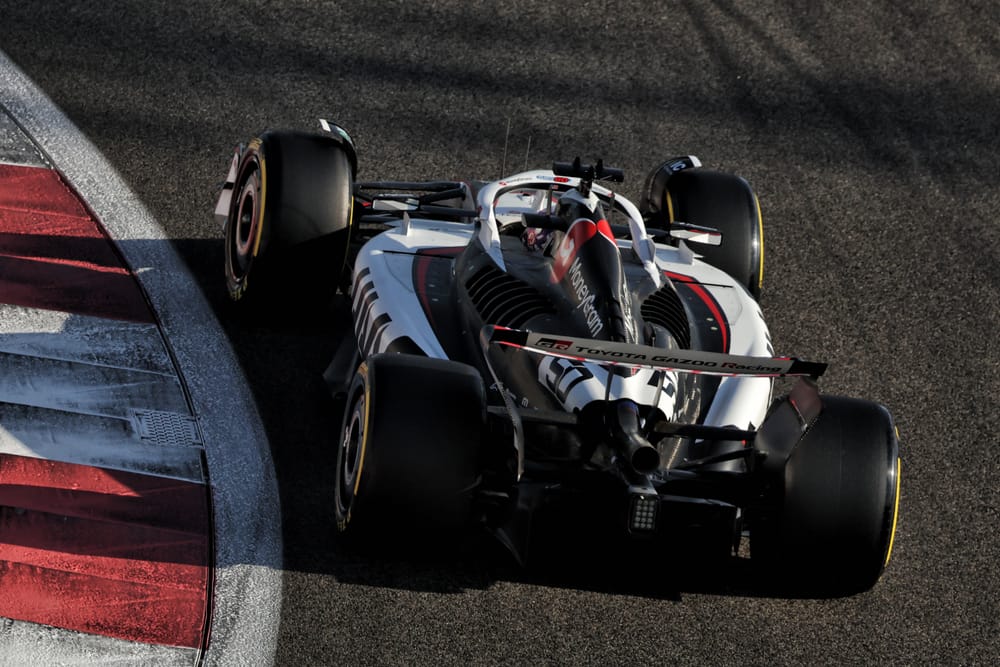
Toyota's name is back on a Formula 1 entry, in a manner of speaking, in 2026 with Haas rebranding to reflect an ever closer relationship with the Japanese manufacturer.
Since their technical partnership first began in October 2024, Toyota's ultimate intentions for Haas have been subject to intense scrutiny.
Led by Akio Toyoda, who is a big motorsport supporter and is said to personally regret the consequences that Toyota's F1 exit at the end of 2009 had on the company and future drivers/motorsport engineers, is this Toyota re-entering F1 through the back door?
Will it eventually replace Ferrari as Haas's manufacturer partner? Is Toyota going to buy the team outright? Could one of Toyota's prospects be a future Haas F1 driver?
The news late last year that the deal would escalate in 2026 to rename the team as TGR Haas F1 - reflecting Toyota Gazoo Racing entity in Cologne that is working with Haas more and more - only poured more fuel on the flames. And if this were to be Toyota's means of getting into F1 properly again it would actually be a prudent way of doing it.
Whatever long-term ambitions Toyota may or may not have, though, are probably not quite as well thought out as a works team future being inevitable.
"It's easy for many people to say that, because I think people want to say things like, ‘OK, Toyota works team', or ‘Toyota is going to make an engine', etc.," Haas team boss Ayao Komatsu said in December.
"But between Akio-san and myself, it's totally clear our purpose of this collaboration is really trying to grow people, and through doing that, make a competitive organisation.
"If you look at Formula 1 as an environment, if somebody wants to train people, or throw people into a very competitive or international environment, there's nothing better than Formula 1. In the corporate world, certain things take three months to develop. In Formula 1, we solve it in two weeks.
"So in terms of training people, I don't think you'll find anything better. And that's where our synergy comes from. We are looking for people, and Akio-san was looking for the environment where he can try and grow his own people.
"In the long run, for Toyota Motor Corporation, it's not just for this racing. The people they grow, train in this environment will one day hopefully be a senior manager or top management in TMC, with an international mindset, competitive mindset.
"It's a lot more than just about, are they going to make an engine, are they going to be the Toyota F1 team? That's really, really not the target."
A handy if unusual example of that came at the start of January when, just after the Haas renaming took effect and logos were even placed at its Banbury base, Toyota announced a rejig of its branding that basically wipes the ‘TGR' moniker out entirely!
Toyota and Gazoo Racing have been split, so ‘TGR' itself is no longer a thing. The Cologne company has been rebranded as Toyota Racing. But Haas will, as it stands, continue as TGR Haas F1 Team for 2026.
With respect to Toyota's works rally and endurance projects, the Haas affiliation is surely Toyota's biggest motorsport exposure globally - and the fact this will now not feature Toyota's up-to-date brand plan is hardly an argument for Toyota having a clear F1 masterplan.
The confusing nature of that aside, the name change is a move towards something bigger but it mainly reflects a positive first year with the two sides working together, one in which Toyota got F1 test opportunities for Ryo Hirakawa, Ritomo Miyata, Sho Tsuboi and Kamui Kobayashi across 14 days of private testing.
"It's just going to be a bit more structured, if you like, even doing the TPC [testing of previous cars programme]," said Komatsu of the 2026 plan.
"That was the first year. It's going to be a bit more structured in terms of the driver development programme. Everything is going to be more developed.
"Their goal, one of the many goals, is developing people – and one of them is drivers. But the main thing is performance is first.
"Anybody who gets in our race car has to be the best choice in terms of performance. So we are all clear on that one, even from Akio-san. Even if he wanted a Japanese driver from his academy, it becomes a joke if we put in that driver when he's not good enough. Then people will say, ‘Oh, Toyota is just buying a seat with money'.
"That's not what Akio san is doing. That's not what we're doing. We always pick drivers on performance."
This is a good moment to acknowledge that ‘Toyota' covers two parties in a Haas context. There is the manufacturer, and there is Toyota Racing, formerly TGR. Based in Cologne, this is Toyota's R&D centre, home of its World Endurance Championship team, birthplace of the Toyota World Rally Championship engine – and site of a windtunnel that is still of an F1 standard.
So what is now ‘Toyota Racing' is the ‘TGR' part of TGR Haas (this is getting confusing). This is the entity providing the F1 team with personnel to support the TPC programme, some manufacturing capacity, and most importantly to the F1 team itself a driver-in-loop simulator at Haas HQ in Banbury for the first time, in addition to supporting an extensive private testing programme in 2025.
This simulator is being built and having its models integrated using another Toyota simulator in Epsom as a reference. According to Komatsu this will mean the Banbury simulator is online properly in May or June 2026 – far too late to assist with critical initial development of the 2026 car but then a crucial weapon for Komatsu in terms of future car development and race preparation work.
"It is very important, because we've got access to a Ferrari simulator in Maranello but of course, it's not great because most of the engineering team is in the UK, the days are limited, and it's in Italy," he said.
"So logistically, it's been pretty difficult.
"Ideally, I wanted to have it at least half a year earlier, if you like, because [for the 2026] regulations I think the simulator is going to be even more important.
"We can't have that access straight away. But it's going to be really, really key, and then it's a milestone for the team to be able to do that."
Over time, the technical alliance should grow deeper. That probably will not mean Toyota (it's just easier to say Toyota isn't it?) eventually takes over all or most of Haas's design and production work, but at the moment there is every indication that the Haas-Toyota bond will grow rather than diminish.
It has supported Haas growing from 230 to 380 people in the two years Komatsu has run the team since replacing Guenther Steiner, which has helped identify and slowly address the various bottlenecks faced by F1's smallest and most logistically challenged team.
That is a title that Cadillac might now take, but it says something about the state Haas is in versus a few years ago when its eponymous team owner seemed to have given up all interest in the programme. There are still clearly areas where Gene Haas needs to properly support the F1 team's expansion but it has gradually become more fit for purpose in modern F1 and Toyota's been a key part of that, like it will be for the future.
There is no question that Toyota's involvement has raised the ceiling for what is possible. Komatsu says that is not a consequence of the new title partnership - that was immediately a benefit of the original deal - but it also serves as evidence that is not just a marketing exercise either.
"Maybe externally a title partnership may mean that, but internally, even without title sponsorship, that was always the case," he said.
"Toyota's objective is not really branding. Toyota's objective is to make us competitive, grow people, and make this team competitive together.
"We accelerate that, then having a title partnership means the next step, but in terms of what we're doing, it's not like the direction changes, or there is a step change, if you like.
"It's going the same direction. But it's really nice that now we've got this title partnership. It's been a long-term collaboration from the beginning anyway, but externally it gives people confidence, or even internally as well.
"In terms of actually what we're doing inside, other than the difference in let's say the value of sponsorship, it doesn't change a huge amount. Honestly, branding is not the purpose of this. It's really trying to make the team more competitive."
