F1's stunning Gasly penalty U-turn - all you need to know
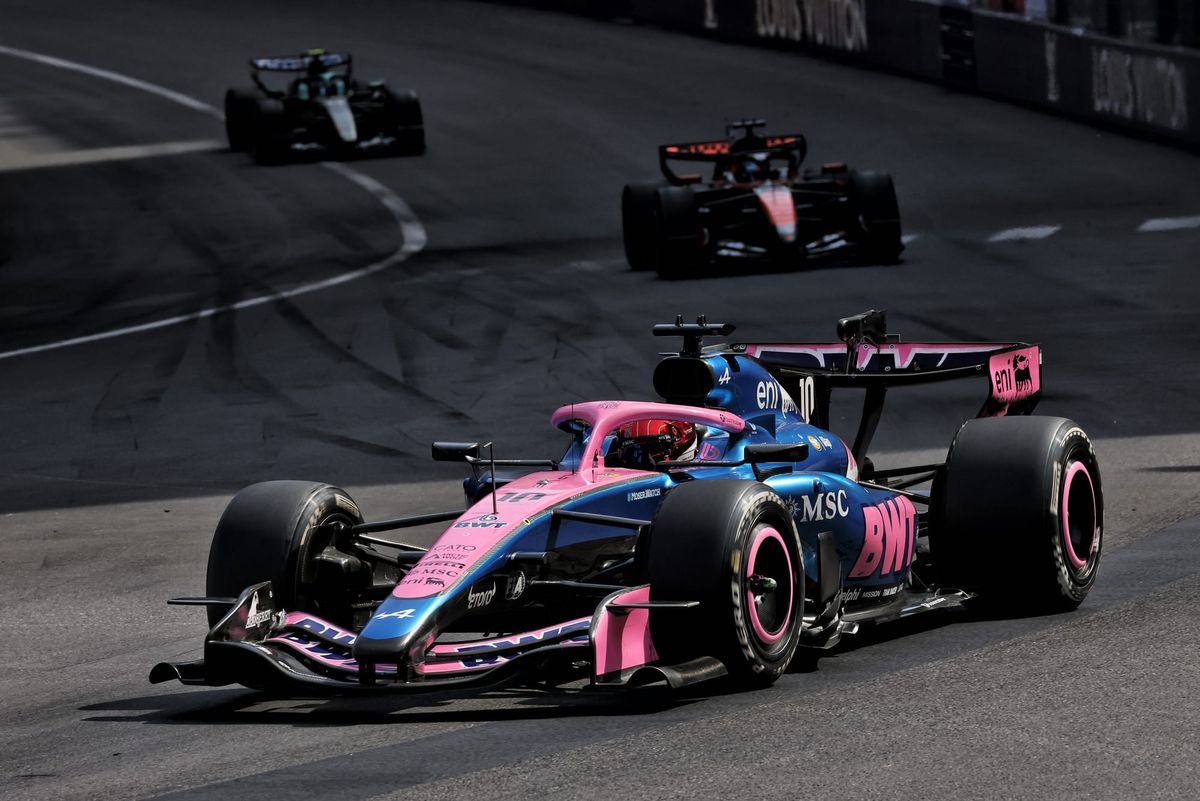
The extraordinary removal of Pierre Gasly’s Monaco Grand Prix penalties, changing not only the result but who gets the race’s third place trophy, came down to a matter of centimetres.
Gasly was reinstated to third place, denying Isack Hadjar his first Red Bull podium after all, following the stewards’ decision to overturn Gasly's pitlane speeding penalties and the two five-second penalties he had applied last Sunday in Monaco.
In the stewards’ lengthy explanation of what it considered in making this decision and why they ultimately decided to take the unusual step of changing the results several days later, some fascinating details have been revealed.
The error that was made
The pitlane speed system calculates an average speed using the distance between two timing loops divided by the time taken to pass between them.
Formula One Management, the official timekeeper, had recorded the first timing zone immediately after pit entry as 2,692 cm long.
However, Monaco's pitlane, including the entry exit, is curved - so the shortest geometric path through the zone is not a straight line. And post-event scanning revealed the actual shortest possible distance through that zone was only 2,615 cm - a discrepancy of 77cm.
This was a significant and relevant new element that was unavailable to the stewards at the time of their decisions, hence the review being granted.
The standard process, which involves satellite and real-world measurements, is designed to find the minimum distance. The pit entry barriers had been repositioned since 2025, possibly enabling a significantly shorter trajectory in 2026 than was possible before.
So even if the measurement had been adequate for previous years, it might have become outdated for 2026. The FIA’s most senior F1 figure Nikolas Tombazis said the measurement method "may have been insufficient for this particular pitlane layout".
The bottom line is that because the formula uses distance divided by time, a longer assumed distance artificially inflates the calculated speed - so the underlying data used to decide who sped and who didn’t was inaccurate.
“We measured the relevant areas in the pitlane identically to the 2025 event and followed procedures in the usual way,” F1 said in a statement.
“However, the process has identified a measurement discrepancy. Like everyone in the sport we strive for the best results and, as always, any improvements or refinements that are identified as being required in light of this situation will be implemented.”
How it was ‘corrected’
F1’s rules only refer simply to a "speed limit" with no clause stating it is "solely determined by the Official Timekeeping System process".
This gave the stewards the latitude to look beyond the raw timekeeping output. They felt “the simple question to be answered is whether Gasly exceeded the speed limit of 60km/h”, and that this could be established another way.
Based on the shortest theoretical distance, and the time it took Gasly to pass between the loops (1.604 and 1.602 seconds respectively), his speeds would have been 58.7 km/h and 58.8 km/h.
It would not have been possible for Gasly to have travelled that distance because of the width of the car and the trajectory it would take (presumably because pit equipment or other obstacles would be in the way).
However, the wording of the formula referred to in F1’s official timing report: the measured minimum distance. It was felt there was merit that this should be the figure of 2615cm.
And in reviewing the penalties, the stewards performed their own back-calculation: if Gasly had been travelling at exactly 60 km/h, he would have covered 2,673 cm and 2,670 cm in the recorded crossing times - less than the 2,692 cm the system assumed.
Using the data available meant there could not be a 100% guarantee that Gasly travelled a precise distance down to the last centimetre.
However, with the data the stewards did have available, it could be ascertained that it would be closer to the shortest theoretical distance than what the timekeeping system assumed.
Thus the stewards concluded with "comfortable satisfaction" that Gasly was not speeding.
Stewards actually queried the penalties in-race
The extent of all this only emerged days after the race because the key information was either not available in-race or emerged because of specific post-race analysis.
Interestingly, the Stewards did query the speeding penalties with race control mid-race, flagging it as unusual that multiple drivers were all recording exactly 60.1 km/h.
This happened after the third offence - Franco Colapinto’s - but they were told there was no issue and that the data was therefore accurate.
This was based on the system being applied as it should and the understandable assumption that the system was also being fed with the right information.
Those in-race reports also contained no reference as to which particular part of the pitlane the alleged breach occurred in. So the stewards had no knowledge that the alleged breaches were all occurring in the one same timing zone nearest the pit entry.
The scanning discrepancy only came to light when Alpine built their case. FOM produced its own report - it “proactively assisted the FIA in gathering all the relevant information to help inform the steward’s assessments” and is understood to have gone to great lengths to ensure transparency, sharing as much information as it could.
Why 100% proof wasn’t needed
The stewards don’t know with absolute precision that Gasly wasn’t speeding. But they didn’t need 100% proof.
As mentioned, the 58.7/58.8 km/h figures cited were based on the theoretical shortest distance of 2,615 cm, which was not possible to take. And other distance information or data - like Alpine measuring the pitlane with a trundle wheel, or providing speed measurements from the car itself - were dismissed because the calibration cannot be trusted for various reasons.
So the precise speed cannot be stated definitively. What the stewards were satisfied of is that the timekeeping system produced a false positive and they had enough conviction Gasly could not have been speeding "even taking into account the car width and the likelihood that the car was not driven on the theoretical shortest route".
“There is still a significant delta in the distance used to calculate the speed and the distance which could be driven and which appears to have been driven,” the stewards noted.
Within the FIA, based on the practices and findings of the FIA International Court of Appeal, there is a certain level of "proof" that is required to make a judicial determination. That level is referred to as "comfortable satisfaction", which means "a strong and clear conviction".
Within most judicial systems, the lowest level of proof required is that of "balance of probability" which essentially means "more than likely". The highest level, usually required in criminal cases, is "Beyond reasonable doubt" - which means almost absolute certainty.
In this case, the stewards unanimously felt it met the required level of comfortable satisfaction - and the evidence “approaches that of beyond reasonable doubt”.
Other penalised drivers can’t be helped
Nothing happens to the other drivers who were penalised in the race - even though Gasly wouldn’t have finished third without two others getting penalties.
Lewis Hamilton, George Russell, Franco Colapinto and Oscar Piastri all received penalties for the same 60.1 km/h reading in the same zone. Russell and Piastri would have beaten Gasly without theirs.
The stewards acknowledged there "will undoubtedly remain questions as to whether those breaches were genuine”. But there is no regulation that gives the stewards the power to 'undo' a served penalty.
They served their penalties in-race, so there is nothing as simple as Gasly’s post-race time penalties to remove, and they have missed their window to challenge their penalties through a right of review anyway.
However, it remains to be seen if any team will go through with an appeal, and keep this process going. McLaren and Red Bull have stated their intention to do so while they review their options.
McLaren won’t get Oscar Piastri’s penalty removed after-the-fact or benefit that way. But along with Red Bull and Racing Bulls they lose a better result for Gasly being reinstated. That’s why they joined this FIA review to argue that Gasly's penalty should have stood.
Red Bull argued timing was consistent all weekend, that normal process was followed, and teams had adjusted their systems to work within the established method. McLaren noted teams are well aware of the imperfections in pit lane speed calculations and coached drivers accordingly.
They could not stop the stewards making their new decision. Now they need to decide if they feel there is a genuine chance of getting it overturned.