The 'scary' new element to qualifying in F1 2026
It’s been known for a while that Formula 1’s 2026 cars are going to be energy-starved, which means harvesting and deploying battery power will be critical to laptime.
Initially this seemed to be relevant to races, but first impressions of the cars at the recent Barcelona test have exposed an element that one team boss has called "scary".
It is that the available energy is on such a knife-edge that even qualifying efforts will be destroyed in 2026 if drivers get things wrong on their outlaps.
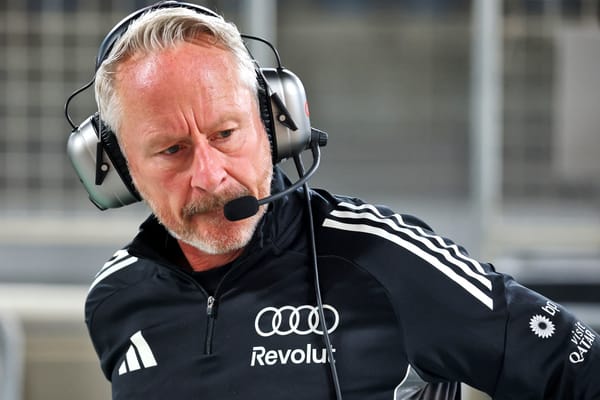
Haas team boss Ayao Komatsu has revealed how the fight for pole could be influenced heavily by small errors made in preparation laps.
He reckons that any trip up on this front will not just cost a little bit – it could see a driver lose around half a second per lap.
From Komatsu’s perspective, this could become a major factor in dictating grids early on in the campaign.
“There is more vulnerability at the start of the season,” he said. “I think if something goes wrong, I think it will be pretty obvious.
“If somebody is not deploying correctly, let's say opening a qualifying lap on the pit straight, or going into Turn 1, if somebody is not going very quickly, then you will realise straight away they didn't do it correctly. So I think it will be very visible, especially early on.”
He added: “We're not talking about tenths. You can lose half a second, six tenths, seventh tenths very, very easily. That's the scary bit.”
Outlap conflicts
What Komatsu is referring to is that, with cars not having enough battery to run laps flat out, drivers can't waste any energy on the outlap at all.
That means not triggering any more usage of the battery element of the package than is absolutely necessary.
But that is a very tricky thing to achieve properly – because drivers cannot just drive slowly to achieve that aim. The demands to warm the tyres, avoid traffic issues and keep up to the maximum delta time mean there is a requirement to get a hurry on as well.
Furthermore, there is no scope in the regulations to simply run a quick outlap on the internal combustion engine alone, as there are strict rules regarding power demand.
Article 5.12.1 of the Technical Regulations states: “At any given engine speed, the driver torque demand map must be monotonically increasing for an increase in accelerator pedal position.”
This effectively means that the trigger for kicking in battery usage is throttle position - not a button on the wheel.
So in effect, the only way to avoid burning up any battery is to be very cautious on the accelerator.
There are therefore a host of conflicting demands of what drivers need to do to cover off tyre preparation, traffic, timing deltas and energy.
And the end result is a massive headache in how to get things nailed perfectly.
Komatsu said that Barcelona offered a first clue about how complicated things were when his team tried some qualifying simulations.
Haas quickly found out that how cars were driven in the final sector on a preparation lap ultimately decided how quick the subsequent qualifying effort would be.
“It's very, very important how you go through those last couple of corners,” he said.
“If you don't carry enough speed out of, let's say, Turn 14 in Barcelona, by the time you come to the start/finish line, you don't have enough speed. So your qualifying lap is already ruined.
“But if you try to get the speed up, but then have too much throttle, you are deploying towards the end of the outlap, so you just waste the battery on the timed lap.
“There's a very clear conflict of demand about what a driver needs to achieve, and the system needs to achieve. So you have got to get it right.”
Things could get even trickier at places like Baku, where there is the city section where you don’t want to burn battery power, but also a very long straight before the start/finish line where you'll need battery to deploy.
“In the castle section, there's no point deploying electrical energy in between corners,” added Komatsu. “That's going to do nothing in terms of straightline speed.
“But if you accidentally do that, go on the throttle a little bit too much, and then deploy MGU-K, or use MGU-K to basically engage turbo, then by the time you go to the main straight, you haven't got the necessary electric energy available. Then you pay a big price.”
Komatsu believes that all teams face an uphill challenge to try to get on top of the situation as quickly as possible.
And that will be made even more challenging by the fact that preparations will be done in the tests in Bahrain – run on a Sakhir track with some good heavy braking zones that will allow for straightforward charging of the battery.
However, the season starts in Australia, with the Albert Park track one of the more challenging venues to harvest.
“Even if you get to the stage where you are very confident in Bahrain with consistency, then you go to Melbourne and it is a completely different condition," warned Komatsu.
“That's going to be a huge challenge. So I think it's going to be a steep learning curve for most of us.”