'You feel powerless' - Russell's mystery Mercedes F1 problem
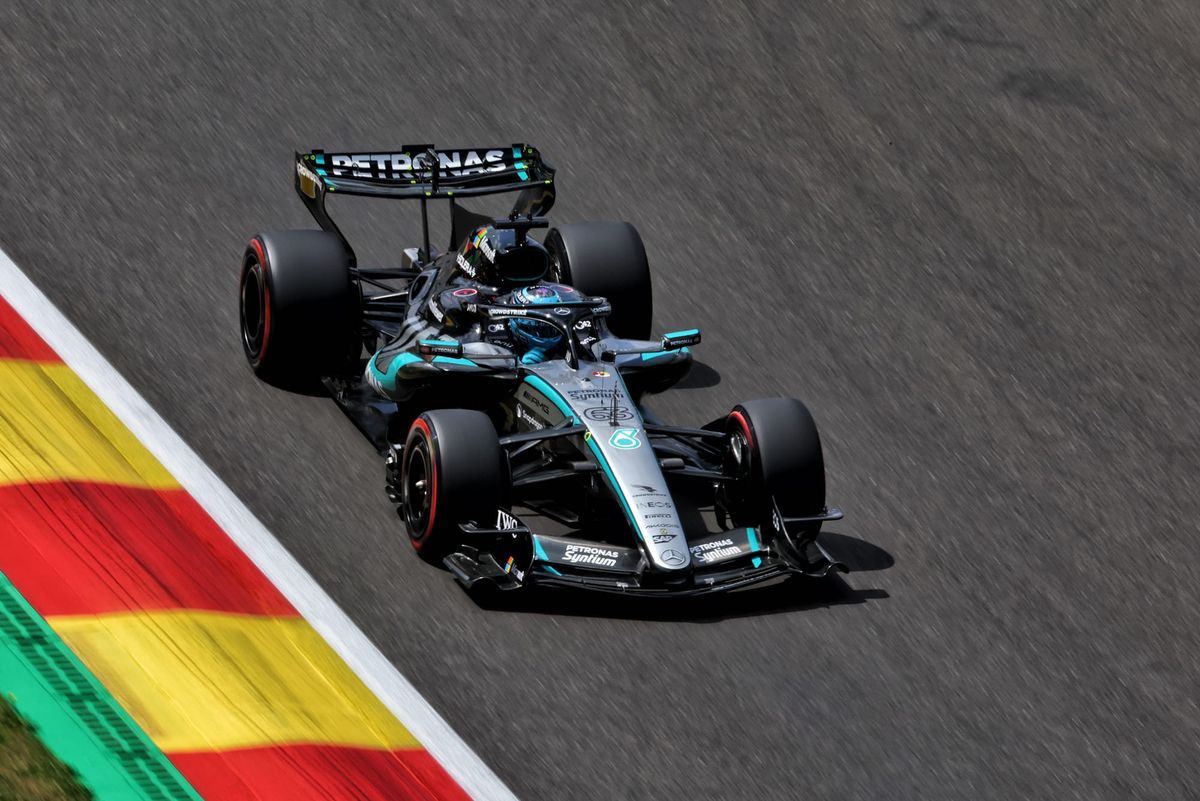
George Russell has labelled mystery speed losses on the straights compared to team-mate Kimi Antonelli as “infuriating”, with Mercedes still chasing an answer as to what is going on.
Russell has been on the back foot throughout the Belgian Grand Prix weekend, as he has had no response to the impressive pace Antonelli has shown.
Although there is a sense of damage limitation after qualifying, as he lines up third on the grid at Spa-Francorchamps behind Antonelli and Red Bull’s Max Verstappen, Russell is well aware that a 0.508-second deficit is not something he can simply brush aside.
What is triggering most angst for Russell is that a lot of the gap to Antonelli seems to be out of his hands, as he is losing most of his time on the straights.
It is a theme that has run throughout the last few grands prix, and was exposed already in Friday practice in Belgium when Russell was a whopping 1.285 seconds slower.
But the quest for an answer as to what is happening has not been successful yet – and has left Russell obsessing over trying to work out what is happening.
“My whole focus for the last 36 hours has been on straightline speed,” he said. “It hasn't been focused on the set-up, tyres, or anything, because we're all trying to solve what is going on.
“Even my last lap, for some reason, I lost another tenth and a half to myself, just on the straight. And you're watching on your steering wheel, [you're] losing speed when you're full gas on the straight.
“You feel powerless. We don't know what's going on. I don't think it's the power unit, to be honest. My team are really, really on it now, to try and solve it.”
What the data says
Despite Russell and Mercedes having been trying to get to the bottom of things, a particularly confusing picture in qualifying in Belgium has only served to add to the mystery.
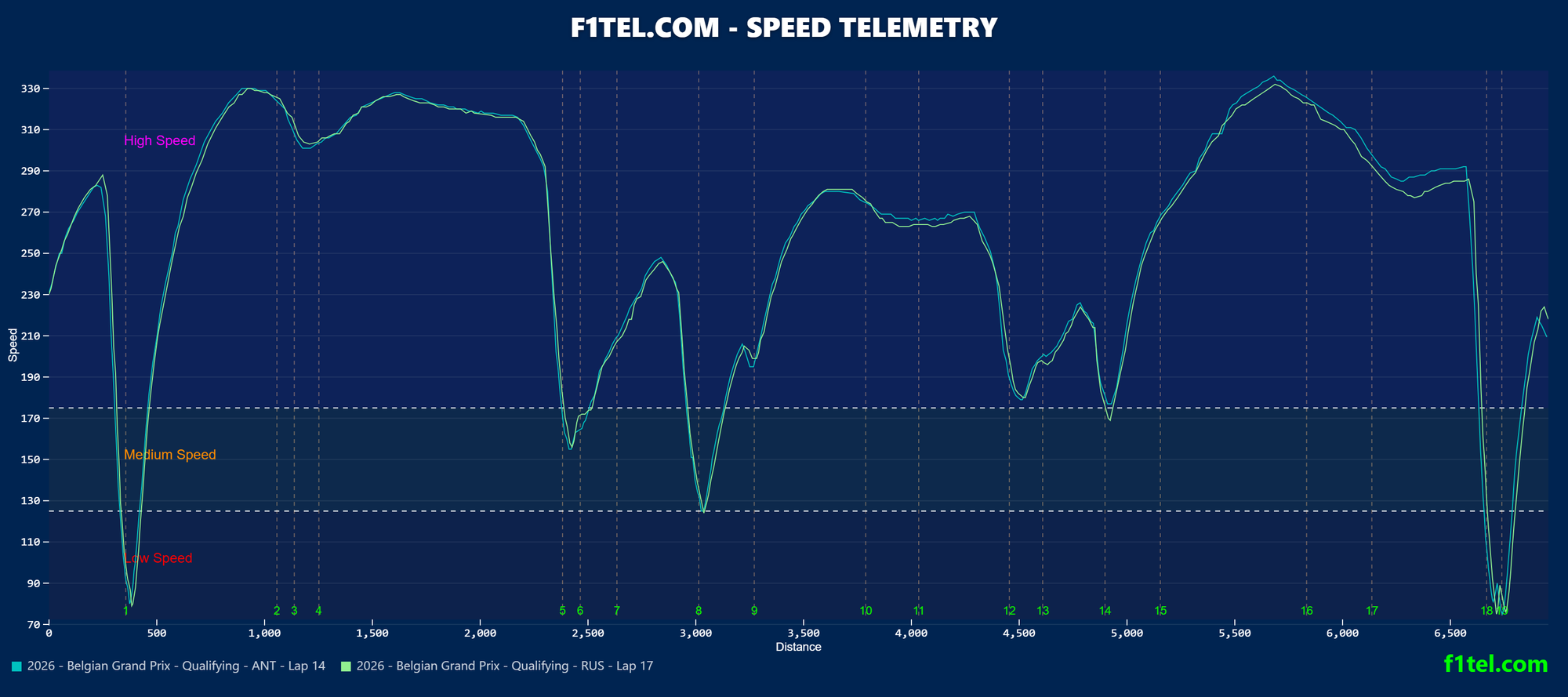
Looking at a comparison of telemetry data between Antonelli and Russell’s best laps in qualifying, the top speed differences between them is not exhibited on all parts of the track.
Russell’s top speed is nearly identical to his team-mate on the run up the Kemmel Straight to Les Combes – with him having been quicker through Eau Rouge.
Carrying higher top speed in the corners, Russell is even ahead of his team-mate for a bit – and they have virtually identical lap times as they exit Turn 8.
It is from here onwards, however, where Antonelli is able to stretch his legs as he gets more deployment on the run down to Pouhon and then carries more speed through to the Fagnes Chicane.
By this stage – over what is essentially a flat-out section of track - Russell has lost more than two tenths of a second.
He then loses a further two tenths on the long run down through Blanchimont and to the final chicane, where the speed difference between them opens up to as much as 10km/h at times.
Russell recovers a bit of time through the chicane, but loses what he gains as both drivers perform their qualifying trick in lifting off before the line – with Russell coming off the throttle slightly later than his team-mate today.
A question of energy
The Race understands that Mercedes is not planning any component changes to see if there is a problem with a specific part on Russell's car, as it believes the answer lies somewhere in deployment management.
Mercedes team boss Toto Wolff told Sky: “I think the cars are so on the edge to drive in terms of how you deploy the energy, but also the tyres.
“You can see that sometimes it's just a few hundredths between the cars, like it was in at the end of Q2. And then the gaps are a little bit bigger again in Q3.
“But fundamentally, whoever drives faster, whoever is able to manage the energy more clever, is going to be ahead.”
This idea of deployment usage being the root cause has been strengthened by the fact that Russell’s top speed down the Kemmel Straight was so strong – so there cannot be a problem that manifests itself around the whole lap.
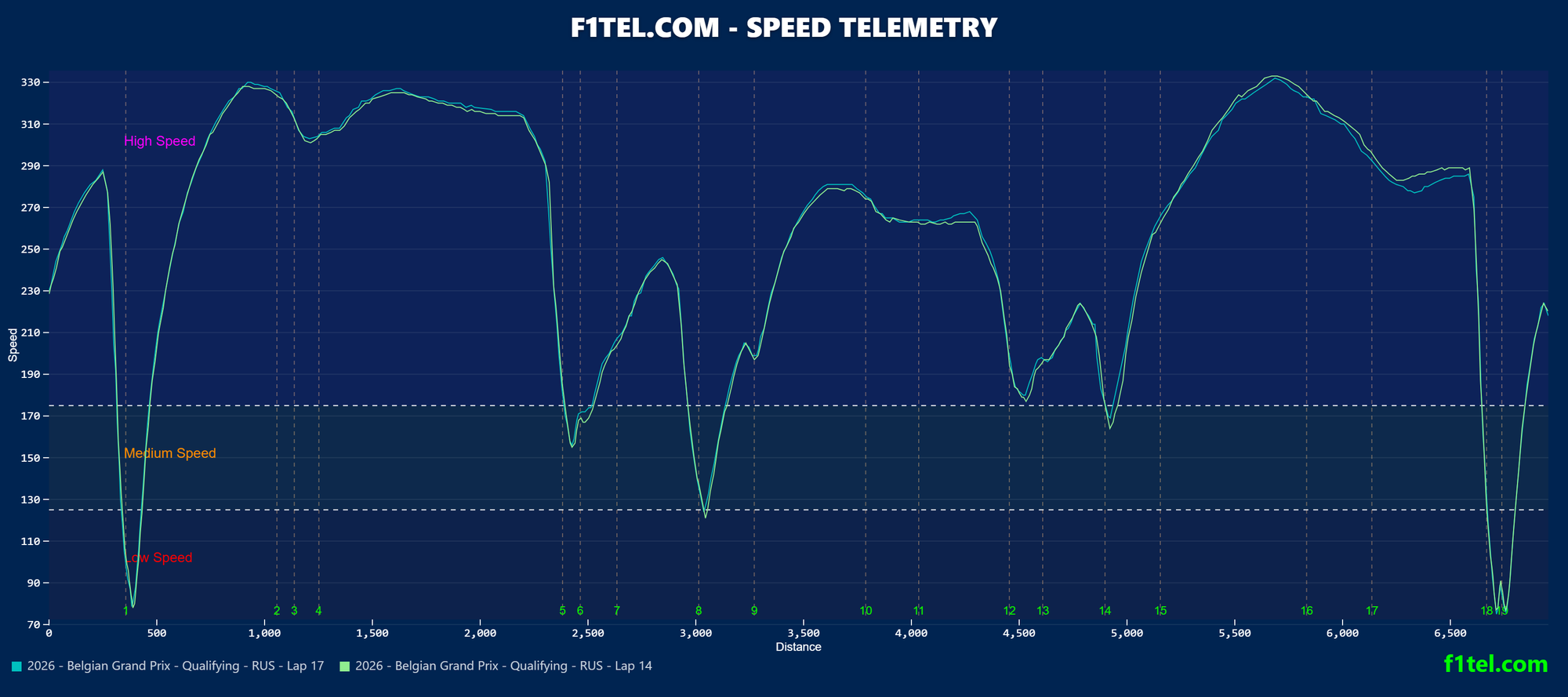
While there is no firm answer yet as to what is going on for Russell, the chase for a conclusion could be helped by the fact there was also such top speed variation between Russell’s own laps in qualifying.
In particular, his first effort in Q3, a 1m45.156 seconds lap that was slower than his final effort of 1m44.869s, resulted in him having a top speed on that run to the final chicane that was only a couple of kilometres behind Antonelli.
Getting to the bottom of what the difference was between Russell's own laps that resulted in such a speed difference could be key – and may well lie in how he took the previous corners.
Russell says previous suspicions of it being related to his braking style or how he treats the throttle have proved to be wide of the mark - something confirmed by trackside engineering director Andrew Shovlin as he reflected on what was happening.
"We're investigating what's causing this as a priority, as there is a clear loss that we cannot explain by driving style," he explained.
Russell suggests that something else is likely in play.
“We saw this from Silverstone, we thought we found the problem,” he said. “We thought it was something with the brakes, it wasn't the brakes. Then we thought it was my driving style, with the throttle.
“I convinced myself that it was something with me, the driving style. Now we're very confident it's not the driving style, and that there's a serious issue at play here.
“The team are working so hard to resolve it. But, you know, every lap I do I see I'm down anywhere from two tenths to six tenths on the straights. It's pretty infuriating.”
Some of the answers could come from the way that the computer algorithms used by teams to manage deployment self-learn over a lap - so they adjust energy management patterns based on how the car is being driven.
McLaren team boss Andrea Stella, who saw a similar top speed deficit pattern as Mercedes between Lando Norris and Oscar Piastri, felt that live adjustments were a big factor in what was being witnessed.
"To operate these power units, you don't operate them in an open-loop way, whereby I would be able to have an offline simulation and say, ‘oh, that's how the electrical power will be deployed, and it will always be identical to itself’," he said.
"There's a large component of the controller that operates the power unit that happens with live calculations, and the power unit kind of forwards thinks, forward calculates what it has to do based on some… I don't want to get into too much technical description or technical IP…but there's a lot that happens as the car goes. This is why it's not so easy to understand what kind of calculations have been made as the car was going."
He added: "This is not only for the influence it has in the power-limited sections, on the straights, but also because it affects the braking points, because if you have an additional amount of harvest with a super clip before braking, then you are approaching the braking 10km/h slower, and your braking point changes. So this is quite difficult to master, I would say, for the drivers."
Praying for a solution
While deployment variation seems to not be as big in races, so Russell should not suffer as much on Sunday, he admits he is “praying” that a solution comes in time for the next event in Hungary.
If he gets on top of what is happening then he maintains faith he can properly challenge his team-mate.
He told Sky: “The truth is, battling against my team-mate, who's such an incredible driver, doing such a great job at the moment, in the best of times is a tall order. But I feel confident head-to-head I can achieve it.
“But when it feels like you're battling with one hand behind your back, it's a challenge. But we had the issue in Silverstone and we ended up P2 on the podium.
“So I pray I'm going to try and endure the pain of this issue tomorrow and hope for a great result and try to find a solution for next weekend.”