McLaren's F1 form dip wasn't what it seemed
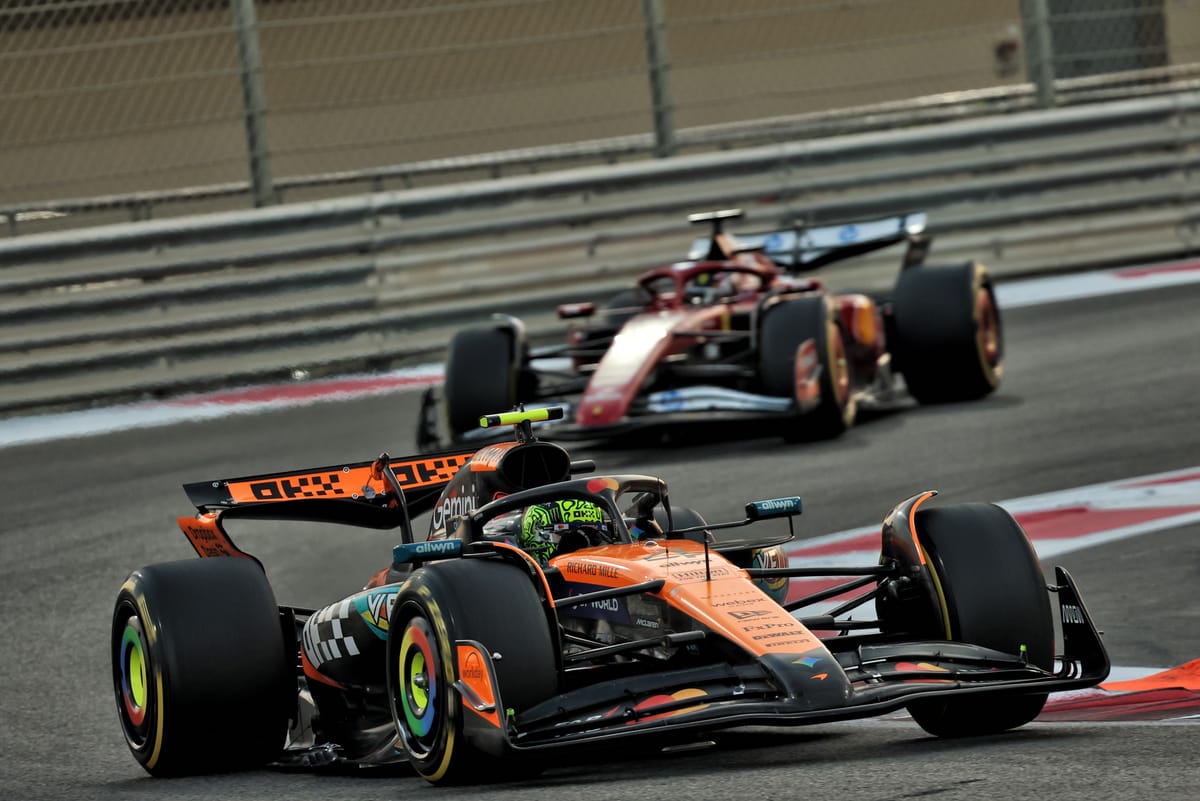
With McLaren having started the year in such dominant fashion, Lando Norris just getting the world title across the line in Abu Dhabi inevitably triggered critics to suggest it had made life unnecessarily difficult for itself.
There had been numerous opportunities late in the campaign for McLaren to put the championship beyond the grasp of Max Verstappen and Red Bull, but setbacks like the double disqualification in Las Vegas and the strategy blunder in Qatar kept its rival in the game.
The contrast between just how far ahead McLaren had been early in the year, and how much it seemed to make heavy weather of getting the title wrapped up, inevitably fuelled this idea that McLaren had majorly dropped the ball.
As Verstappen said in Qatar: “We are in this fight still because of other people’s failures, not because – if you look at the whole of the season – what we did.
“If we would have been in the position of how dominant of a car [McLaren] had, the championship would have been over a long time ago.”
But the difficulty of jumping to the conclusion that McLaren squandered things based on how far clear it was early on in the year is that it is comparing apples and oranges.
For while McLaren’s MCL39 and the Red Bull RB21 had the same chassis numbers in Melbourne and Abu Dhabi, they were far from identical cars and their pace relative to each other was not the same.
Alternative approaches
There are two parallel paths here that point to why it is wrong to judge McLaren’s challenging second half to the year as a failure to build on the momentum it had gathered early on.
The first is that it and Red Bull were not on identical upgrade paths. McLaren had decided pretty early on to take a different strategic approach to this final year of the current rules set.
It opted for an aggressive new design that would deliver a big step forward for the very start of the season.
This would not only allow it to start the campaign on the front foot, but also hopefully give it enough of a performance buffer that it would not need to keep upgrading it for long – so its factory design focus could switch super early to 2026.
Furthermore, the progress that it had made with its MCL39 design meant it was far more on top of its concept and the performance drivers in 2025 than other teams.
More downforce, for example, meant its drivers did not need to push the car as aggressively as others – which meant the tyres did not slide, and this then had exponential gains in terms of managing temperatures.
Red Bull, on the other hand, had started the campaign on the backfoot as it struggled to fully understand its weaknesses and through corner balance problems that became the story of the RB21 in the first half of the year.
Work on that front, allied to the approach of new team principal Laurent Mekies in wanting to take some risks in pushing on with development and upgrading quite late into the season, meant that the Red Bull’s performance kept improving over the second half of the year.
And while there were times where the RB21’s narrow set-up window made life incredibly difficult – like in Brazil – McLaren thinks by the end of the year, there was little doubt about who had the advantage.
Reflecting on the performance in Abu Dhabi, McLaren team principal Andrea Stella said: “The Red Bull proved to be the fastest car once again.
"I think they have clearly done a very good job of overcoming some difficulties from a performance point of view in the middle of the season…. [and I am] not even surprised that they are finishing the season being probably the best car.”
A question of risk
The two strategies were different, but they are based on two totally different motivations.
From Red Bull’s perspective, the risks from developing and being aggressive with upgrades were worth it because Mekies felt the team needed to stress test and understand the strengths and weaknesses of its organisation heading into 2026.
Factoring in to its equation too may have been an acceptance that a title next year might be out of reach, given that it would be powered by its own engine for the first time – so there was less downside in going all in for 2025.
For McLaren, the decision to stop development was all about making sure that it maximised the opportunities available for 2026.
Stella admitted recently that if it had kept on pushing to improve the MCL39, it may have made life easier for itself on track right now, but it would have “heavily compromised” things for next year.
This was especially true because by the time of the team’s final upgrades around Canada/Austria time, it was taking weeks for it to find just one more point of downforce with its heavily optimised package.
"If we'd have continued to develop '25 we'd have gone into 2026, although we don't know where we're going to go, we would certainly have gone in slower than we're going to go in," McLaren's technical director for engineering Neil Houldey said.
"We were looking for milliseconds. 30 milliseconds, was a good upgrade at that point.
"The whole car was going to give 0.1s. So when you get to that sort of level, and you're gaining that sort of time in weeks, developing the '26 it was, it was clear for us at the time."
Losing such time on 2026 development, where progress is so rapid because the designs are in their infancy, would equate to a lot of laptime.
Do not forget that McLaren faced a further handicap in its ability to keep throwing resources at 2025 because it has the least windtunnel/CFD development out of all teams as part of F1's aerodynamic testing restrictions (ATR).
The differing approaches inevitably led to a convergence of performances where Red Bull’s pace became every bit a match for McLaren – especially on tracks where the MCL39’s supreme advantage in long, medium speed corners could not be unleashed.
It was having Red Bull breathing down its neck that pushed McLaren into needing to take things more to the edge with its set-up and approach to the races - and that inevitably increased the chances of mistakes being made under pressure.
This is what opened the door for the kind of mistakes that proved so costly in Las Vegas and Qatar.
In the end, despite Red Bull taking things to Abu Dhabi and Norris ending up just two points clear, the final verdict on whether McLaren did the right thing can only come next season.
Smallest margins
In F1, beyond having less stress, there is no extra bonus to winning a grand prix by 30 seconds versus three seconds, or taking a title by 20 points or just two.
It is similar to the approach that four-time world champion Alain Prost often talked about: “I always say that my ideal is to get pole with the minimum effort, and to win the race at the slowest speed possible.”
It’s about getting the job done; not how convincing it is.
So from McLaren’s perspective, even though its execution has been far from perfect, scraping home with the title and having just that two points buffer in the end could be viewed as having done the perfect job development-wise – because any extra effort that it had expended would not have given it any better a result.
But we will only know if it could have made life easier for itself this year when we get to see its 2026 car.
If McLaren is on the backfoot next season, then it could well be left thinking that what it lost this year in having an easier life was not worth it.
But if it appears with the benchmark car again, against rivals who focused too much on 2025, it will have played a blinder.