How each active F1 rear wing concept works - Gary Anderson explains
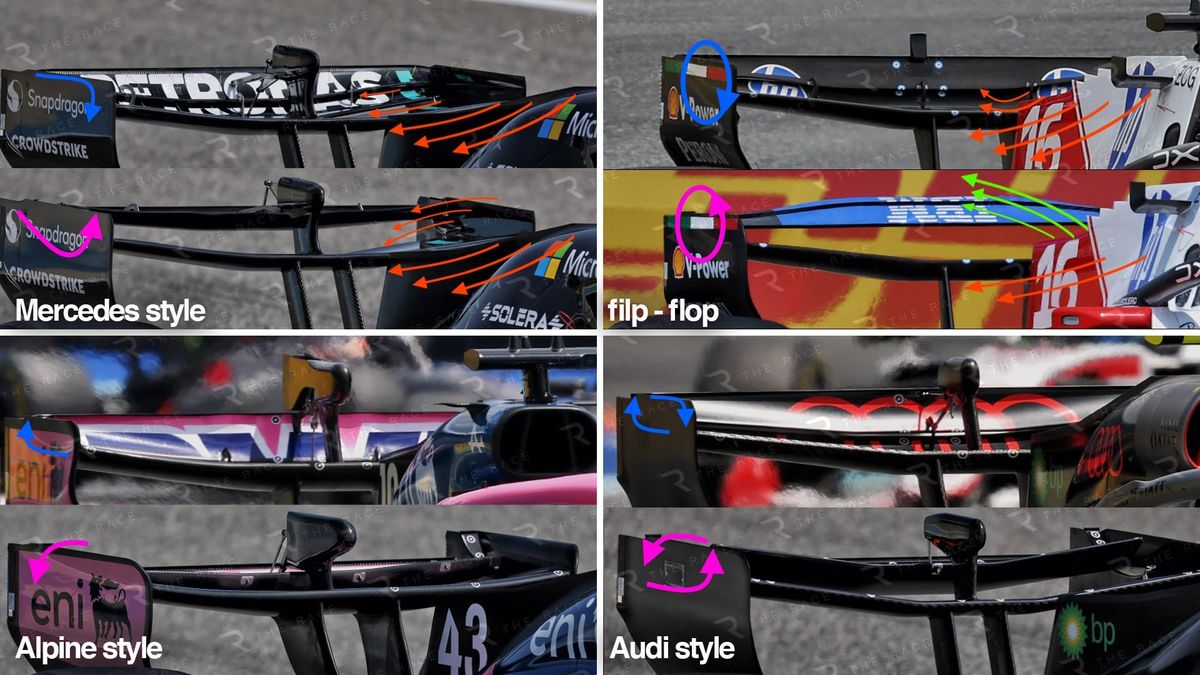
Baku is another track where, like Monza, straightline speed is a major contributor to performance. This means rear wing design, and in particular the difference between cornering mode and straightline mode under Formula 1's new-for-2026 active aerodynamic regulations, is particularly important.
The objective of these two wing states is to create as much downforce as possible when in cornering mode and as low a drag level as possible when in straight mode. However, by regulation that transition between the two modes has to happen within 0.4 seconds.
The driver presses a button to activate straight mode, so there's no real urgency in getting to the low-drag mode. However, when going from straight mode to cornering mode it all happens automatically when the driver hits the brake pedal. When it closes, the airflow must reattach to the wing's undersurface just as quickly, otherwise the rear of the car will be unstable in the initial braking phase.
If that happens too often, the driver can also press a button to set it off just that little bit earlier, but then the on-track closing position will be a little bit random and, when in battle with another car, it could be easy to forget or even try to push the closing more to the limit, triggering the airflow problem again.
On two occasions earlier in the season, at the Red Bull Ring and Silverstone, we saw Max Verstappen go off track on corner entry. Both of these offs were at initial braking after a straight mode, and the team later admitted were caused by a mechanical problem with the design. This sort of problem can increase in magnitude just by being that metre or two later on the brakes, increased turbulence or a slight change in wind direction.
The actual use of it is in no way to improve overtaking, as everyone has it on the straight-mode sections of the track on every lap. It is simply to achieve higher top speeds, especially when these cars, because of a flawed set of hybrid regulations, are prone to running out of electrical power well before the end of the straights. Also, when in straight mode it means lower drag, so you get a bigger bang for your buck when it comes to top speeds, especially relative to the power level it takes to achieve that speed.
So what are the various different solutions that the teams have come up with for this season? Well, there are four main concepts. Within those four are obviously slightly different operational functions.
Concept one
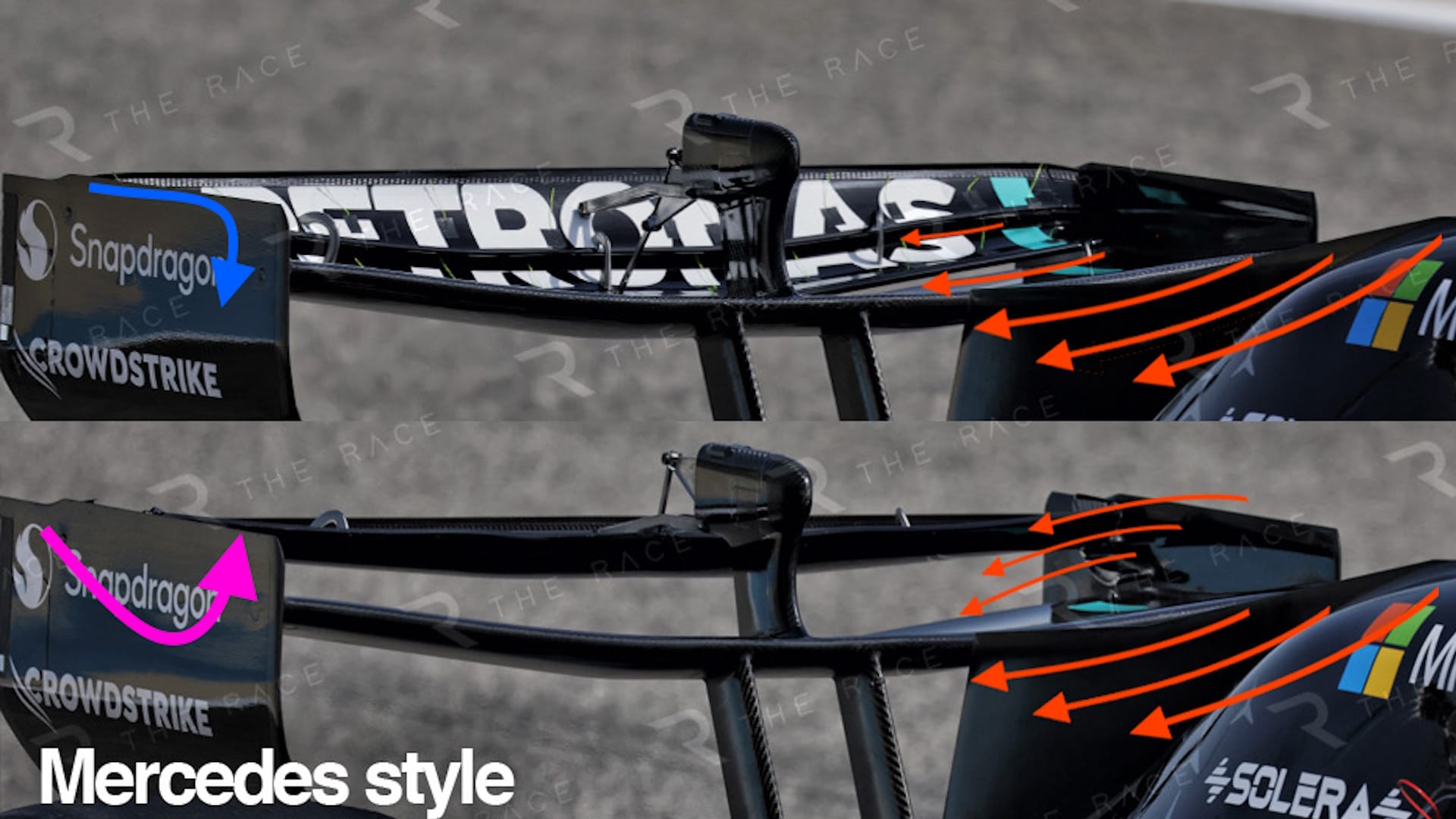
This is what I would call an extension of the previous DRS concept. However, the size of the opening is not defined as it was with the DRS solution, so it can be as big as you like.
The magenta arrow shows the rotational direction that the leading edge of the flap assembly goes in when opening, and the blue arrow shows its direction when closing. Not surprisingly, with the knowledge they had, this was the concept that most teams pursued for the start of the season.
On the Mercedes annotation, the red-line thickness difference is hopefully illustrating the downforce levels from when the wing is in cornering mode to when it is in straight mode.
With this concept, the wing's main plane and upper flap assembly will, even in straight mode, create some level of downforce and the two of them will probably still interact or, as I like to call it, ‘talk' to each other, again producing downforce.
This means that the airflow on each of these sections of rear wing will still be attached to the undersurface even when in straight-line mode. So depending on how aggressive the design group has been on the actual wing configuration there shouldn't be any reattachment problems when it goes into cornering mode.
Concept two
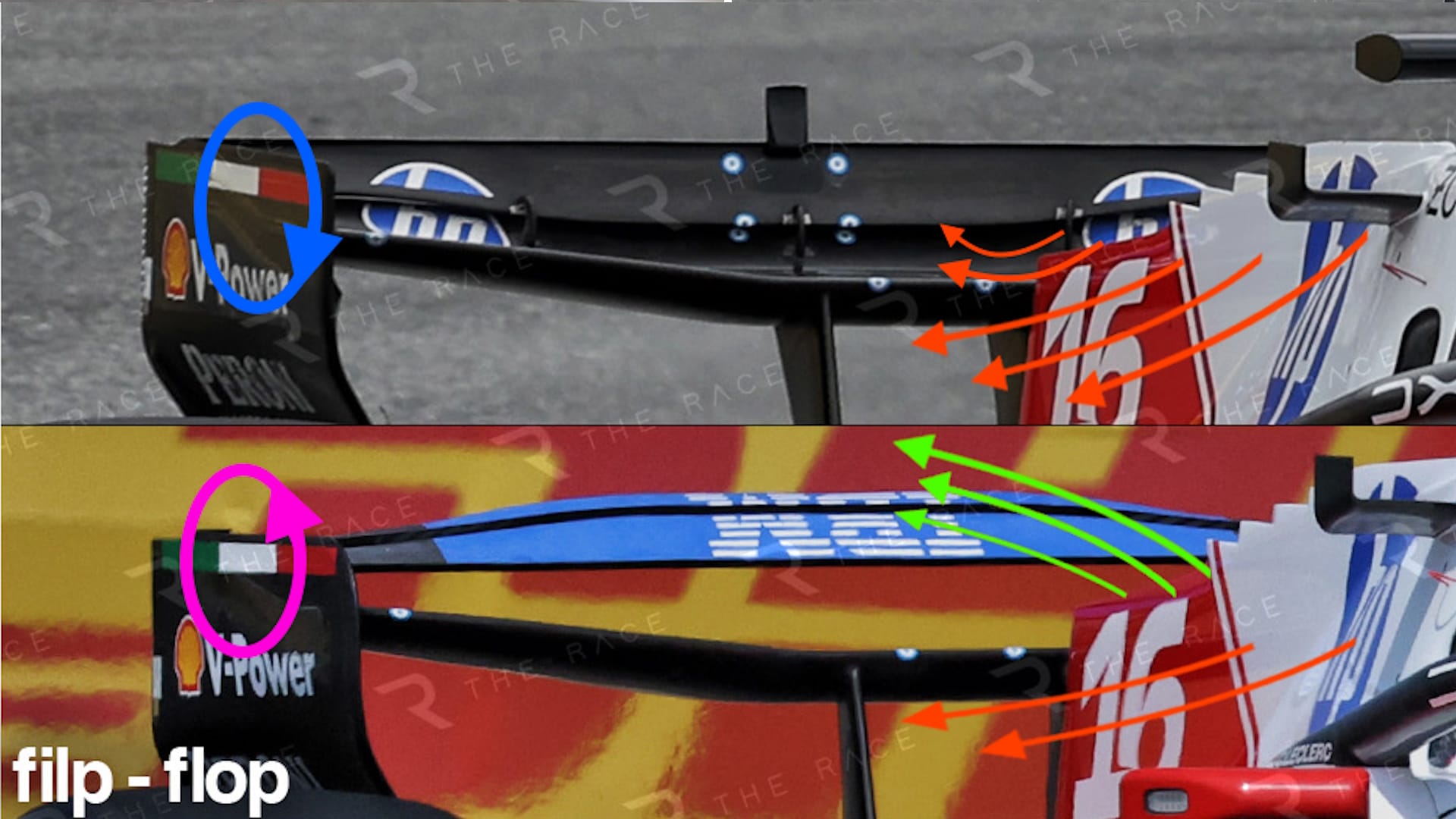
This concept was first introduced by Ferrari and tested in a grand prix weekend very early in the season at round two in China. It has had many names, from ‘macarena' to flip-flop and H-wing, which is what McLaren called its version.
It is now used consistently by Ferrari and Red Bull and seemingly randomly by McLaren - it's only actually been raced at Monza but will be back this weekend for Baku.
If we take into account that both Red Bull and McLaren followed this path after seeing what Ferrari was up to (though Red Bull's insisted it had its version in the works before Ferrari's appeared), there must be something worthwhile in this concept. Otherwise, why bother?
Assuming that the cars generate similar levels of rear-wing downforce when in cornering mode, the red arrows change in weight just like the ones on the Mercedes. However, when open this concept is different. When open, the flap assembly, by being upside down, will, as highlighted with the green arrows, produce some level of lift – in other words, the opposite to downforce.
The mainplane will still produce a small level of downforce, as the reduced red arrows show. This reduction will mainly be because of the lack of interaction – ‘talking' – between the airflow on the flaps and the main plane. Will that reduce the levels of drag? Probably, but it would need fairly intense research to actually come up with the potential percentage performance gain.
The interesting thing for me about the Ferrari concept is the direction of rotation the flap assembly goes through when opening and closing. Looking from the driver's right-hand side of the car, the flap assembly rotates anti-clockwise, as the magenta arrows show, when opening. As I said earlier, this function is not critical to the airflow change, as all you want is a drag reduction as quickly as possible. As for the closing, it obviously closes in the opposite direction, clockwise, as the blue arrows show.
This means that it increases its angle of attack and induces airflow reattachment as it rotates. The last part of the rotation is very similar to the Mercedes concept in that it is just reducing the slot gap to its minimum, so it is not asking the airflow to reattach any differently from this more standard concept. One of its potential advantages for me is that, when being rotated to close, it is fighting against the in-line aerodynamic forces, so its closing rotation will be taking up the maximum of that allowable 0.4 seconds. During that period it is a bit like a parachute, helping with the speed reduction of the car.
The big difference with the Red Bull and McLaren versions of this flip-flop wing is that they both rotate their wings in the opposite direction when opening and closing. So for both of them, the flap assembly is going through a greater angle of attack until it gets to its final position, meaning they are asking for instantaneous airflow reattachment when that positioning is achieved.
Concept three
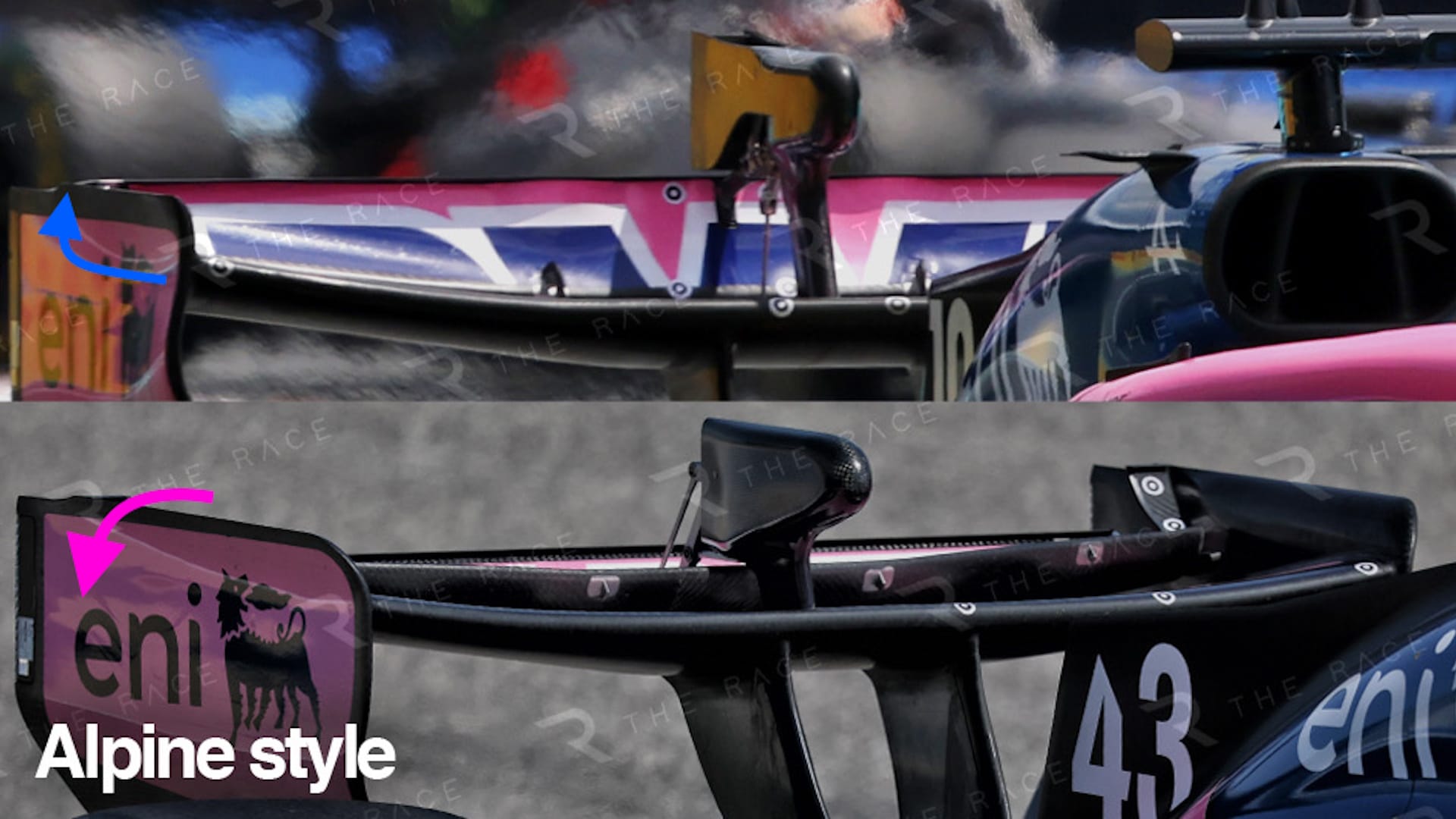
This is a lone concept used by Alpine since the start of the season. Assuming once again that, when closed, it produces similar levels of rear-wing downforce to Mercedes and Ferrari, it simply reduces the angle of attack of the flap assembly by dropping the trailing edge, illustrated by the blue arrow.
This inherently opens the slot gap slightly, so reduces the downforce level and with it the drag of the complete wing assembly. Its positives are that it never really loses airflow attachment on the wing assembly, so when the angle of attack of the flap assembly is increased, which is shown with the blue arrow, all it is asking is for the downforce to increase in relation to the angle of attack.
Concept four
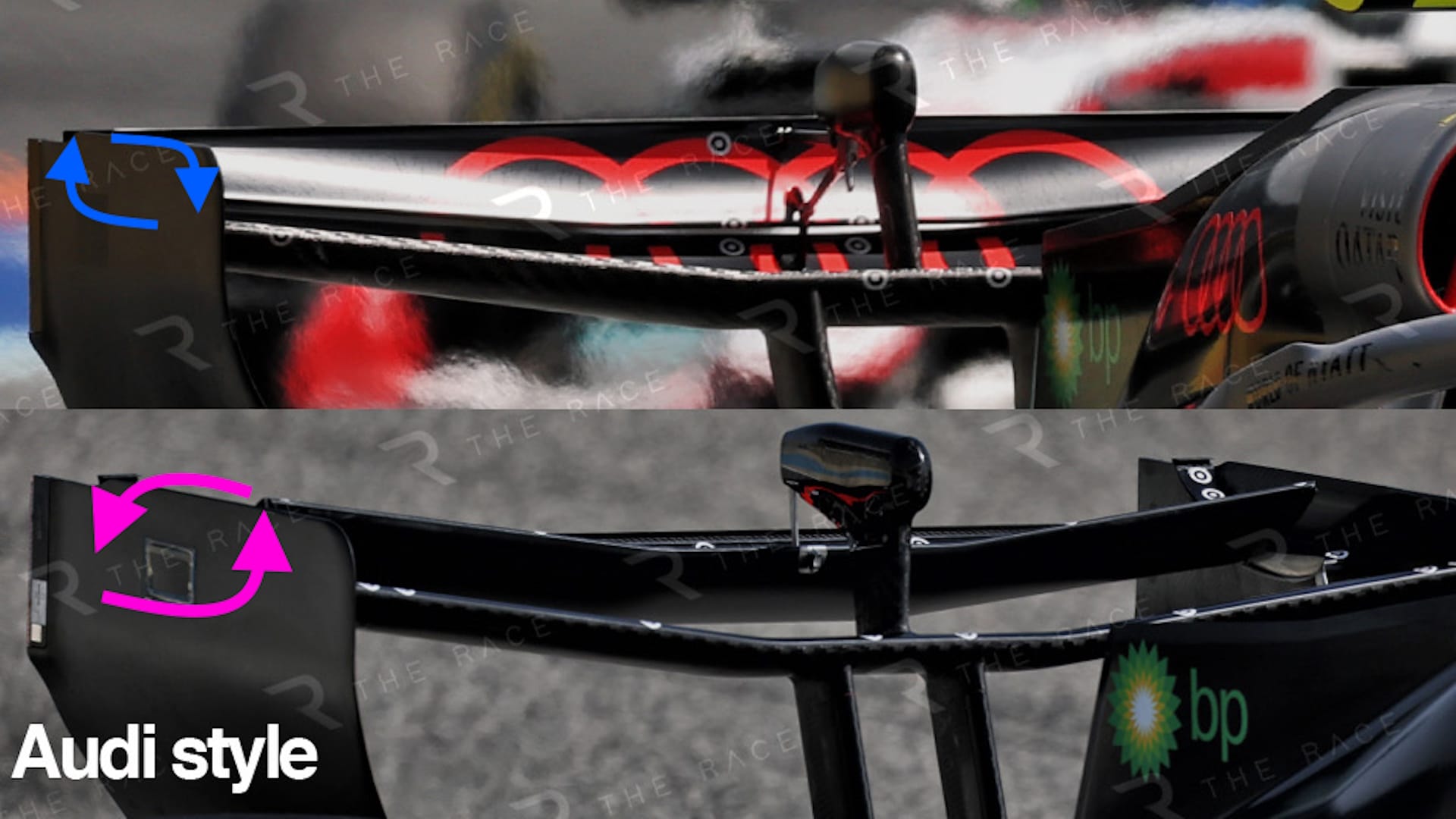
This is again a one-off, but I would call it a deviation of the Alpine concept. It is only used by Audi.
It reduces the angle of attack of the flap assembly by rotating the flap assembly around more or less its centre. When it goes to straight-line mode, it drops the trailing edge and raises the leading edge of the flap assembly, as shown by the magenta arrows. It does the opposite to go to cornering mode, again highlighted with the blue arrows.
So the big question is which concept is best? Well, if you simply look at poles, race wins and the points table, you would have to err on the side of the Mercedes concept.
That, together with the fact that the concept is simply an extension of the DRS concept, means Mercedes didn't start the season from a clean sheet of paper. It had knowledge and understanding of the wing's characteristics and had a mechanism to operate it fairly well defined, so didn't have to use a lot of research and design capacity to come up with a functioning system.
It will be interesting to see who heads in which direction for next year as this season progresses.