Gary Anderson's verdict on the real 2026 Williams F1 car
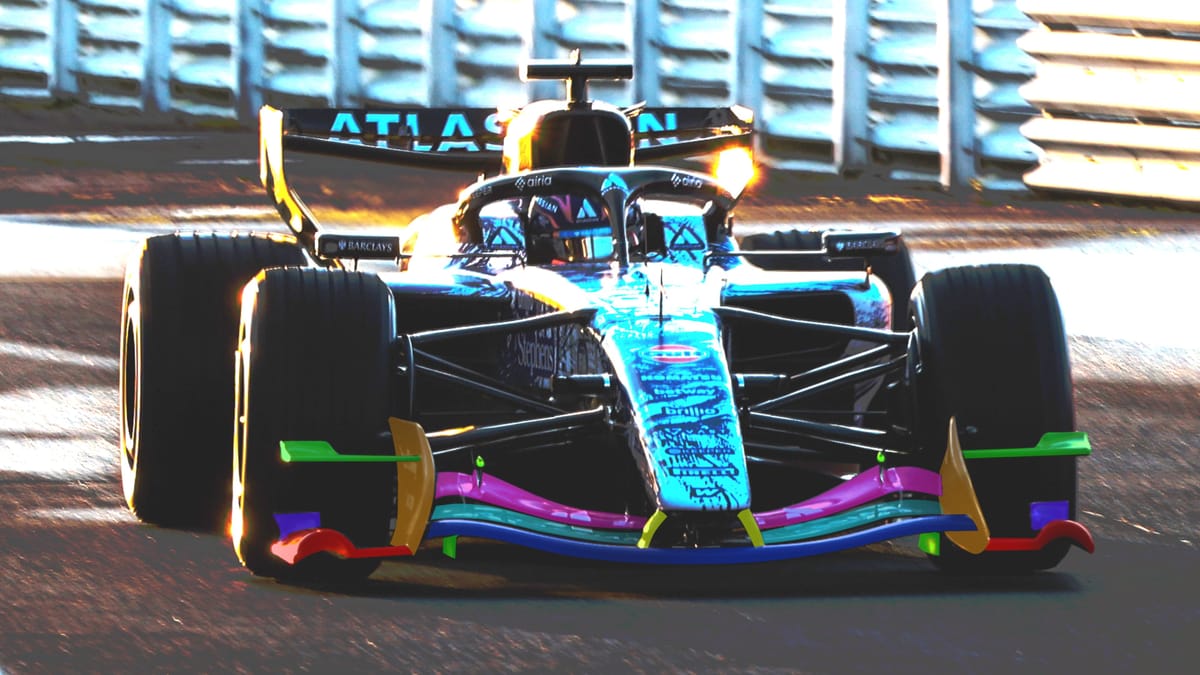
After missing the behind-closed-doors shakedown at Barcelona, then putting out a completely unrepresentative livery launch car a couple of days ago, Williams has finally run its 2026 Formula 1 car for the first time at Silverstone on a filming day.
It starts this season behind the eight ball, which wasn’t the intention last season when the team declared it was forgoing development on its ‘25 car to be well-prepared for this year.
In F1, planning and component manufacturing has become as much of a priority, if not a higher priority, than design time. It’s one thing that brought the initial success to Red Bull, as it was the first to recognise that it’s all well and good coming up with something new, but you need to be able to turn it around into components very quickly otherwise it will be superseded by the next great idea.
Being late with the new car means Williams is not there yet as far as that is concerned. Not getting the car ready in time and missing the first three days of running will have an ongoing effect on development through the season. The question is, how big will that negative impact be?
We only have one picture to go on, and we will see far more when the car runs in the Bahrain test next week. But there is plenty to see in this one image. As normal, let’s start where the airflow structure gets its initial flow deviation from.
The front wing endplates have the central horizontal fin, as highlighted with the orange ellipse below. Underneath that, highlighted with the yellow ellipse, at the end of the footplate tunnel is a ramp. This should increase the flow through that tunnel, improving the performance of the wing itself.
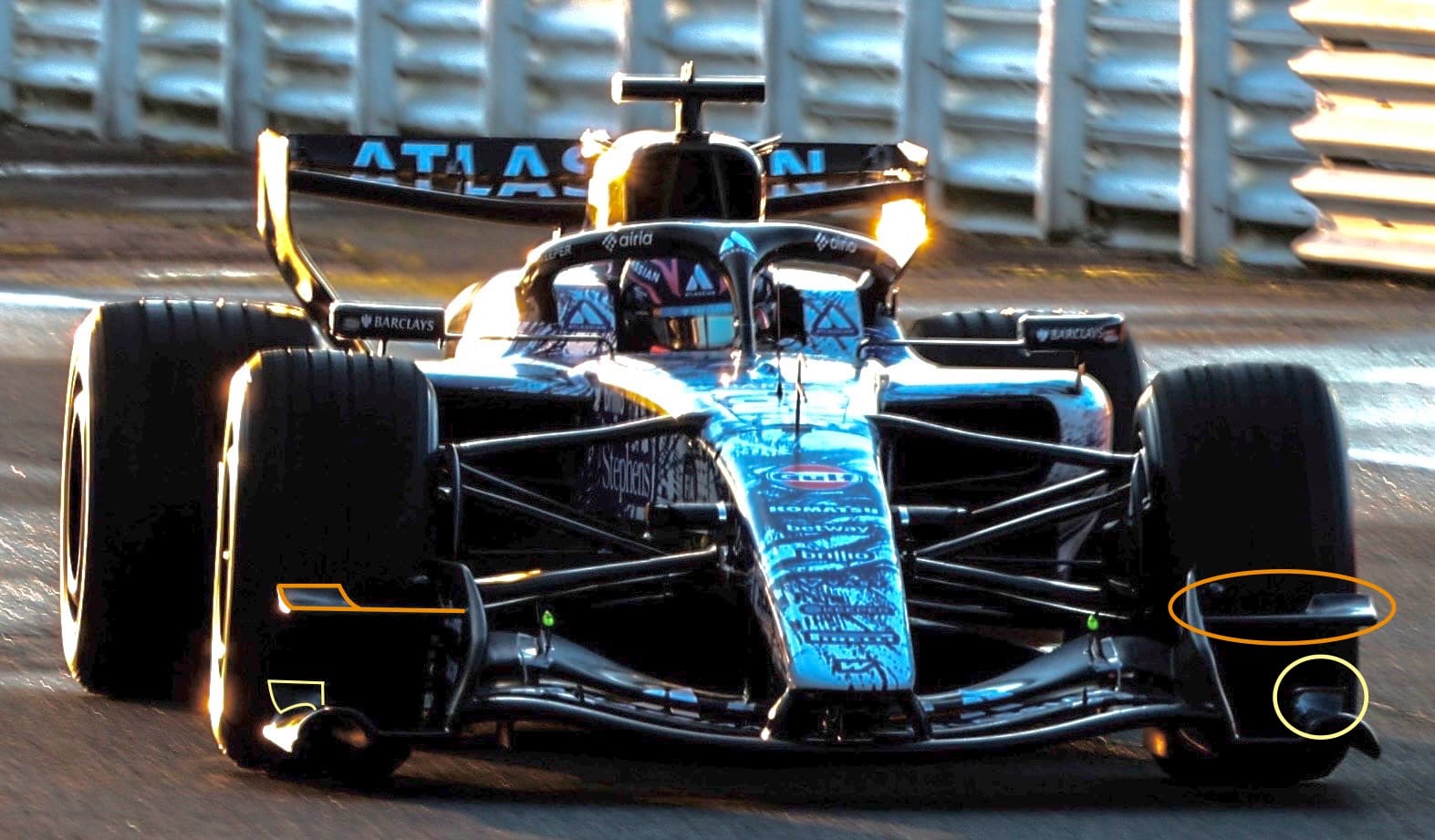
On the other side of the car, I have highlighted these components in the same colours above to show what the profile should do to the airflow. As you can see, the outer ramp on that central vane is only on the outboard end and vertically above the lower ramp. Both of these should work together, but will be influenced by the steering angle. This means they could be inconsistent due to varying corner radii.
The front suspension is interesting. It has stuck with the pullrod-operated system, which is highlighted in red. It also seems to have increased the anti-dive and is very similar to what we saw on the Aston Martin.
The top wishbone forward leg, highlighted in dark blue below, has its inboard pick-up point mounted very high. The rear leg, highlighted in light blue, has its inboard pick-up point mounted fairly low. It looks like, as with the Aston Martin, it’s a long way rearward, meaning a wide-based A-frame style wishbone.
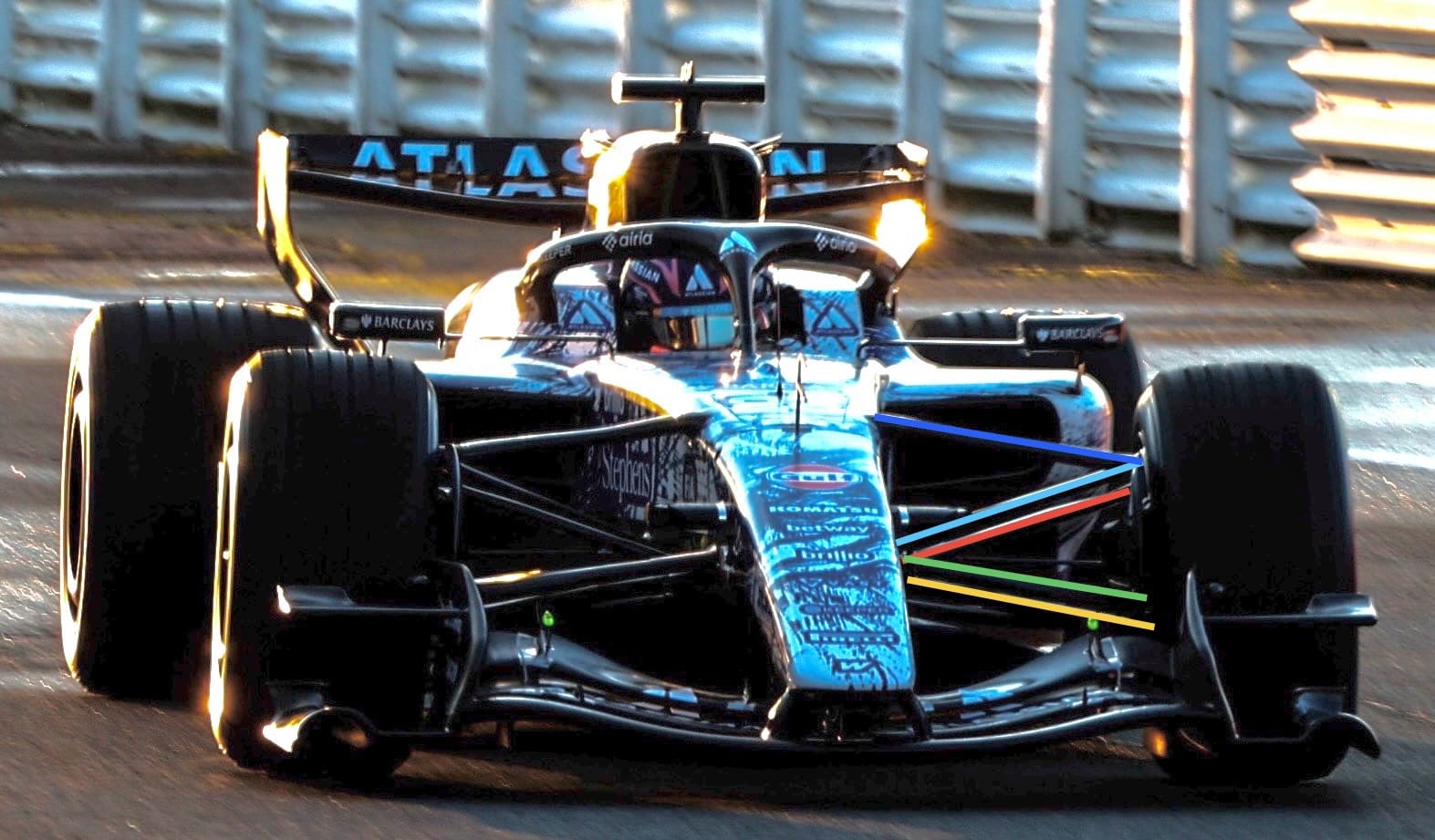
As for the lower wishbone, positioning-wise I believe (but could be wrong) that the forward leg is the component that I have highlighted in green above. To achieve a sensible suspension geometry, it runs at a similar angle to the top wishbone forward leg.
I can’t see the rear leg of the lower wishbone clearly, but if that front leg position is correct then the rear leg could mount on the chassis in the same area as the top wishbone rearward leg. That’s unusual, but as long as it gives a reasonable suspension geometry, it could save weight in the chassis structure.
If the wishbone positioning above is correct, then the trackrod could be the component highlighted in yellow. It also seems to show that it comes from behind the lower wishbone forward leg inboard mount position to forward of the lower wishbone outboard point.
As the outboard pivot points for the top and bottom wishbone are fairly central to the wheel and upright assembly, it would have to do this to achieve the required steering arm length on the upright assembly.
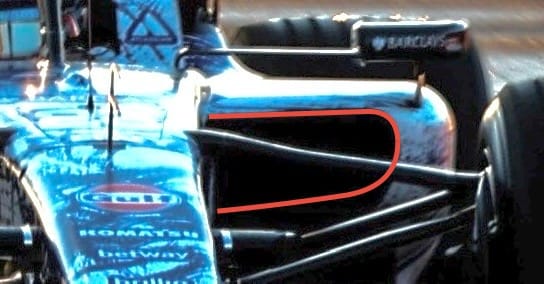
The radiator inlet is, to say the least, far from the smallest I have seen so far this season. So I’m not sure about this or why you would compromise the overall aerodynamic flow structure so early with this size of opening. I need to see more of the side profiles to see if it is working in conjunction with anything new in that area.
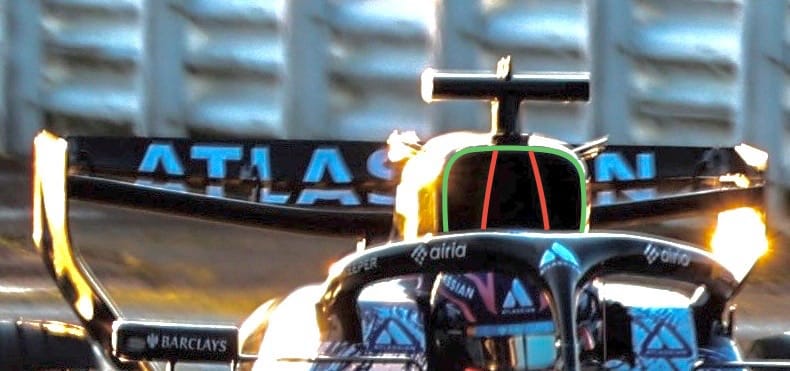
The airbox intake, highlighted in green with the roll bar structure highlighted in red going through it, is again fairly large. The combination of both these two intakes means Williams should have enough cooling capacity for the hottest of circuits.
If you are a mid-performing team that expects to be running in traffic for most of the race, a little extra cooling will do no harm. However, giving away too much overall aerodynamic performance in preparation for that could just ensure that you will be running in traffic.
It’s too early, and there are not enough real pictures, for an in-depth analysis on the Williams. However, I’m pleased to see it has not stood still on the front suspension layout. This geometry being very similar to what Adrian Newey instigated, or allowed to happen, at Aston Martin will give Williams confidence that it was not just a mad ‘eureka’ moment. Also, integrating it with the pullrod, in my opinion, is not wrong. Having said that, it’s all about breaking new ground for the correct reasons and not just because of a wild idea.
Roll on Bahrain testing. It's time to really see who has what up their sleeve.