The game-changer in F1's 2026 fuel revolution
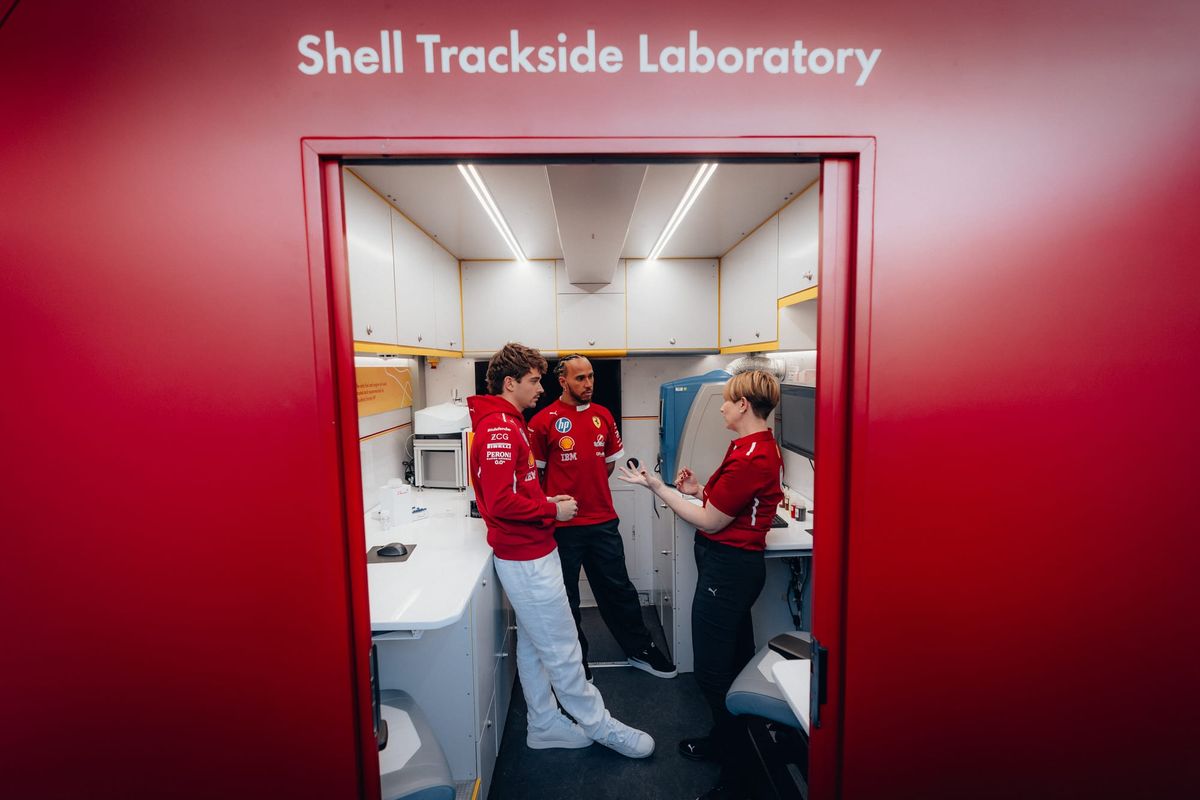
Presented by Shell
Shell’s partnership with Scuderia Ferrari HP in the Formula 1 World Championship stretches all the way back to the 1950 Monaco Grand Prix. The latest step in its remarkable journey of technology and innovation is the introduction of Advanced Sustainable race fuels in 2026.
History of Race Fuels from 1950 to today
So what exactly are Advanced Sustainable race fuels and how big a challenge is their development? Nobody is better placed to explain that than Shell’s Principal Scientist for Motorsports, Valeria Loreti.
"The major change for 2026 is that the molecules inside the race fuel need to be synthesised, manufactured or generated from advanced sustainable feed stocks. The big game-changer is where these molecules come from," says Loreti. "We have the freedom to choose the processes, the feedstocks and therefore what comes out of it.
"So we can use, for example, residues from the paper or wood industry, we can use residues from crops and agricultural waste, we can use municipal waste, we can even use recycled plastics.
"The important thing is that we need to measure the energy that is used to process the molecules we want out of the feedstocks. So there will be a calculation about the carbon intensity of the process from the feedstock manufacturing the molecules we want until blending. The FIA has set a limit that the new race fuel needs to save 65% or more greenhouse gas in comparison to a basic standard reference fossil fuel."
Shell and Ferrari: How the innovation partnership comes to life from factory to track
While the key change to the fuels is in the origin of the components and sustainability of the entire process, with the supply chain certified by the FIA, the fuel itself will ideally be similar to what is currently used.
"Ideally, if we were able to manufacture a fuel that has exactly the same composition as today, everybody at Scuderia Ferrari HP will be happy because we know that these molecules work very well in their engine."
However, there is the added complication that next year’s power units are dramatically different to this year’s. While still a 1.6-litre V6 turbo, there is a far greater reliance on the electrical power provided by the MGU-K. The MGU-H, which is currently attached to the turbo, is dropped entirely.
"Adapting our formulation to the requirements of the engine is one of our main goals," says Loreti. "We work like a tailor. We try to understand how the engine is designed and which molecules will fit its appetite in the very best way. It’s like designing a dress for a specific body and not just going somewhere in a retail store and buying one that may fit you. This special optimisation process doesn't really change.
"Our project started in 2022. As soon as the current fuel hit the track, we started with the new project. There was a phase of exploring and understanding what is available on the market and also exploring the gaps. What is it that we would like to have, but doesn't exist?"
"We consulted with experts on manufacturing, we consulted with chemists, people doing the optimisation of all the processes in manufacturing. We really leveraged the knowledge of a very big number of colleagues.
"We need to be imaginative. We need to look into new solutions, something that has never been done before, and find the best way to still deliver the same performance, the same efficiency and the required sustainability."
2026 F1 regulations: What will change and how the partnership will evolve
That’s exactly the kind of challenge that has made Shell’s partnership with Scuderia Ferrari HP such a successful one, and gives Loreti and her colleagues the enthusiasm to push the boundaries of technology.
"I like when there is a plot twist, when there are new regulations," says Loreti. "At the beginning, you think ‘now my life is so difficult, I have to start from scratch and think differently’, but that is what fuels the excitement. A new set of regulations, a new goal is raising the bar to make the game more difficult but also much more fun."