The accusation about Ford's F1 return it's most sensitive to
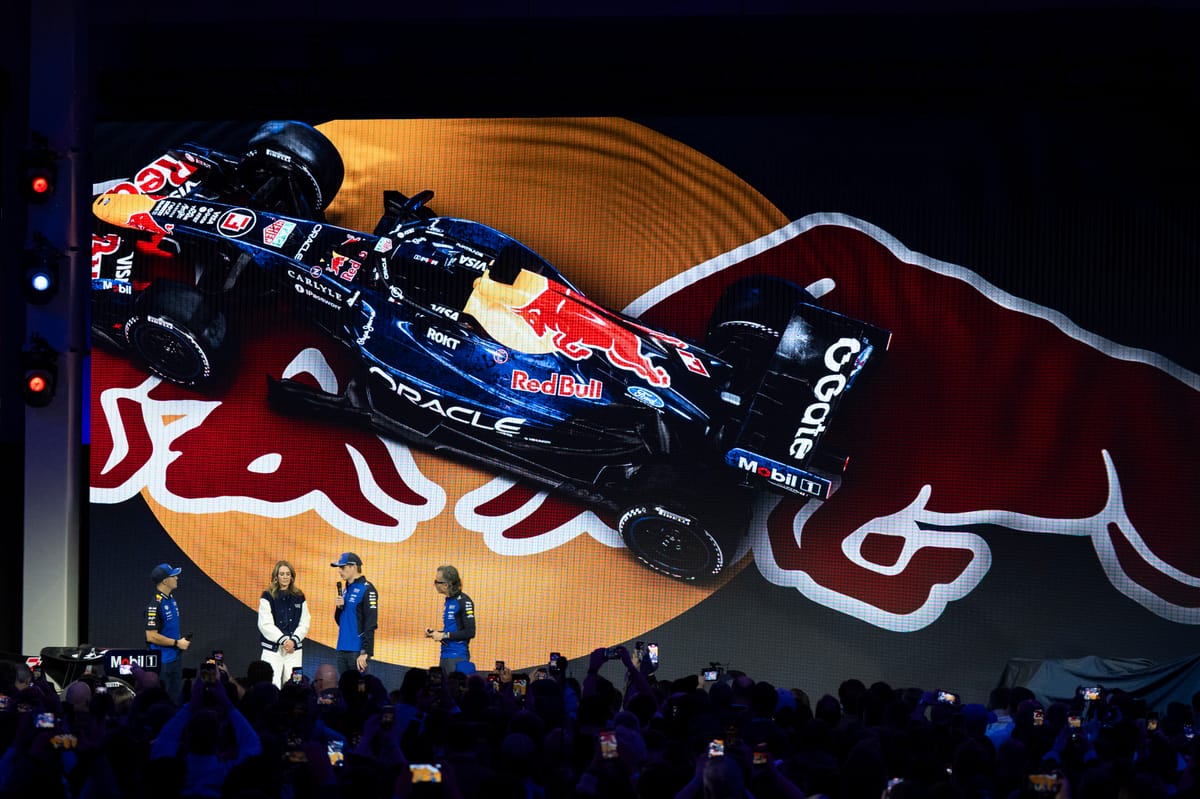
Around Ford's launch with Red Bull's two Formula 1 teams, it has become clear the American manufacturer is desperate to send a certain message.
With so much commercial and marketing clout associated with this partnership and that being fully utilised with the joint launch event, Ford's a very visible new partner.
An accusation it has been unable to shake, though, is that a commercial/marketing deal is all this is. One claim even goes as far as Ford paying tens of millions to have its logo on everything and provide fairly limited support.
Ford insists it is contributing to a real technical partnership in a substantial way. The sensitivity of the issue was made very clear by how badly Ford executives have taken a remark from US rival General Motors, which is also joining the F1 grid in 2026 with the Cadillac team it co-owns.
Last year, key Cadillac F1 figure Dan Towriss said Ford's Red Bull alliance was a "marketing deal with very minimal impact" while GM is "deeply embedded from an engineering standpoint and involved from day one".
This week, quotes from Ford executive chairman Bill Ford indicated that had gone down like a lead balloon at the Blue Oval. The Athletic reported Bill Ford claiming "the reverse is true" because Cadillac's going to be using a customer Ferrari engine for the next few years, and he doubted it would have any GM employees on the race team.
Meanwhile, his son, Will Ford, who is general manager of Ford Performance, claimed "nothing could be further from the truth, in terms of our partnership with Red Bull being a marketing effort" and that "we made a very deliberate decision to form Red Bull Ford Powertrains as a true technical partnership".
Red Bull Powertrains was actually formed entirely on its own basis. The company's technical director Ben Hodgkinson even said ahead of Thursday's launch event that "when I first got involved, Ford weren't in the picture".
The factories were built and the first version of an engine had been developed before Ford got anywhere near the project a year later.
But there was always the possibility of a manufacturer tie-up and to give Ford the benefit of the doubt, two things can be true: that Red Bull Powertrains was set up to be its own thing, and that Ford wanted its alliance to be 'formed' as a technical partnership.
So, as the company's gone about developing its first F1 engine, building three factories, recruiting around 700 people and working through six generations of engine design in the process, how much has Ford really done?
When the partnership was struck, the suggestion was Ford may have some input into the energy recovery system, with the uprated battery and enhanced MGU-K requiring significant investment and ingenuity. The reality is not quite so involved.
But there are some Ford engineers embedded within Red Bull Ford Powertrains and Ford also played a part in filling some holes in the recruitment process, which Hodgkinson called "very valuable indeed" - as is assisting with helping secure parts for the electrical part of the engine.
"The fact that they wanted to get involved was a real vote of confidence in where we'd got to actually, because they could see what we'd done in not much more than 12 months, and wanted to be part of that," he said.
"But it was really important to Ford that they did it as partners, and so we have got a few of their members of staff on site. One of the biggest challenges I had with putting everything together was finding that number of experts in such a short amount of time. It was a real challenge and I definitely had some holes that Ford tried to help me fill.
"And then Ford's manufacturing capability, I've exploited some of that, for sure. The direct metal laser sintering [allowing 3D printing with industrial metal] in particular is something they've helped me out with. It replaces castings effectively and allows me to turn parts around much, much quicker than if I use traditional suppliers.
"So they've been very useful indeed."
More from the Red Bull-Ford launch
- 'Unstoppable'? How Red Bull/Ford engine project is really going
- Gary Anderson: What Red Bull showcar tells us about F1 2026
- What we learned from surprising launch
- Red Bull's 2026 F1 power unit on 'very limit' of the rules
Some of that sounds plenty useful and both sides are adamant there is more collaboration than what is implied by critics, who say Ford's given Red Bull a load of money, a big printer, and a few spare employees.
What will define the partnership, and how real it is beyond a glorified sponsorship deal, is its longevity and success. If Ford remains involved for many years there is always the possibility of a deeper collaboration and more tangible evidence of its involvement. Which it will eventually need to offer if it insists on being taken seriously as a technical partner.
After all, while its rebuttal to Cadillac is that there are no GM personnel involved in that race team, the development of a works engine for the end of the decade is a clear statement of intent that - if it comes to fruition - will result in a tangible GM-associated product. Will the same be said for Ford in a few years time?
Perhaps the more pertinent question though is should Ford be super-involved?
Its F1 record is split quite neatly between 'successful when it pays a partner a load of money to badge its engine' (think Cosworth DFV) and 'unsuccessful when it is directly involved' (the Jaguar F1 team debacle that was ironically Red Bull Racing's predecessor).
That is a slightly glib oversimplification, but the point is: maybe Ford's better off embracing life as a limited partner and focusing on the bigger picture than the occasional vulnerability in terms of the optics.
The Red Bull deal is the best way for Ford to get a slice of the F1 pie without risking a massive investment with no guarantee of success.
Even if it means some people think Ford's just paying a load of money to effectively sponsor the F1 team it sold two decades ago.