

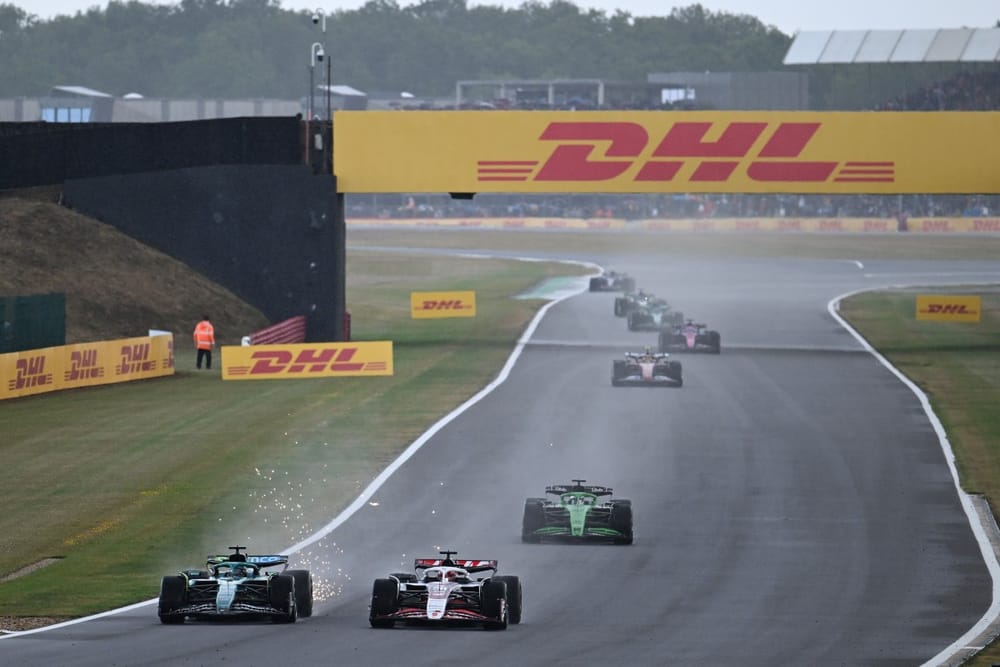
Formula 1 is to introduce a new ‘partial’ aero mode next year as part of an effort to head off concerns about safety and technical problems with the new active wings in wet conditions.
Ahead of a rules revolution in 2026 when all-new power units will be twinned with brand new cars which feature concepts that have never been used before, some final details have needed to be sorted out.
One of the big headaches that emerged as teams got to understand the implication of the new rules in simulators was potential problems caused by new active aerodynamics.
From 2026, in a bid to minimise drag and the rolling resistance of tyres on the straights, cars will feature wings that go flat in set activation zones. The wings will then flip back to a high angle of attack for maximum downforce in the corners.
These were originally labelled as X-mode and Y-mode, were subsequently renamed straightline mode and cornering mode, and now look set to simply fall under a banner of being known as ‘active aero’.
Two key complications emerged with the straightline mode, however, relating to what would happen if races were suddenly hit with wet weather.
The first was that if straightline mode was deactivated by race control on safety grounds, then that could lead to cars experiencing higher downforce on the straights than teams had prepared for.
This would then open the risks for teams to experience their cars being pushed closer to the ground at high speed – potentially rubbing their plank away and risking disqualification.
The other issue which was raised related to the performance of the cars in straightline mode if there was a dramatic reduction of grip – such as in damp conditions.
With the way teams are optimising their wings for straightline mode, they want to shed as much drag as possible – so this effectively means aiming for zero downforce on the straights.
However, simulation runs by teams had shown that a combination of a low-grip damp track and any high-speed kinks on the straights – as are experienced at tracks like Melbourne for example – effectively risked cars understeering easily off the track and crashing out if the wings were not in corner mode.
These two elements of straightline mode effectively called for a more varied approach in terms of what worked best for teams in changeable conditions.
Following discussions between teams and the FIA, a solution has now been put in the rules that gives race control freedom to ensure that straightline mode works in a way to avoid both technical and safety problems.
The first is that as well as there being a straightline mode and cornering mode for the wings, where both front and rear flaps move, there will now be a partially activated mode where the wings are in different configurations.
As detailed in the new F1 sporting regulations, this partially activated mode will feature the front wing elements being in straightline mode (so down) and the rear wing flaps being in cornering mode (so up).
If race control deems that conditions are too dangerous to allow straightline mode to be used, then it can disable full activation of the wings for any period.
Should conditions improve, then the race director will have the ability to allow the next step to be the partial activation.
This will be done in conjunction with the implementation of different length activation zones for different conditions.
Ahead of each race weekend, the FIA will lay out the areas of the track where drivers can activate their moveable wings.
There will be an Activation Zone area for when full activation of the aero modes is allowed, and a shorter one when only partial activation is allowed.
As an example, the FIA could allow a partial activation zone to be enabled after any kinks to avoid any trouble in going through there in low-grip conditions, while also ensuring that downforce levels the cars experience are not extreme at the end of any subsequent straight.
Red flag tweak
As first revealed by The Race, the FIA has also approved a plan for 2026 to extend the first free practice sessions at sprint weekends in the event of a red flag.
The details of this have now been finalised in the regulations, with a new article stating that if there is any stoppage in the first 45 minutes of FP1 then the session may be extended so it runs to the full hour.
This move is in response to concerns that some teams had about a lack of preparation on sprint weekends if they lose a lot of time in practice because of session stoppages.
Another minor tweak to the rules is that in poor visibility conditions, when the safety car is out, the race director can now give drivers permission to increase the gap between competitors up from 10 metres to 20 metres.
