What's new about Ducati's 2026 MotoGP bike
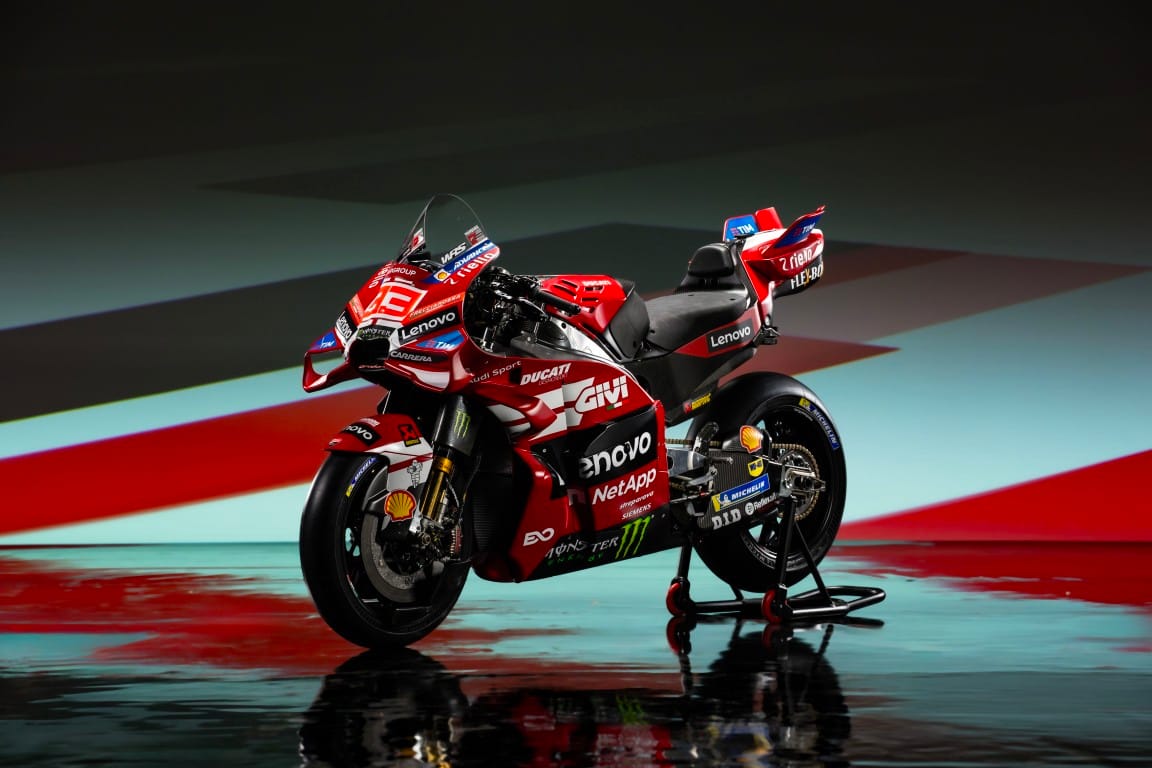
Ducati technical director David Barana has revealed some of the secrets and improvements that the Italian manufacturer hopes will retain its MotoGP dominance in 2026 as the series prepares to end the current rule cycle.
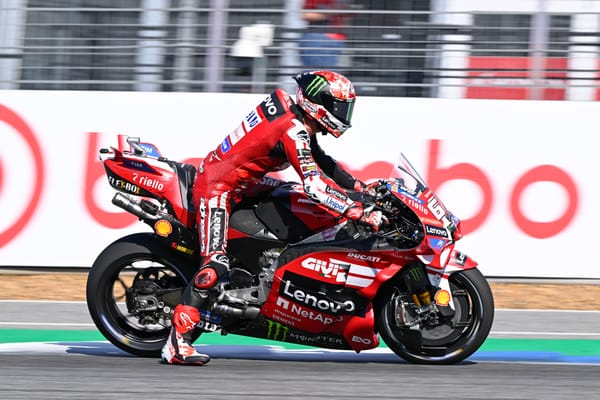
Speaking to The Race among a small group of journalists ahead of Monday’s team launch in Italian ski resort Madonna di Campiglio, Barana and head of data analytics David Attisano laid out the priorities they’ve been concentrating on in developing the GP26 machine after an unusual 2025 campaign in which Marc Marquez dominated but other Ducati riders, including his team-mate Pecco Bagnaia, struggled to come to terms with the bike.
With vibration and stability problems throughout the latter half of the season that left Bagnaia in particular completely lost, Barana says that the team’s 2026 goal is to address those issues while still trying to increase performance elsewhere.
“Our aim is to improve the bike to increase the gap,” he explained. “And to do that, we worked on multiple fronts.
“It would be a big mistake to think that your bike has a big problem and once you solve it, you gain a big advantage. The current MotoGP bikes are very complex, and it's very unlikely that you find a big gap in a single area.
“We wanted to improve the chassis. In the last season we collected a lot of complaints about vibration. Vibration has become more and more a matter because probably the increase of performance has pushed the tyres at their limit, and we see more and more vibration problems, chattering.
“And we'll bring some new components in order to calm the behaviour of the bike. And not only vibration but also stability of the bike, in certain circuits, for example the fastest ones, like Phillip Island or Assen, we have suffered stability problems.
“Not only Ducati probably, it's a characteristic of this type of circuit, but certainly it's a point we have worked on.”
But while those complaints that they’re trying to address may have been most vocally aired by Bagnaia, Barana is adamant that it’s not specifically an issue of the two-time MotoGP champion but more something that they’re keen to address for all of the Ducati line-up.
“Being honest,” he said, “certainly Pecco complained - but not only Pecco, also Marc, and also the other Ducati riders. We have six riders on track, and for what I know also our competitors suffered a lot.
“So... we know, for many years, vibration, chattering expired. But the last two years they came back. Probably because of the tyre, because of the improvement of performance - probably both.”
While engine development is frozen for 2026 as a cost-cutting measure ahead of the introduction of 850cc engines in 2027, Barana is also confident that there’s room for improvement there, too, as Ducati uses its aerodynamics expertise not just to work on the bike’s wings but also to collaborate with technical partner Lenovo and to use its computational power to redesign key components of the bike’s air intake system.
“The target was, first, increase straight performance,” added Barana. “Acceleration and top speed. Because this is the easiest and safest way to overtake. To do that, we worked on aerodynamics and we worked on engine performance.
“You know that this year the engine development is frozen. But of course we can work on the three components that are not under the seal of the engine - for example, all the air intake system, the snorkel and the airbox, this component can affect a lot the performance of the bike, not only for the pure engine power but also for the efficiency, combustion stability, throttle response.
“We worked a lot on improving this component - by simulation, CFD internal simulation, and also here thanks to the HPC [high-powered computing] solution we've been able to run a lot of shapes and geometries in order to finetune the solution and minimise the solutions that we [then] have to test on dyno.”
There’s another novel way in which Ducati has been working with Lenovo behind the scenes as well - by building its very own internal version AI chat bot in order to better problem-solve issues with the bike over race weekends.
Built as a natural language chat bot similar to commercial versions like ChatGPT, Microsoft’s Copilot and X’s Grok, but with Ducati’s data and knowledge library used to educate it, the team its hoping that it’s another weapon in its arsenal.
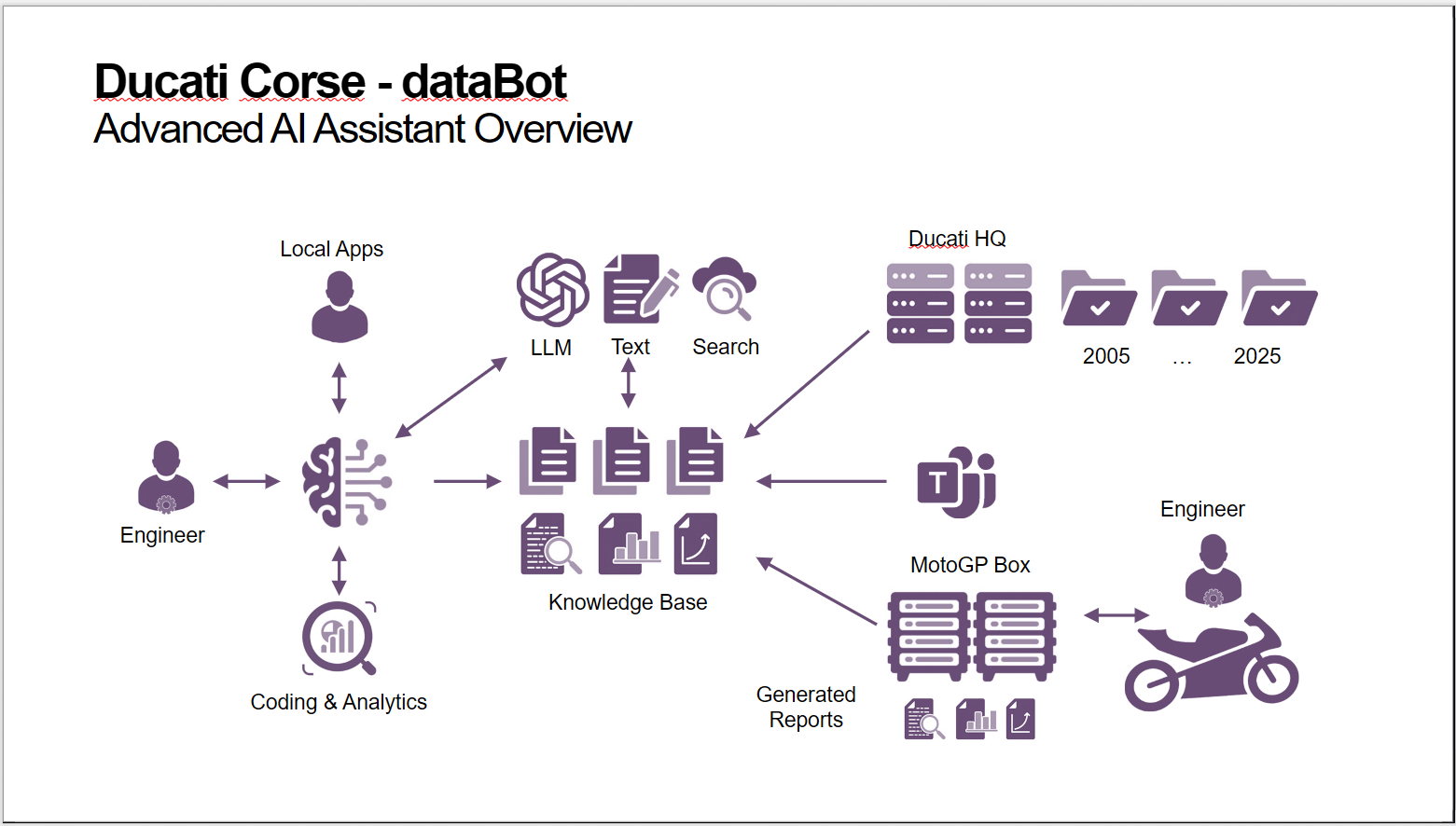
“It’s an idea that comes from the spread of chat bots and natural language interaction with technology,” Attisano explained. “We tried to figure out what is the best solution for us, and realised that we can make a fusion between our expertise and technology.
“The great advantage of this is that you can have something that is applied on our data, our records, our base knowledge. Natural language interaction is very user-friendly, and you can write to it and get an answer that can be a sentence, a graph, an image or a video, or an engineering record.
“What we would like to do is give to our engineers on track access to all the knowledge of Ducati to speed up their work when they have to give feedback or our technicians or our riders.”