

There's an old saying in motorsport. Stand still and you go backwards.
Formula E Operations, the promoter and organiser of the world's only all-electric global competition, is all-too aware of that adage right now.
That's because in the final season for the respected but, let's face it, little-loved Gen3 car, Formula E is pushing a split agenda, with a flicker of an eye on the present and a focused stare on the future.
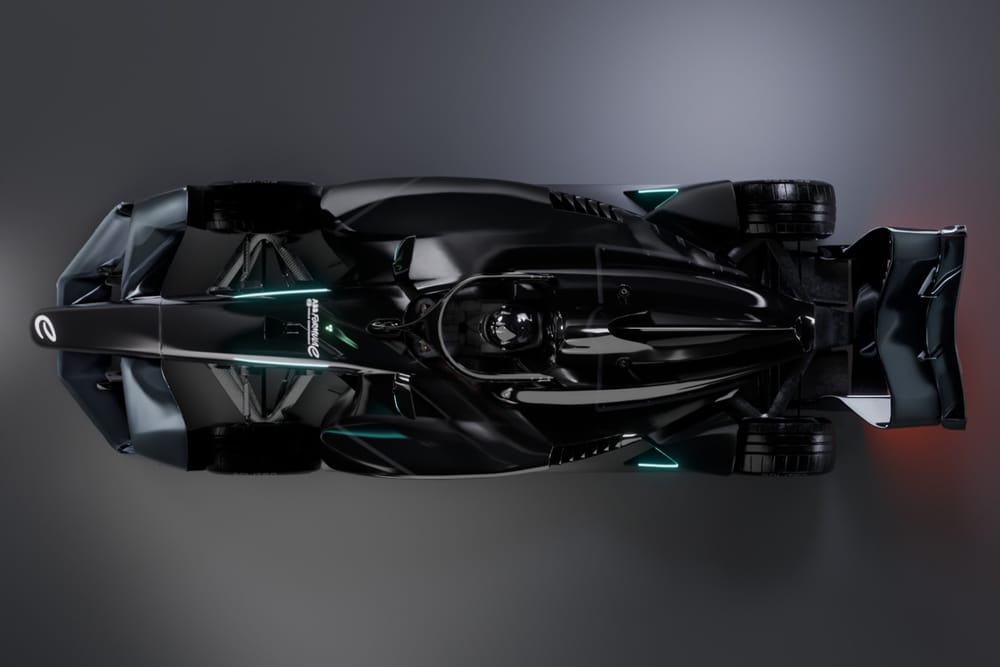
Gen4, the era that will begin at the end of 2026, will be a huge occasion for Formula E. It will herald a significant advance in pace and spectacle. With that will come massive challenges on the racetrack but perhaps more profoundly off it.
The present year is therefore essentially a building one for Formula E, towards Gen4, a ruleset that is developmentally already in a much better place than its Gen3 predecessor. That is largely thanks to a controlled and pragmatic approach in its overall architecture and also longer lead times in getting the project off the ground.
The Gen4 car, in mule form, tested for the first time in April 2025, fully 20 months before it was expected to race. Now, there has been a healthier chunk of time to prove it, to make it reliable, and to make it much quicker than the Gen3 model.
Skip back four years and the Gen3 car was in a dark place via accidents and supplier issues. It is without question that the pandemic and the circuit-breaker of supply-chain problems contributed to the malaise, yet so too did poor and confused project management. It is clear this has now been addressed by the FIA and Formula E. It had to be.
"We want the [Gen4] car to come out of the blocks like an absolute beast and for everyone to go, 'Oh my God' and stand up and take proper notice," Formula E CEO Jeff Dodds boldly told The Race last month.
Dodds will also want a full grid of cars, something which only six months ago looked very unlikely indeed. Now, with Porsche doubling up and Stellantis expected to bring in a new brand, probably Opel, 24 cars looks a very real prospect indeed.
"Clearly, as many teams, cars and drivers are on track then it is something I am pushing for as [much as] is humanly possible," added Dodds.
Can Gen4 be contained?
The expectation for the Gen4 car is that it will sit on pace somewhere between Formula 1 and Formula 2. Think of it as a kind of global, Super Formula-type machine (in appearance, in addition to pace).
Taylor Barnard's 1m26.315s lap during qualifying last May was the fastest ever recorded around Monaco in a Formula E car. Still, that was over five seconds off Alex Dunne's F2 pole position time made just a few weeks later. Lando Norris's 1m09.954s pole in Monaco was 16.361s faster than Formula E's best.
This is interesting but not useful, particularly with the F1 match-up. The discrepancies between F1 and Formula E are so vast on every level that they are barely worth even attempting a comparison. What is much more interesting is the F2 evaluation.
That five seconds will likely not just be matched but considerably overturned at Monaco in 2027. That's when a lot of Formula E's doubters may also be rethinking.
But here is the crucial point: Formula E must also retain its raceability around tracks such as Monaco if any comparisons transition from mere stat-tastic headlines to actual take up by new fans.
When Formula E went to Monaco - the proper Monaco Grand Prix circuit - for the first time in 2021 it felt like it had blossomed from sluggish caterpillar to nimble butterfly. The racing was fantastic and it produced a classic when Antonio Felix da Costa, Mitch Evans and Robin Frijns fought tooth-and-nail over much of the race, evidencing nooks and crannies like Massenet and Tabac as legitimate overtaking areas.
All of this is relevant because the FIA and some Formula E teams use Monaco as a kind of benchmark when it comes to simulation, of which they do plenty.
There's some irony in this because Monaco sits outside of rational thinking when it comes to a venue hosting races, and it is loved and loathed in almost equal measure.
No one can deny the spectacle of simply having a race there, as much as one can't ignore the huge marketability and commercial reality of having to be there. But when it comes to actual racing, for F1 it's a problem and produces very little in the way of excitement.
But what is F1's loss is Formula E's gain. The Gen4 cars must keep the sporting spectacle, otherwise it will become just another racing series, something which even its most virulent hater cannot accuse it of ever being.
By logic, if Monaco is OK for F1, then it's OK for anything else, bar sportscars perhaps. So, its place on the calendar is absolutely assured in Formula E.
But what of Sao Paulo, Tokyo and London, three other important events that make up the Formula E calendar?
The first is likely to again be the first race of the new era in December 2026 but its nature as a confined street track brought some quizzical eyes last month. This was especially so after Pepe Marti's accident under a full course yellow.
This was a spectacular accident but not one that was overly worrying. But Pascal Wehrlein's a year before was. That was when the Porsche driver impacted the Turn 6 wall, halo-first, and although it was a relatively low-speed shunt it still rammed home the fact that street circuits don't need speed to offer up a big accident.
Shunts happen everywhere but big brawny single-seaters on street tracks bring bigger risks. With Sao Paulo having several big stopping areas, its environs will at least be looked at and potentially broadened. The good news is that the Anhembi Sambadrome does have some room for manoeuvre.
Tokyo similarly has some space for modifications and depending upon its contractual status, which will come to a head in 2026, it is expected to remain as one of the jewel-in-the-crown races for Formula E.
London is clearly an issue. Most perceive it to be the perfect finale location for the season and it has had date equity in that regard every year, bar 2022 when the single Seoul event took place, since the ExCeL was added to the calendar for 2021.
But the difficult practicalities of racing in the ExCeL have been seen in recent seasons with limited overtaking and snarl-ups that have bordered on the farcical.
The problem area is the Turns 3-6 section of the track and in the early phase of that combination any modifications structurally are impossible. The unique inside and out configuration lost its novelty value a few years ago but one and all are reminded of its tight confines every time the cars hit the track. It's like trying to do a Pilates session in a lift.
So where else will Formula E race?
The solutions are limited though for London. The days of putting on a Birmingham Superprix-style event are probably over, therefore Silverstone or Brands Hatch appear to be the favourite plug-in options.
The Race can reveal that Formula E visited Brands Hatch late last year but questions remain about the infrastructure in the paddock at the Kent facility. The one bonus of Formula E heading to the former British GP venue is that it could just about get away with a London E-Prix moniker; it is less than five miles from the M25 motorway, often cited as a de facto boundary for Greater London.
Additionally, Formula E has long since been talking to Zandvoort and Imola, as well as pursuing a long-lusted-after second race in the US.
For Dodds, the "heightened anticipation around the Gen4 era" means a "bigger calendar, a lot of consistency, but some added premium events going into the calendar and more people tuning in".
Getting the final part of that wish is no easy task. In a crowded racing space, Dodds and his teams have to continue to stand out from the crowd, something which, to be fair to them, they have managed to do in the last few seasons.
Future-proofing
Formula E Operations feels like an organisation which is metamorphosing, perhaps in conjunction with the hardware itself. In Mexico City, its new chief media officer Michaella Snoeck will start her new role after joining from F1 recently.
The Race also understands that chief revenue officer Tiziana di Gioia, who joined the world championship from Juventus FC in early 2024, is no longer with Formula E.
Changes are in the air, which feels natural as what one of Formula E's founding fathers Jean Todt always described as motorsport's 'growing child' starts to mature into a much stronger independent adult.
"It's a massive jump. And we have to harness that changing car to use the opportunity to bring as many new people into the mix as we can," said Dodds.
"So obviously retaining all of our existing fans is important, but this is our moment to attract other motorsport fans that maybe came and looked at Formula E in season one or season two [between 2014 and 2016] and thought, 'Oh, it's all right, but it's not for me, it's just not operating at a level or a speed that excites me'.
"I think Gen4 changes that."
