

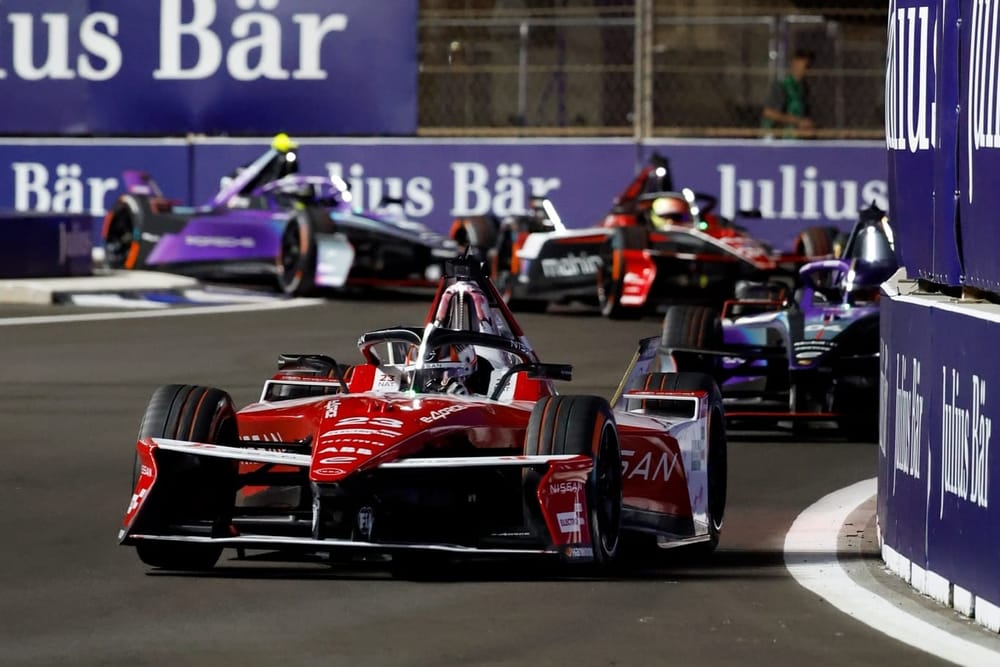
Whatever particular taste you may have in motorsport - and Max Verstappen made his viscerally known last week - Formula E is going to become a much sturdier little brother to Formula 1 in the coming years.
That's not just the forecast of Formula E CEO, Jeff Dodds, who reckons that Formula E in its Gen4 guise will ramp up some serious rivalry with F1; but it is also why major manufacturers such as Porsche, Nissan, Stellantis (with Citroen and, most likely, Opel) and Jaguar have committed to the Gen4 ruleset between 2026 and 2030.
The initial sparks of Formula E's technical maturity are being seen right now via a curious little prism that twinkled across from the Bahrain F1 test and the Jeddah Formula E double-header last week.
Those well-reported comments by Verstappen caused discussion and opinion to ferment in both paddocks simultaneously. Formula E, rightly, capitalised on it. It has a great story to tell technically and it had every right to parry the ever-so-slightly snooty Verstappen comments, and let the world know that it has been developing cars that are extraordinarily difficult to drive for many years now.
How difficult are they? Ask the likes of Stoffel Vandoorne, which The Race did last week, and they will give a demonstrative outline of how Formula E cars require a notional 'degree level' of intellect and aptitude to get the best from.
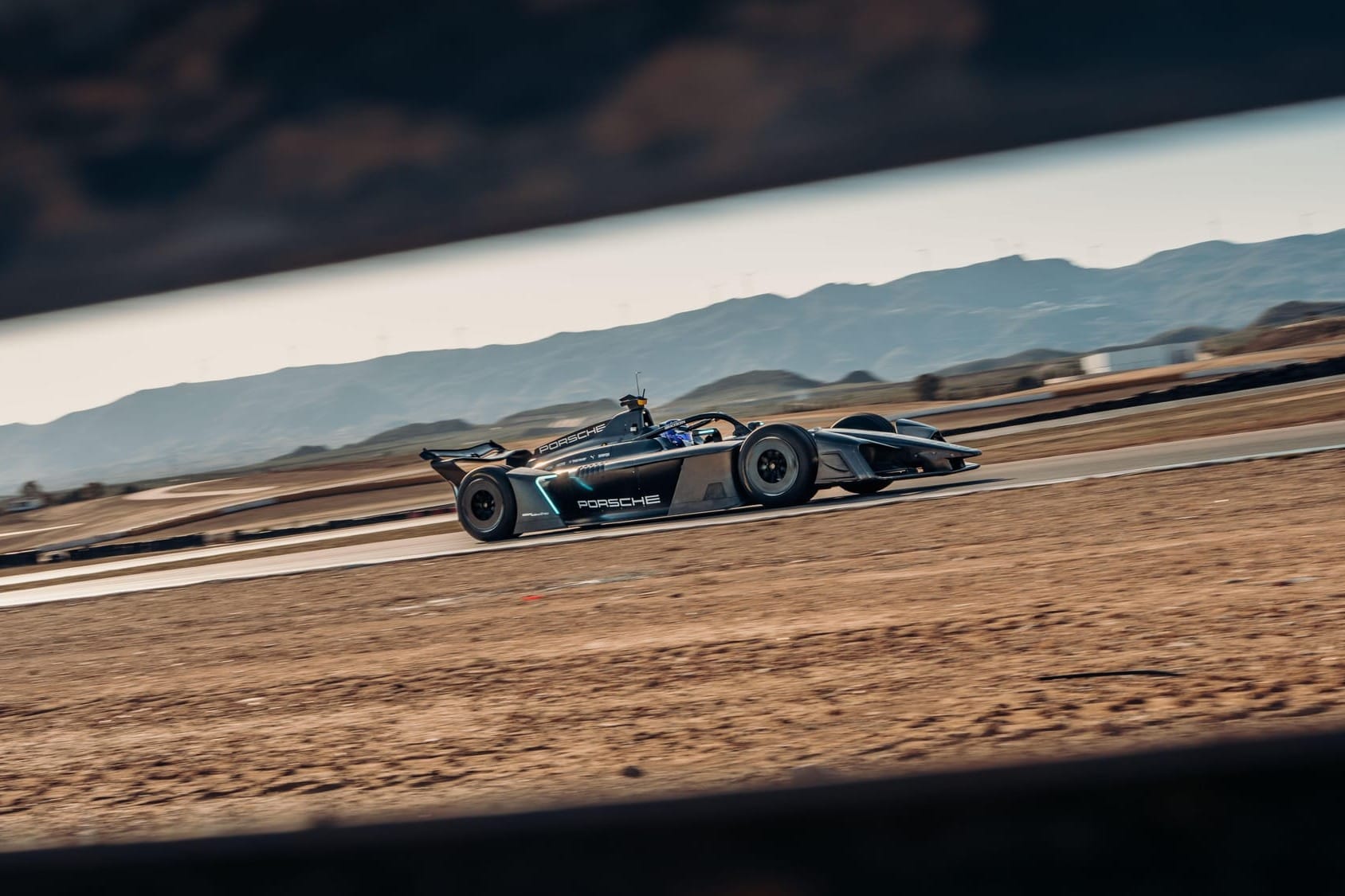
That apart, Formula E is about to launch its fastest car yet, the Gen4. This will be a game-changer in performance for Formula E and help take it to another level of acceptance, not only from the motorsport world but also in its desired crossover into what it dreams of becoming: a tier-one sporting spectacle.
On Verstappen specifically, Dodds conceded the obvious that the four-time F1 champion is a "purist".
"In the '80s and '90s, they [drivers] were always preserving something, always trying to optimise tyres, fuel, whatever it was. These guys now are optimising energy, and they're about to have to learn that in Formula 1 now," Dodds told The Race in Jeddah last weekend.
"The thing I love about Max is he just says what he thinks. But is anyone surprised that trying to compromise two technologies together, in a combustion engine and a battery electric vehicle, is going to create some challenges and some different styles of driving required?
"So that's the bit that really fascinated me. Because we all knew the [F1] car was going to be slower."
F1 is getting slower and Formula E will soon get faster. The Gen4 car should eventually be at least a couple of seconds a lap quicker than Formula 2. But the Evo version of the Gen4 that will arrive in late-2028 could, if the FIA and Formula E allow it, have further technical elements that allow for big chunks of laptime to be sliced off again and again.
All of a sudden, Formula E will get to Super Formula levels of performance, itself not that far off F1 pace. Approximately, those domestic single-seaters lap Suzuka - the track where comparisons are possible - seven-to-nine seconds off F1 cars.
F1 and Super Formula compared
Best 2025 pole
F1: Max Verstappen 1m26.983s (April)
Super Formula: Ayumu Iwasa 1m35.736s (November)
Best 2025 race laptime
F1: Kimi Antonelli 1m30.965s (April)
Super Formula: Ren Sato 1m38.083s (March)
If these F1 cars are, give or take, four seconds a lap slower now, then it starts to look pretty close. And all this too with Formula E cars not using slick tyres.
Also, the all-wheel drive on Formula E cars make them super-potent on traction in the wet. Could it be that by the time the Gen4 Evo is in use, it's a match for - or faster than - an F1 car around Monaco in greasy conditions?
Formula E isn't taken anywhere near enough as seriously as it should be. The old tropes of the lack of noise, and perceived spectacle, still ramble on. Yawn.
Added pace brings added spectacle and enhanced respect. Formula E will start to garner that in great swathes in the next few seasons.
A matter of taste?
"We always thought the shift to 50-50 [the rough split between internal combustion and electrical power in F1 this year] would reduce the speed of the car," Dodds told The Race.
"Just the power-to-weight ratio was challenging. If they were to go beyond 50% all they're doing is making the car slower and slower and slower over time. That's largely what the maths will tell you is going to happen.
"There's a bit of me that thinks Max referencing Formula E for its energy racing, and what he's really saying is, 'If you want to race this style of racing, go and drive Formula E'.
"It's not to his taste, and of course, what Max doesn't know is what the Gen4 will be like. Because if we were to sprint race the Gen4 car - all-wheel drive, 600kW, it will be still 30% faster off the line than a Formula 1 car - I think Max would be pretty surprised at what that car is capable of.
"So, it could be really to his taste."
Verstappen is friends with several Formula E drivers and socialises with some of them such as Antonio Felix da Costa, Norman Nato, Mitch Evans and Stoffel Vandoorne. He will know about the intricacies of how best to manage energy from an MGU beyond his own experience in the previous ruleset. It's just that in practice he does't feel it matches with his own philosophy of racing just now, or perhaps ever.
That's fine. This radically new F1 will likely be an initial mindset thing: the shock of the new, etc. Just like it was when Felipe Massa and Esteban Gutierrez came to Formula E and ultimately failed to make an impression. But for every Massa there is a Jean-Eric Vergne, a Sebastien Buemi, or a Vandoorne.
Verstappen will adapt and win because that's what all of the greats do. Juan Manuel Fangio did it from team to team in the 1950s; Jim Clark did it with technical innovations, via Colin Chapman, in the 1960s; and Ayrton Senna did it with turbos and then both V10 and V12 normally aspirated engines in the 1980s and 1990s.
"To allow us over the coming years to have technology that could surpass Formula 1 in terms of performance for a fraction of the cost and obviously a fraction, fraction, fraction of the carbon emissions and everything that goes with it, I think it's amazing technology for racing cars," argued Dodds.
The industry warning
All this might seem idealistic and to some no doubt even fanciful. But it's a reality that Formula E will get quicker and more incrementally so than F1 in the coming seasons.
But there are caveats of course. One clear one is that Formula E has next-to-no aerodynamic development. The cars of course generate downforce but compared to F1 it is next to nothing. It is for a good reason: to manage costs. Formula E is cost-capped to a €28million maximum spend (minus marketing) over two seasons for teams and manufacturers. F1 runs to $215m - approximately €185m - this season (though it has been increased significantly to account for the new regulations).
Another hurdle for Formula E is the current uncertainty from manufacturers on backing the aggressively forecast EV boom. Geo-political instability and the clear market-shifting advance of cheaper Chinese models are all part of a rich soup affecting the growth of EVs.
"On one hand, I hear data points that make me really, really pleased like in December in the EU for the first time ever, EVs outsold petrol cars. That's a big moment," said Dodds.
"Then I heard last year in China that there were more EVs sold than total cars sold in North America. That's also a great moment for us."
Political decisions around subsidies and even just political statements have knocked the industry recently. Stellantis' realignment, away from an EV-first strategy, will cost it an estimated €26billion, and other manufacturers in Formula E such as Porsche and Nissan have had to make significant adjustments too on original plans.
"We've seen perhaps consumer demand fluctuate a bit from where people thought it might be. There's been questions around residual values and it's not a straight line," reckons Dodds.
"Where we feel relatively comfortable is it's not a straight line, but if there's 18 to 20 million electric vehicles sold this year, the view is it will be between 30 and 40 million sold by 2030.
"We still feel very confident from what we hear and we look at the analyst's report that that's still going to happen. Do I think it's going to be plain sailing between those two points? Absolutely not."
Specifically on Stellantis's decision, Dodds added: "They made some big bets on EV. They've modified their plans, which any good business will do. But I see no wavering in their commitment. They're all-in on Gen4.
"We have great support on the grid today from them and they support the marketing efforts. I see nothing that leads me to believe they're anything other than fully committed."
Ultimately, the new F1 regulations should be seen as something of a validation of the technology Formula E has hung its hat on over the last decade.
The good news for Formula E is that because it has a statute in place for 100% exclusivity on electric single seaters until 2045, F1 could find itself fundamentally compromised to a certain extent.
With the future inevitability of solid-state batteries and torque vectoring coming on board, on the Formula E side the technical compromises don't even enter the discussion when it comes to how fast it really wants to go and how popular it can really become.
