

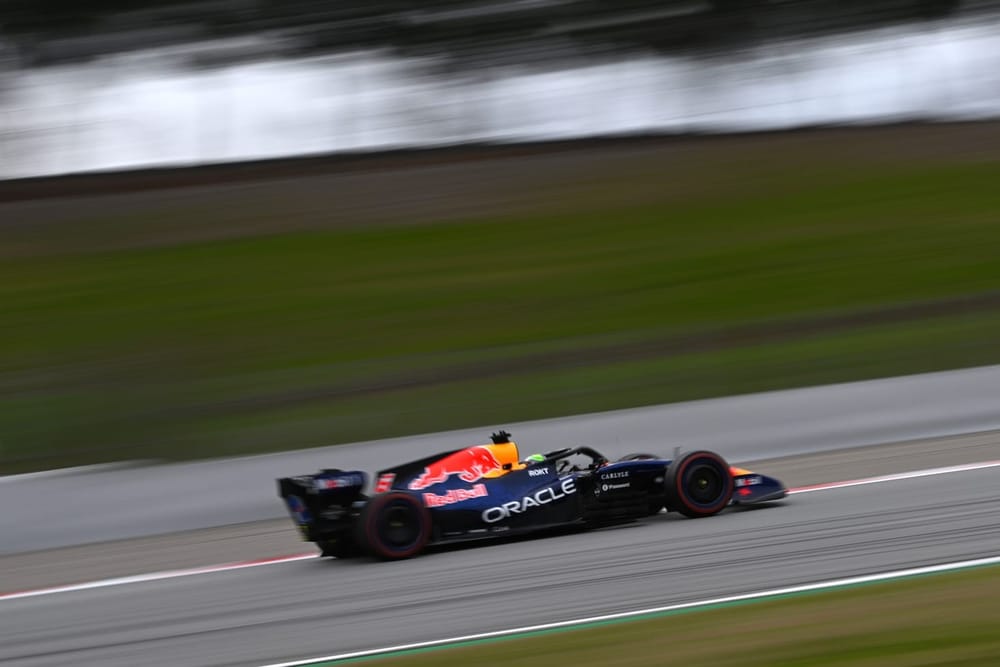
The new 2026 Red Bull has hit the track at Barcelona and, at the time of writing this very limited analysis, Isack Hadjar was fastest, although way off the pace of last year's Formula 1 cars.
But it all has to start somewhere.
As for the car, we have very limited images and not of great quality, but I'll do my best to go through what I have seen so far.
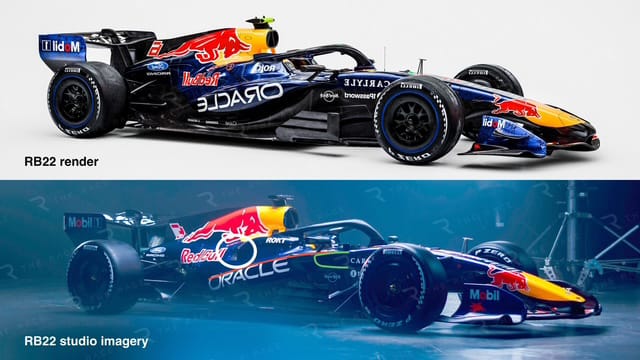
Comparing Red Bull's initial 'concept' renders to the studio shots, we can see a marked difference in the sidepod size and upper surface (red highlight) detail. Could we call this a 'zero sidepod' solution? Well, it's certainly smaller than most, but 'zero'? Not really.
The radiator intake (green highlight above) is similar in size and concept to the other cars we have seen.
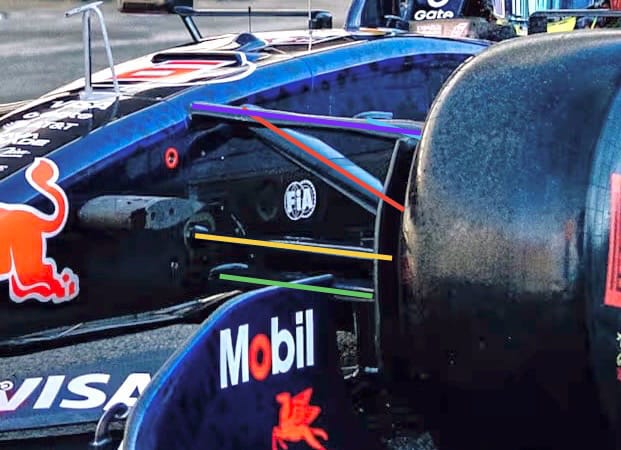
The RB22's front suspension is now the nearly standard pushrod version (red highlight). The top wishbone is shown by the forward leg in purple and rear leg in light blue highlights. You can just about see the rear leg and although Red Bull still has some anti-dive I think it has been reduced.
The lower wishbone (forward leg green highlight) and trackrod (yellow highlight) are separated as opposed to some of the other cars, where the teams have tried to keep them in close proximity.
Sometimes, a little separation creates more blockage as the airflow around each of the components affects each other, so separating them by a reasonable distance can be beneficial.
The sidepod image below shows that Red Bull - like Mercedes and Ferrari - has gone to town on the bargeboards. The airflow through these slot gaps (yellow arrow highlights) will turn upwards and rearwards, pulling flow out from under the front corner (orange arrow highlights) of the floor. This section has a reasonably large footplate so increasing the speed of the flow on that undersurface will generate some ground effect and, with it, downforce.
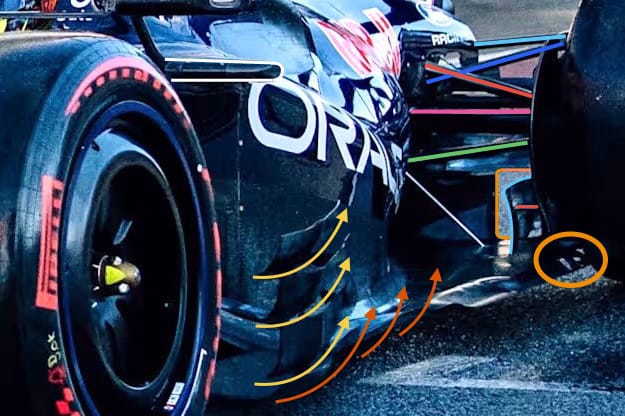
To go with those reduced-size sidepods we can see an ear sticking out (white highlight) of the top corner of the sidepod. This, as it was with the 2022 Mercedes, is a legality requirement to comply with the side impact structure position and width.
The rear suspension is, as last year, pushrod operated (red highlight), top wishbone (forward leg dark blue), rearward leg (light blue highlights). It still has a similar amount of anti-lift on it. The lower wishbone (forward leg green highlight) and the driveshaft shroud (magenta shroud) is possibly part of the lower wishbone structure, but I can't really see any other detail.
The floor detail in front of the rear tyre (orange ellipse) appears to have some louvres through it, though smaller than we have seen on some other cars. The more interesting thing is that slightly inboard, we saw on some but not all of the Mercedes shakedown shots from Silverstone what seemed to be a cutout in the sides of the diffuser.
At the time I didn't take much heed to it because, as it wasn't on all the pictures, I thought it might just have been a piece of silver tape. However, looking at the Red Bull in this area (orange highlight line) it looks like there is a significant cut out here.
It may be that Red Bull doesn't have a side in the diffuser in that area going rearwards and so is then using the turning vane further outboard (light blue highlight line) to help pull airflow through the diffuser by connecting what we call the 'tyre squirt' airflow that is created by the tyre rotating onto the track surface.
It is fairly high-energy flow, and if you can manage it and contain it then it could very easily improve the performance of the diffuser.
Is it a new version of what used to be called the blown diffuser? Yes, I suppose you could say that - it is using high-energy flow to optimise lower-energy flow in an area that will create downforce and that is exactly what blown diffusers did.
I don't really have much more to say on the Red Bull for now. It's interesting and yes, it looks like the team has pushed the limits in various areas. But time will tell who has made the best use of taking those 246 pages of F1 2026 technical regulations to bed with them and deciphered them better than the others to find those critically important grey areas.
