Why Williams has turned Sainz and Albon into test drivers
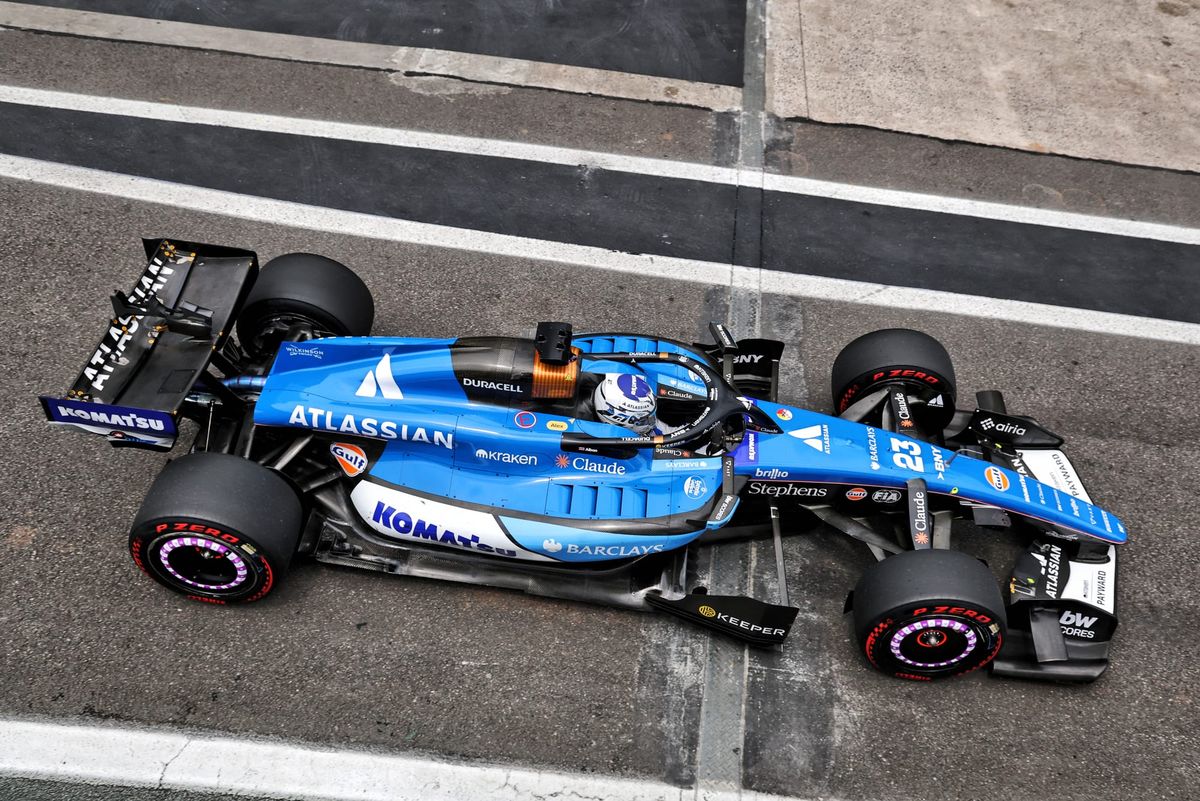
Williams duo Carlos Sainz and Alex Albon have become arguably the most overqualified test drivers in the world as the team has sacrificed parts of the final Formula 1 weekends this season to help its 2027 car.
As the Williams narrative has turned almost entirely to making progress for next year, Sainz and Albon have been conducting very different programmes in Friday practice to other drivers, and talking more about the value of experimental work outweighing that of absolutely nailing the preparation of a given weekend.
Asked by The Race if that made him a test driver for this part of the year, Sainz said: "I am. And I told the team that I don't care about finishing 15th or 17th.
"It's more how much can I learn, how much can they learn, in order to get myself and the team and the car in a better place for next year."
Though Williams's 2026 problems are well established it is important to understand the core issues – and the reality Williams faced in addressing them – to appreciate what it is doing right now in turning Sainz and Albon into willing, glorified test drivers.
New rules and the best engine on the grid were meant to help Williams build on Sainz's two podiums in 2025 but hopes of this being achieved in 2026 were abandoned very early.
It was the only team that failed to get a car to January's Barcelona shakedown, and the car that arrived late in Bahrain was also overweight and slow. The turnaround since has been minimal in relative performance, hence Williams is ninth of the 11 teams on points, and on single-lap pace, ahead of only Aston Martin and Cadillac in both metrics and slipping closer to both (and behind in the case of Aston Martin) as the season has worn on.
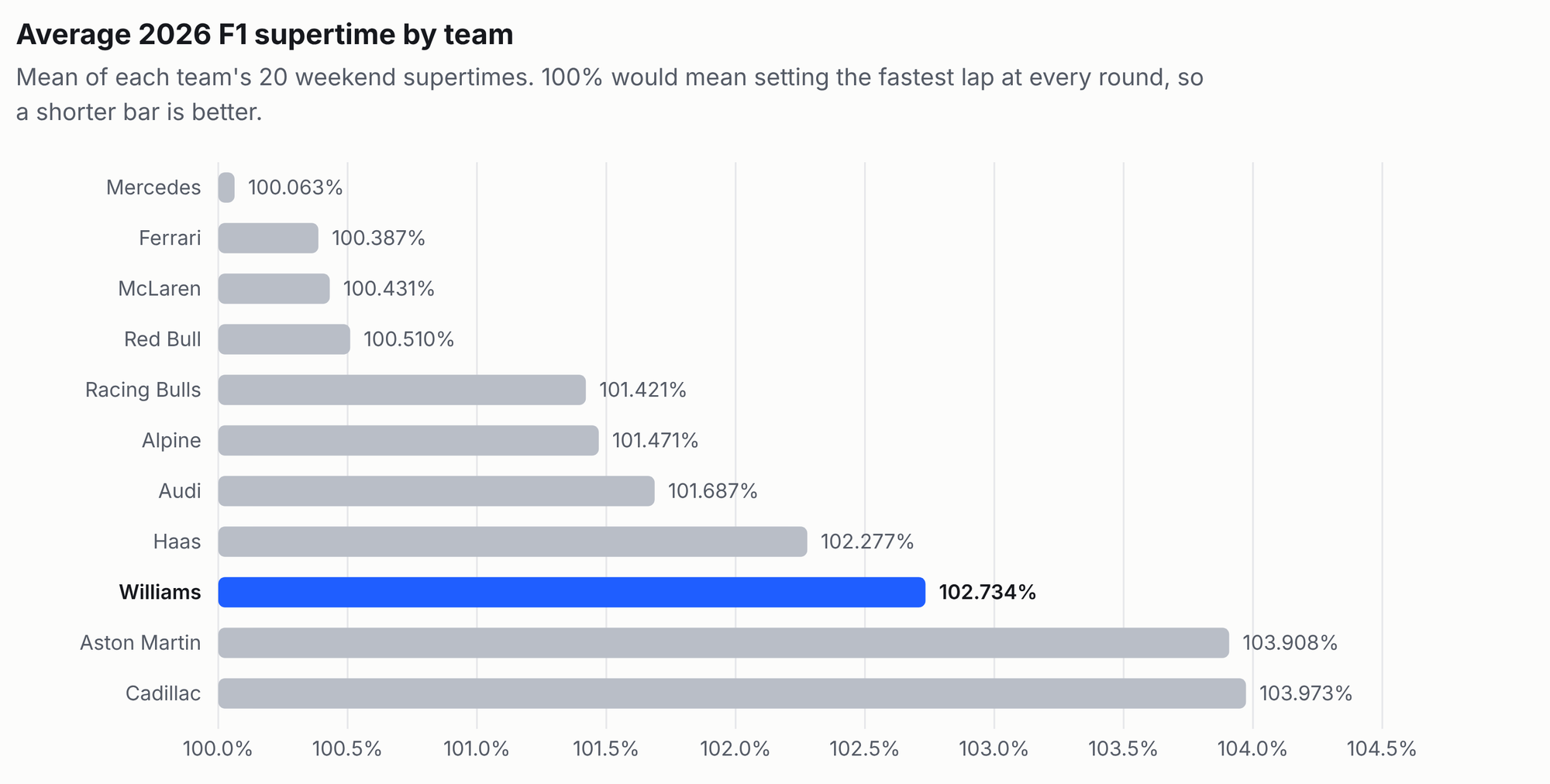
Though the weight has since come off the car, the deeper flaw was its high-rake aerodynamic concept. Aston Martin took a similar route and abandoned it with an in-season B-spec car, Williams decided doing that would cost too much.
The Baku upgrade in September that got the car to the weight limit was largely an investment in 2027, as its chassis carries over, and Williams has "left quite a bit of performance in the tunnel at home" according to team boss James Vowles to avoid wasting precious resource on a smaller return this season.
An 'it'll get worse before it gets better' reality was embraced months ago. At his home race in Madrid in September, when Williams was preparing its final major weight-cutting upgrade and was hoping it would at least get closer to scoring points, Sainz said: "That's nowhere near where we wanted to be this year, nowhere near what we promised.
"Our biggest hope is putting all the eggs in next year's basket."
The conventional element to this is not bothering with ongoing 2026 car development and shifting windtunnel and CFD focus to 2027 as early as possible. What's unconventional is how Williams is turning part of grand prix weekends into test sessions.
With the car's performance ceiling effectively clear and fixed, Williams has decided it matters less how well it optimises certain events. This applies to the work in advance – Albon said "even the simulator work we're doing at the factory, we're spending almost no time on this year's car, and spending all our time on next year's car" – but then at the track running experiments that link the real car to the design and simulation work at its Grove base.
Sainz explained: "We are doing proper set-up test experiments, also for my knowledge and experience of the car and the team, how big the changes feel, and trying to do a bit of correlation work with the simulator: what the car does in real life versus what it does in the simulator, what it does versus our models, and what the model is expecting it to do.
"So as a driver, once there is nothing to fight for, like there is right now, there is always experience and learning that you can do with big test items, because normally in F1, testing is super limited."
The clearest example came in practice for the United States Grand Prix. Chief trackside engineer Paul Williams said the team had "balanced off performance for this weekend versus long-term learning", collecting data for 2027 because the Circuit of the Americas is "very good for aero data collection".
Williams's FP1 run plan was unlike any other team's. On hard tyres, each car made five trips of an out-lap followed by a lap driven at pace through the first two sectors, before peeling into the pits instead of crossing the line. Each car then spent six to nine minutes in the garage before the next run.
Albon did this four times and Sainz five, while the rest of the field managed six such laps between them. Neither Williams driver started a full flying lap until the medium-tyre runs about 48 minutes in, and neither ran the soft tyre or a run of consecutive laps. Every other car did both.
Every team's Austin FP1 runplan
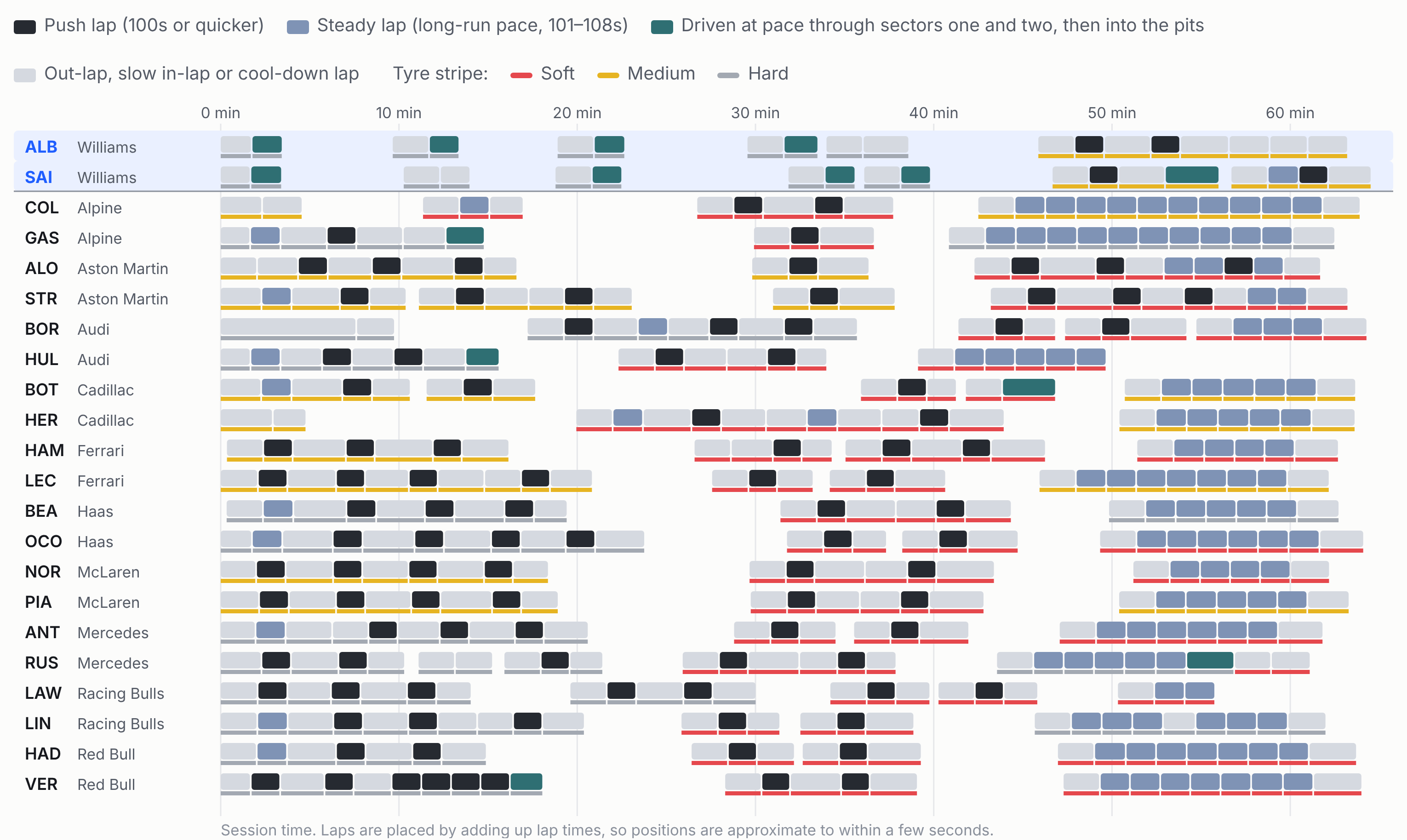
With his only flying laps on mediums deleted for track limits, Albon ended the session 40.416 seconds off the pace. But Williams left with a far bigger bank of controlled data for its 2027 correlation work than a normal session would give, effectively turning FP1 into a micro-version of the sort of in-season test F1 no longer allows.
Williams has also been taking more risk with how it runs the car, to find out how wide its operating envelope really is.
"We're trying new things, not just physical hardware on the car, but also systems and processes, and challenging the risk that we take to see what the responses are," said technical director Matt Harman.
"We're pushing the envelope of the car in where we run it, some things on the cooling and bits and pieces like that. We're trying to exercise a little bit more aggression in the car, and that serves us well, not just for what you see here today, but for the correlation of our models back at the factory.
"It's very easy to be in the middle of the model, but we need to be trying to get to the edges, and that's what we're doing."
Teams in a closer fight usually limit the risks to avoid compromising the rest of the weekend. Williams has far less to lose – but it switches it on when it matters, like maximising the wet qualifying in qualifying at Interlagos to get Albon inside the top 10 on the grid.
Likewise, though Sainz says points on merit are "a bit out of the question", Las Vegas this coming week is the remaining exception if Williams can qualify a few places higher than usual, make a strong start and hold on. So expect to see it conduct a normal practice programme there.
"[Points are] a remote possibility this year, which I'm going to fight for in Vegas," said Sainz.
"I'm going to try everything to get those last points for the team.
"But everywhere else, I see it almost as testing weekends to improve next year's car."
And though the races are largely a foregone conclusion in terms of the competitive result, they still afford Williams key opportunities to improve – like pitstops.
Albon said this is keeping the race team sharp and giving it a clear motivation to keep working as hard as possible, pointing to Williams getting the fastest pitstop of the race for the first time this season in Mexico.
Teams' pitstop spreads since the summer break
Fastest and slowest 10% of each teams' pitstops removed
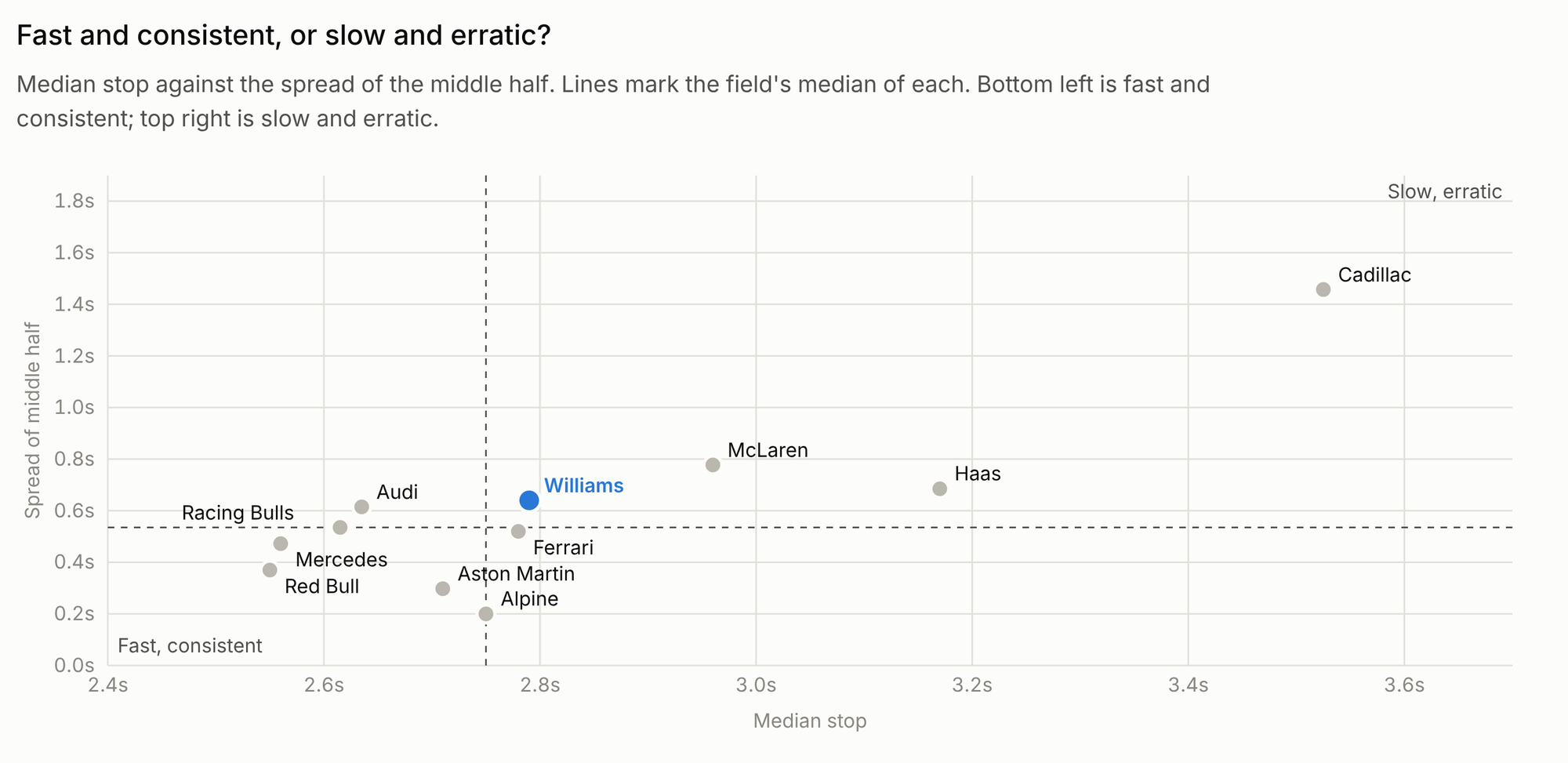
Its median stop has dropped from 3.28 seconds before the summer break, ninth-best of the 11 teams, to 2.79s since, so there is a decent body of evidence to back up this improvement more broadly.
However, none of this matters if the 2027 car does not deliver the step Williams needs, and Sainz admits that is his biggest concern.
"There's three key areas where we've failed this year," he said. "One is getting the car on time to the track. Two would be getting the car on weight. And number three would be getting the aero concept right.
"The first two, I trust that we're going to solve next year. Number three is the one that worries me, or let's say that we are having to put more effort on. And that number three is the most important one, because it's the one that generates performance."
The reason is that Williams has lost one of its strengths from the end of the ground-effect era, when Sainz says its upgrades delivered exactly what was predicted.
"With these cars we're having more problems," he said. "Not everything that is being delivered is performing as expected.
"So it leaves a certain level of doubt in my head when I test the simulator and see the numbers that we're producing for next year, because some of the numbers that we've produced this year haven't exactly gone one to one like they did with the ground-effect car."