Why F1's ended up with rules that so many hate
Formula 1’s high-level meetings to discuss changes to the 2026 rules are seeking to unpick something nearly six years in the making after just three races.
A first meeting between senior technical figures took place last Thursday and discussions will continue between various F1 stakeholders over the rest of the month as options to improve the most compromised parts of 2026 are weighed up.
By the time the season resumes in Miami in May, F1 2026 is likely to have a different set of rules governing at least one key competitive part of the race weekend: qualifying. And as Ferrari boss Fred Vassar said, whatever is changed will have an impact in some way on the pecking order.
A set of rules that took so long to come to life being changed so soon reflects the fact this is not a formula that anyone is particularly happy with. However, the heart of the problem – the switch to a near 50/50 split between the internal combustion engine and electric power – is not changing any time soon.
The rise of the '50/50' engine
This 50/50 slogan that has become a millstone around F1’s neck, and cannot be removed completely by crunch April meetings, can be traced all the way back to the start of the decade.
It first started to be openly referenced by competitors in F1 in 2020, namely Mercedes, but also the FIA, who felt it was a realistic goal to set in terms of power output.
“Working on the electric part will be an important aspect of the 2026 powertrain,” then FIA technical director Gilles Simon told The Race in 2020.
“Today, it’s a very important topic everywhere. Everybody is speaking about electrification.”
This was tied intrinsically to a desire to bring new manufacturers on board. There were private internal meetings by the end of 2020, and then in 2021, conversations at CEO level with various engine manufacturers: those already in F1, but also representatives from the Volkswagen Group, including Audi and Porsche, and also Ford. Honda, despite intending to formally withdraw at the end of 2021, was also represented.
These various discussions outlined several elements that needed to underpin any future F1 engine formula, with some familiar pillars: cost control, sustainability, and electrification.
Critical to the plan was removing the MGU-H. This was an incredible technological novelty of the previous hybrid engine formula that recovered wasted heat energy and worked to spin the turbocharger directly to eliminate lag. But it was very expensive to produce, very complex, and had minimal road relevance.
Audi made it very clear that it would not proceed with its F1 plans without the MGU-H being dropped, as it felt that the established manufacturers' mastery of that component was too great a headstart for it to overcome.
The likes of Mercedes were willing to make this compromise, in return for ensuring that new manufacturers didn’t get too much assistance with extra dyno time or a bigger cost cap allowance.
But to facilitate the loss of the MGU-H and have a bigger electric component overall, the MGU-K needed to be uprated pretty much threefold to 350 kilowatts of peak power output. In addition, the internal combustion engine power output was brought down to somewhere around 400 kilowatts. Thus, the ‘sort-of 50/50’ engine was conceived.
This equal split is not actually an equal split. And it is also misleading in another important sense as the MGU-K can only be used at its full 350kW for a very short period of time across a lap. There are many moments where it is working in reverse, and the total power output of the engine is massively reduced. So in reality, the 50/50 is a peak headline ratio that bears only a partial relationship to what actually happens across a racing lap.
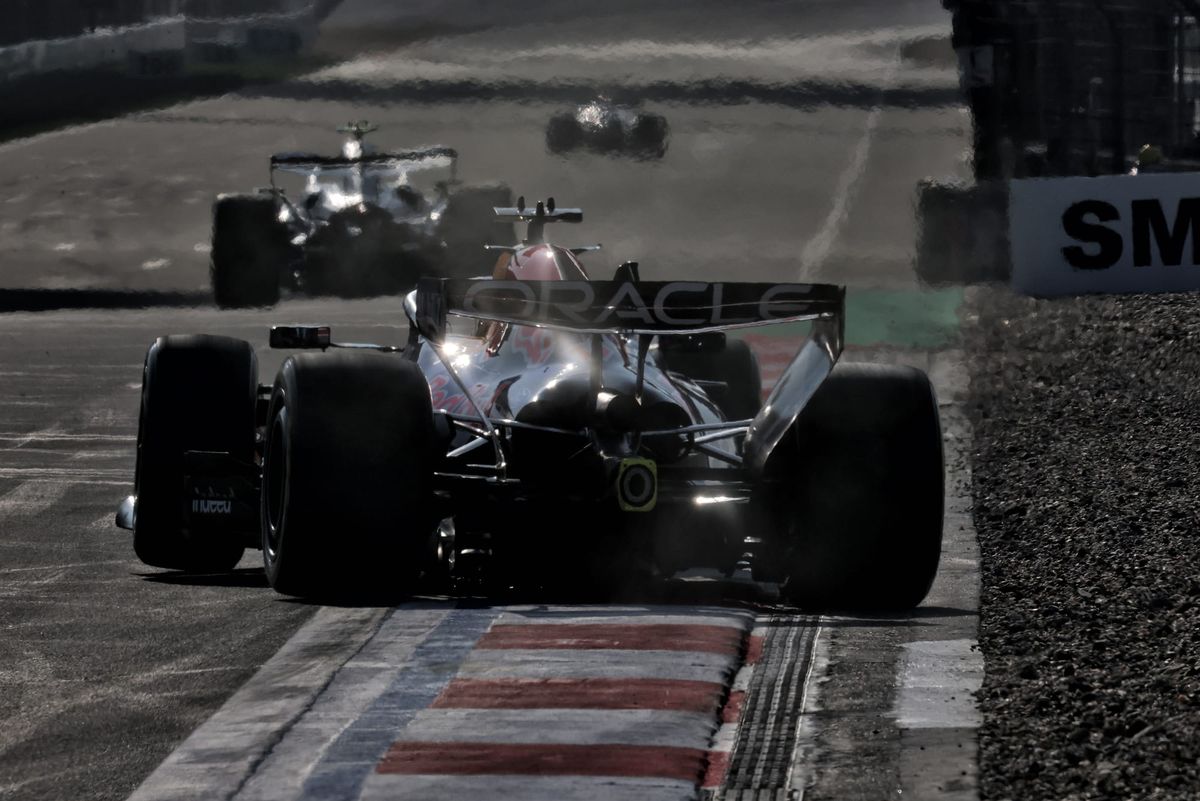
In principle, the 50/50 split is not a bad idea. And it could be made to work. But there are too many technological and/or regulatory constraints that undermine the concept. The battery does not have the capacity to power the MGU-K sufficiently across a lap, yet the charging capacity rules encourage lifting and coasting, and super clipping by harvesting energy while still at full throttle at the end of a straight. The latter causes strange Vmax situations where peak speed is achieved very early on the straight and then there is a gradual ramp-down.
Audi’s desire for harvesting energy from the front axle to increase recharging capacity simply under braking was a non-starter as competitors felt it would give Audi an advantage as it knew this technology from sportscar racing, and there were also concerns this would lead to far too complex driving aids as well.
So the rules eventually settled on meant F1 was left committed to an engine with an increased electric power demand from one component, but ultimately the same battery capacity and reduced flexibility on how it could be charged.
Manufacturer influence
The first goal for the 2026 regulations was ultimately to attract more manufacturers, and by any measure, that has been a success.
Audi, unlike Porsche, which ultimately walked away despite prolonged discussions, went through with its desire to enter F1 and made it clear the 2026 rules were critical to that.
“Now is the right time for us to get involved,” then-Audi chairman Markus Duesmann said. “After all, Formula 1 and Audi both pursue clear sustainability goals.”
Others were tempted by the marketing line of F1's new reality. Ford came to the table in collaboration with Red Bull Powertrains and CEO Jim Farley said when that partnership was announced in 2023: “We’ve got to generate a lot of interest [in our new electric cars]. We want to use Formula 1, and its growth in the US, with a new younger audience, to promote our EVs.”
Meanwhile, Honda committed to a U-turn on its plan to withdraw from F1 completely as it decided to build a new engine for 2026 after all. And General Motors was also enticed to start an engine programme that will be ready by 2029, something that has been key to Cadillac being allowed to join the grid this year.
That means three brand new automotive manufacturers getting involved in some way this decade that would not be there without the rules as they are, plus Honda recommitting.
It’s important to understand the context for why it mattered.
In F1 specifically, Mercedes and Ferrari were definitely continuing into any new engine formula, but Honda was withdrawing, while Renault was considering its own future and did eventually discontinue its engine programme despite initially signing up for 2026.
There was a real risk that F1 could have had only two proper manufacturers signed up, with Red Bull forced to create its own engine division. This was a key factor in why F1 wanted new manufacturers – along with the financial benefits they bring, through marketing spend, partner attraction and audience appeal.
And while F1's popularity was growing significantly at the start of the 2020s, it still needed the manufacturers more than the manufacturers needed F1. So it had to sell the idea to them.
Coming out of the COVID-19 pandemic, the automotive world was under great financial pressure, and there was also a massive push for electrification alongside the phasing out of combustion engine cars in various cities and countries around the world.
If negotiations started with manufacturers in 2026 versus 2020, for example, the parameters and the negotiating leverage would be different. But the outcome may well be the same because F1 and the FIA know there are huge risks associated with moving away from a model that is ultimately dependent on manufacturer participation.
Of course, there were also political and personal agendas involved here. The prospect of bringing in manufacturers was clearly something F1 and the FIA wanted to count as a massive victory for themselves.
Is Audi to blame?
Of all the manufacturers at the table, Audi clearly had a big hand in these rules being conceived the way they have been.
But Mattia Binotto, who is now the head of the Audi F1 project, is adamant that Audi never made it a requirement that there had to be a 50/50 split.
“Audi has not been part of the 50/50 decision,” Binotto told The Race. “That was before certainly, when Audi decided to join.
“[Audi wanted] high efficiency engines, sustainable fuel, a significant part of electrification and then the removal of the MGU-H, because Audi believed that the knowledge would have been a competitive advantage to the previous manufacturers.
“But Audi has not been part of the 50/50 discussion."
The absence of the MGU-H, ironically, is now partly responsible for a major weakness in Audi’s package.
Its starts are particularly terrible, presumably because it has the largest turbocharger size of any engine: and without the MGU-H, turbo lag on these 2026 engines is really bad, hence so many teams struggling with consistent launches. And Audi's are the worst on the grid.
Somewhat supporting the idea that Audi was not specifically part of the ‘50/50’ demand is that Binotto suggests it would not stand in the way of an adjustment to this ratio. So, clearly, it’s not a non-negotiable from Audi’s perspective.
However, it should also be said that Audi’s management has changed completely since it green-lit this F1 programme and was part of those initial talks half a decade ago.
The VW and Audi top management is entirely different and Binotto’s essentially the third different F1 boss the project’s already had.
So who knows what Audi really demanded or not – maybe what it needs has just changed along with the industry, or the people in charge.
Only treating the symptoms
Regardless of who was responsible for this ruleset taking this form, there have been chances to correct it.
The concerns about what the 50/50 split would actually produce on track began to surface from inside the process, not long after the core framework was agreed.
Christian Horner, then Red Bull team principal, was the most prominent and persistent voice of concern. In 2023 he warned that the regulations risked producing bizarre charging techniques and what he described as Frankenstein cars forced to paper over the cracks.
He argued adjusting the ratio between combustion and electrical power – not abandoning the formula, just tuning it even to 65/35 or 60/40 – would remove the need for much of the complexity that followed. But that ship had sailed.
Among the clearer signs that these problems were understood, and considered controllable, was the reduction of the charging limit across a lap from 9MJ to 8.5MJ.
This reflected the fact it was already known that the more the cars could harvest, the more extreme the tactics would be. And the FIA knew right from 2022 that the 50/50 engine split had challenges, and was adamant the worst problems had been mitigated.
To go through the process, insisting that the problems would be or had been sufficiently addressed, opting not to react to how the cars then ran on track in reality in testing, but at the same time reviewing everything after just three races and committing to making at least some changes anyway is hard to reconcile.
With what was known, surely the worst of the problems could have been headed off sooner. Perhaps this was genuinely believed to have been achieved – in that case, the rulemakers either underestimated the challenge or overestimated the work that had been done, be that due to naivety, hubris or something else.
The worst-case scenarios that were predicted may have been mostly avoided, but there are still problems starting these engines, charging these engines, and racing these engines.
Fiddling around the edges now by adjusting super clipping thresholds, tweaking deployment parameters, and softening harvesting rules should address the worst of the problems in qualifying, but how much it helps is subject to what gets agreed in the ongoing meetings.
And it will not get to the core of the issue. Some are absolutely adamant that the type of racing triggered by the 2026 rules is definitely a good thing - judged by simple metrics like total number of overtakes - so there will be a limit to how much they are willing to change.
However, the greatest constraints are intrinsically tied to the 50/50 architecture itself and the way the formula was conceived.
Until that changes, F1 can only treat the symptoms instead of the cause.