What's killed off the F1 driver market
The Formula 1 driver market is dead. But who killed it? And when will it truly return?
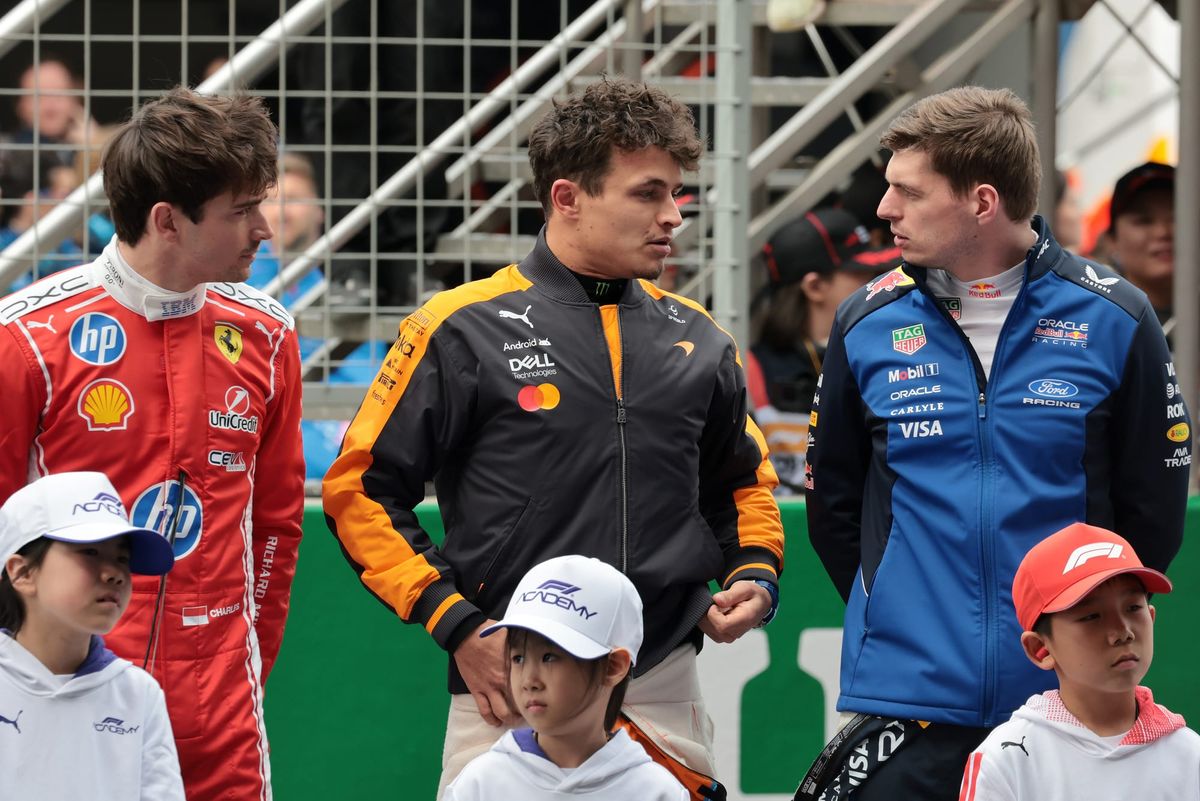
Max Verstappen and Lando Norris's huge new Red Bull and McLaren deals mean many of F1's prime seats are locked down until the end of the decade.
So why aren't star drivers moving very often? Is it good or bad for F1? And is there any hope for aspiring F1 drivers and fans who want a more volatile driver market?
Is our perception accurate?
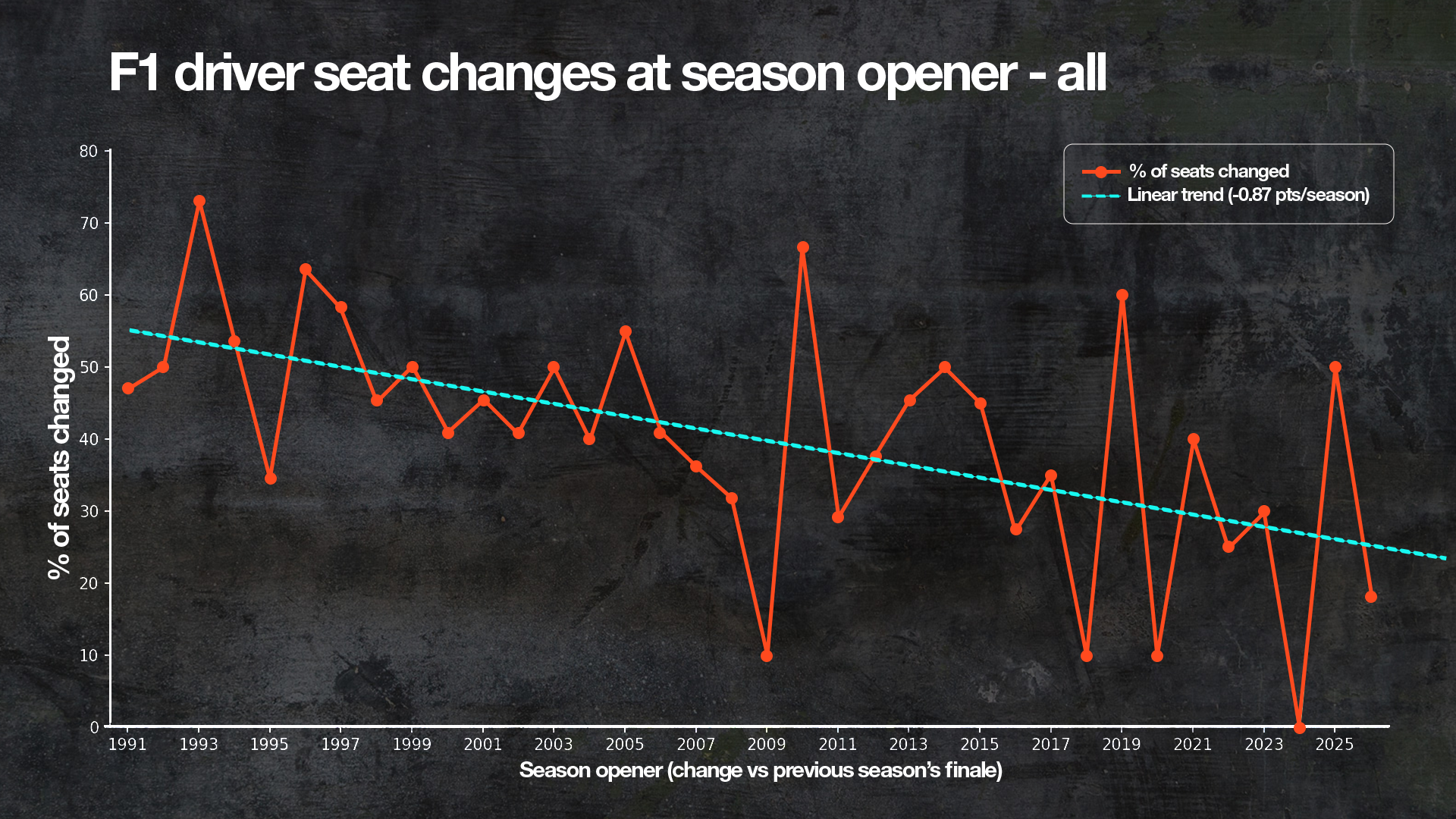
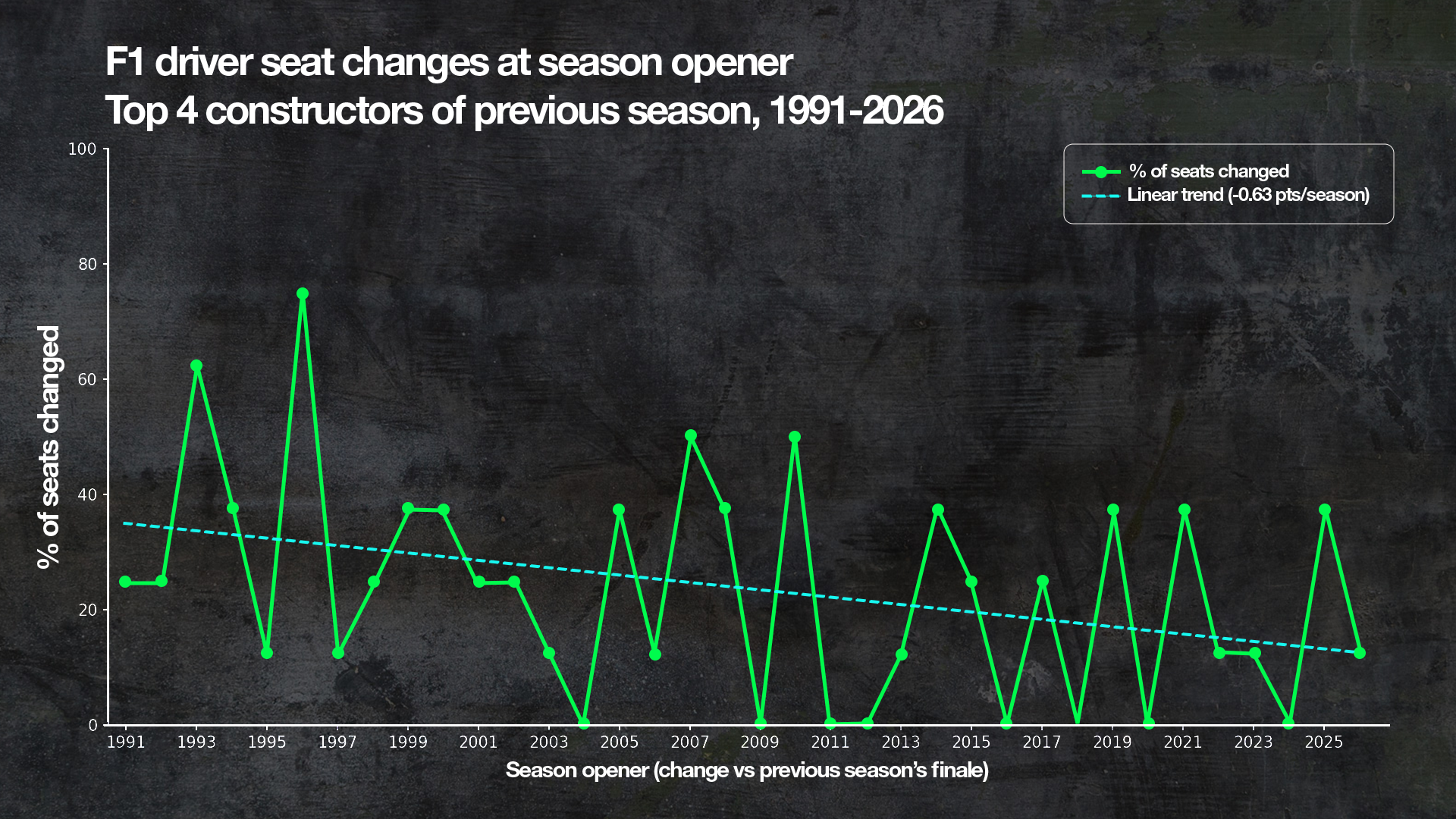
The statistics are clear: there’s a very, very strong downward trend in what you might call driver market volatility. Measuring driver changes from one year to another, it’s about half of what it was at the start of the 1990s - with a pretty continuous trend downwards.
There are also extreme spikes - such as 2019 and 2025 - featuring a huge amount of change. But they’re the exception.
The trend applies very clearly when you limit it to changes among the top four teams at any time. Driver market movement has declined by around half.
If you count Toro Rosso as effectively part of Red Bull, Verstappen and Norris could realistically be ‘lifers’ for their F1 teams. Norris is on course for at least 12 seasons at McLaren and to cruise past Mika Hakkinen and David Coulthard’s records of nine after next year. Charles Leclerc is on course to beat Michael Schumacher’s record 11-season run at Ferrari.
Bar Hakkinen and Nico Rosberg (who both still started at smaller teams), every F1 champion in the last 40+ years has made at least one significant team move in their career - until most recent champions Norris and Verstappen. They’re at the vanguard of this new trend of extreme career stability.
Reason 1: The cost cap
Exact figures for deals such as Verstappen and Norris’s are kept secret, but they’re known to be in the mega-millions. And they’re outside the limits of the cost cap - the early-2020s bid to introduce a driver salary cap within that too having been rejected.
Throw in the explosion in team valuations and the commercial popularity of F1, and there’s more money flowing around the top teams but a hard limit on what they can spend on car development, which means spectacular amounts of money are available for top teams to spend on driver salaries. And that gives teams the financial firepower to tie down their ‘franchise’ drivers long-term - and gives drivers plenty of financial security.
Being able to promise driver continuity also helps for tying down long-term deals with potential sponsors, so it’s in teams’ interests.
Reason 2: F1's very slow 'social mobility'
What you might call the ‘social mobility’ of F1 teams - the potential for their competitiveness to rise and fall - has slowed significantly. Drivers have to be more long-term strategic. Remember Norris being linked with a Red Bull move in Red Bull and Verstappen’s heyday, while McLaren was still yet to resume winning? Norris could’ve jumped ship just as McLaren usurped Red Bull at the top.
Even pre-cost cap there were very few potential or proven championship-winning teams. Now the baked-in facilities advantages of the teams that could spend heavily before the cost cap and the way the cap limits the potential for big development leaps from season to season make it much harder - and slower - for ‘upwardly mobile’ teams to actually progress.
It’s therefore a much bigger leap of faith for a driver to pick an ambitious midfielder such as an Audi, Alpine or even Aston Martin, than it would’ve been just a few years ago. If you’ve got a seat in an established top team secured, you want to keep hold of it. Drivers are no longer chasing the elusive great team to leap into next.
Reason 3: The adaptation period has got longer
It takes longer to adapt to a new team than ever before, and that means any big team move guarantees an adaptation period that might effectively waste a first season. Lewis Hamilton’s 2025 struggle and much better 2026 at Ferrari are a prime example, and Carlos Sainz - a prolific 'mover' who's raced for five different teams - recently told The Race that he feels he gains at least a tenth of a second per lap just from team familiarity in his second season at a team.
These are now very, very complicated cars, with a lot of subtleties. Teams are bigger than ever, with more personnel and processes to adapt to. It takes a long time to get the last fractions of a second out of a new car and team. Drivers can no longer be confident of jumping into a new team and very quickly getting the best out of its car.
Does it matter and should anything be done?
We love a driver rumour mill, but it’s not purely a media-confected thing. Fans want to see different drivers in different teams taking on different challenges - it’s a fundamental part of F1.
But it can’t be forced. MotoGP, for instance, is eyeing up a rider transfer window for different reasons, and has a convention of two-year rider contract cycles anyway. Something like a contract-length limit would be contrived and restrictive for no real benefit.
If F1 can create more opportunity for teams’ form to fluctuate, drivers will have more incentive to move around. With four teams in the mix to a degree at the front right now, this feels like a less urgent priority than in eras of clear single-team domination, but keeping hold of the recent influx of new and returning manufacturers will be easier if they see tangible routes to the top. F1 also needs to think more about what it’s doing to bring more young drivers through.
Where are there signs of hope?
One significant move could still trigger a domino effect, and the most obvious contender is Hamilton. He’ll be at Ferrari next season but will be approaching 43 years old by the end of it. Will he retire at the end of 2027? That could create a lot of changes… but equally Ferrari could simply slot Ollie Bearman in and it would remain something of a closed system.
Remember that even in deals such as Verstappen at Red Bull there will be performance clauses. He’s not going to completely handcuff himself to Red Bull. If a once-top team is suddenly ninth in the championship, a leading driver won’t get stuck there.
And will Oscar Piastri decide he wants a move out of McLaren? He's still got a few years on his deal, but it's possible. Does George Russell see life alongside Kimi Antonelli at Mercedes as what he wants for the long term?
Based on where we know some of these contracts are now, it could be 2031 - which is currently scheduled to be when the rules change, likely pivoting to V8 engines - when we next see major movement.
But you never know. And that's the tantalising thing with the driver market. It may feel flat and locked, but you never know when that bombshell happens that will change everything and the market scrambles again. As the data shows, the general picture is much calmer now than it used to be, but when there’s a spike in movement, it tends to be a very big one.