Why Mercedes cannot dominate F1's new era
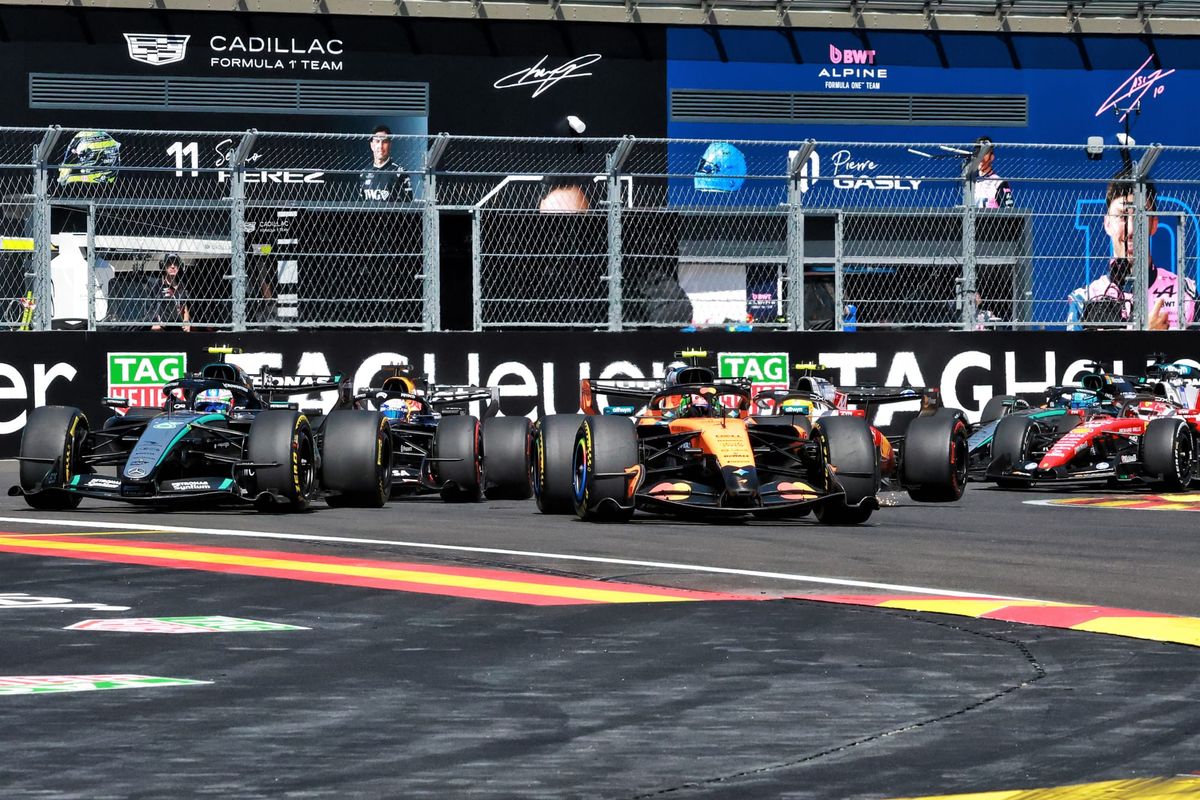
They say history doesn't repeat itself, but it often rhymes. And that applies to Formula 1 as well.
The start of new-rules eras have often been hugely indicative of what is to come, as the trends of the inaugural season lay down the story of future years.
If we do some comparisons of the first years of the most recent major rules-change eras, we can see how the comparisons between the first and second half of each of those seasons gave us a hint of what was to come in the following campaigns.
Constructors' championship splits
Represented as first half / second half / total
2009 (17 rounds; 9 / 8)
Brawn GP: 112 / 60 / 172
Red Bull: 92.5 / 61.0 / 153.5
McLaren: 14 / 57 / 71
Ferrari: 32 / 38 / 70
Toyota: 34.5 / 25 / 59.5
2014 (19 rounds; 10 / 9)
Mercedes: 366 / 335 / 701
Red Bull: 188 / 217 / 405
Williams: 121 / 199 / 320
Ferrari: 116 / 100 / 216
McLaren: 96 / 85 / 181
2022 (22 rounds; 11 / 11)
Red Bull: 359 / 400 / 759
Ferrari: 303 / 251 / 554
Mercedes: 237 / 278 / 515
Alpine: 81 / 92 / 173
McLaren: 81 / 78 / 159
2026 (23 rounds; 20 completed so far; 11 / 9)
Mercedes: 379 / 273 / 652
Ferrari: 307 / 203 / 510
Red Bull: 177 / 238 / 415
McLaren: 222 / 176 / 398
In 2009, Brawn GP took the crowns thanks to its stellar start to the year, but you could see Red Bull getting its act together ahead of what became its era of dominance.
In 2014, Mercedes was unstoppable and its advantage through the year clearly told us about it becoming the main force in F1.
In 2022, Ferrari started well but Red Bull got the weight off its car and pushed forward to begin Max Verstappen's real run of supremacy, off the back of his maiden title the year before.
For 2026, Mercedes has secured both crowns, but the story of the year is an intriguing one because a trend has emerged of there being no clear benchmark late on.
While Kimi Antonelli and George Russell kicked 2026 off strongly and laid title-winning foundations early on, subsequent spells of success for Red Bull, McLaren and Ferrari have pointed to a shift.
In fact, as the table below shows, if you take the results of the last five races up until and including Brazil, Mercedes is only the third-highest-scoring team.
Top four constructors (last five rounds)
Red Bull
Last five total points: 152
Average per round: 30.40
Overall total: 415 (3rd0
Ferrari
Last five total points: 132
Average per round: 26.40
Overall total: 510 (2nd)
Mercedes
Last five total points: 114
Average per round: 22.80
Overall total: 652 (1st)
McLaren
Last five total points: 92
Average per round: 18.40
Overall total: 398 (4tth)
No one has the edge
F1 has a super-close top four where no team seems to have been able to edge clear of its rivals, and it has been hard to pick out anyone who has built up some momentum.
This is why, for all the joy that Mercedes team principal Toto Wolff has taken from getting his team back to title-winning ways, he has no sense that this is the start of "runaway" success.
"It looks like the most competitive era that is about to start," he said.
"The teams have become so professional in capability and resource that these kind of runaway seasons, I don't see them anymore, whether it's four in a row or eight in a row. And that is a completely new challenge.
"You can see how quickly it goes from you being dominant and within a few races you realise that your upgrade doesn't work and you fall back and you're just third on the road. So it's great for the sport.
"I wish it was the era of Mercedes and me running away with another few championships. I don't think it's the reality."
A 'ping pong' season
The upgrade war seems to have had the effect of repeatedly shuffling the order of the top four.
Whenever any of the major teams have brought big development steps, often those have helped push them to the front and changed the hierarchy.
McLaren team principal Andrea Stella has labelled this "ping pong season" in terms of how teams bounce between being at the front or the back of that top-four block.
"Anybody that upgrades kind of takes an advantage, but even if you do a good job of developing, not necessarily [is it the case that] you can establish yourself at the top," he said recently.
"We have a variable level of supremacy, dependent on the track conditions or the optimisation of the set-up.
"But the reality is that I think nowhere before we have had F1 so competitive and with such a rate of development. If we raced with the race-one car [from the Australia season opener], we will be one and a half seconds slower than what we are at the moment."
The cause of this major shuffling is not only the fact that the big teams all seem to be so evenly matched in terms of their capability. (And have found ways to all keep pushing on with developments under the cost cap.)
It is that the FIA appears to have made life very difficult for teams because the aero regulations are so restrictive, leaving designers with only very small areas they can work on.
Focused on creating cars that did not produce significant dirty air, the FIA was determined not to allow areas that teams could exploit to ruin this and improve downforce.
And this has left teams capped in terms of how much performance they have been able to eke out.
Stella added: "If you take the regulations and you define the volumes within which you can put aerodynamic devices, that's not how an aerodynamicist would do it.
"They [the rules] have been done in a certain way somehow to jeopardise for the sake of competition and also for the sake of allowing the following and the overtaking."
Red Bull team principal Laurent Mekies agreed on the lack of design freedom leading to diminishing returns for all teams.
"The convergence is probably happening earlier than what we all thought," he said. "I'm guessing somehow, it's perhaps an indication of fairly restrictive regulations.
"That being said, you see cars with visibly different concepts and you see four top teams fighting, which is probably a great point to be for the sport.
"So, let's see how it will pan out in the second year. But to be already in the second part of '26 in situations where you turn up at the race weekend and you don't know which one of the four top teams is going to win the race, I think it's great for the sport."
The end result of all this is a form book that is in a state of flux.
Ferrari team principal Fred Vasseur thought that the 'ping pong' element of rapidly shuffling fortunes was a consequence of immature rules offering potential for big gains, something that will slow down into next season where he felt teams would converge more.
"Each time that we were bringing something, we are doing a step," he said. "That was a little bit the story of the season because, as we [the top-four teams] were not bringing upgrades at the same races, you have this kind of rotation.
"Probably it could be less through next year and the following years, but we will have a kind of convergence of performance of where we are next year."
And it's for this reason that Wolff was convinced that it is important Mercedes gets back to its early performance levels now that give it a springboard into next year.
"Look at the last few races: we haven't won [Mercedes has one win in the last five]," he said in Brazil.
"The competition has been getting tougher, between Ferrari, McLaren, Red Bull and ourselves. It's four teams that can win races and will be challenging for a world championship. And I have no doubt that it's going to be very difficult for us next year.
"For me, the 2027 season has started now."