What weird F1 2026 starts are really like to watch
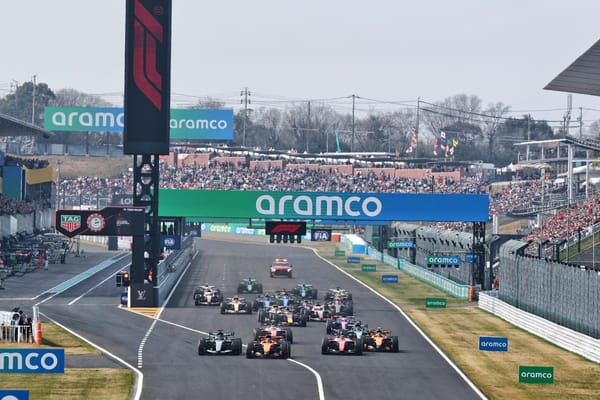
Starts are a massive talking point with Formula 1's new engines and what stands out in person more than the complexity, inconsistency, and alleged safety risk, is simply how peculiar the 2026 procedure is.
With so much new this year, it is hardly surprising that there are some counterintuitive experiences for those driving the cars, and those observing them.
Bashing down the gearbox aggressively to first, hearing the revs rise and seeing the cars lurch around from the engine braking, is a good example. But witnessing practice starts during F1 testing was by a clear margin the most unusual experience of the lot.
Without the MGU-H, the new engines don't have an electrical assist to pre-spin the turbo. So sustained revving is required to increase exhaust energy, spin the turbine faster so it is closer to its effective operating speed, and eliminate the lag before the boost kicks when the driver wants to accelerate.
Videos of practice starts at the Barcelona shakedown showed drivers spending several seconds longer than normal on the throttle, revving the engine for a long time before launching. So this was a known, unusual phenomenon going into Bahrain - but is maybe another 20% or so weirder to experience in person.
Looking for more expert insight from F1 2026 testing? The Race Members' Club is the place to be - join today to start a seven-day free trial
The car pulls into position, the driver engages the clutch and selects first gear, the revs rise - and the car just sits there revving for what feels like an eternity. Some sound more piercing than others - the Audi made for a particularly eardrum-bashing listen in my experience - but overall it is quite jarring compared to the usual hold of a few seconds that came before.
Ollie Bearman in the Ferrari-powered Haas was the first to arrive. He revved the engine for just over 11 seconds before pulling away - but the sound isn't consistent. Even if the revs only change subtly there are small but noticeable crackles, presumably as Bearman slightly modulates his throttle input to go with the clutch bite point.
Next up, Gabriel Bortoleto's distinctive Audi. He revs the engine for a whopping 13.5s before pulling away and the oscillations are unique. I'm not sure if this makes much sense, but it has a very 'metallic' sound: a high-frequency rasping that's not as clean as the Ferrari or the Mercedes, which I heard via Lando Norris's McLaren. The exhaust note is a lot higher and the revs change more before the launch too, although that could obviously just be differences in how quickly the driver settles into the level he wants to launch with.
Lewis Hamilton's practice start in the Ferrari was impacted by waiting for another car to pass, but even so, revving that for some 15-16s was quite something even though it was almost certainly Hamilton just taking his time. Valtteri Bottas taking 11s in the Cadillac despite waiting a few for another car to pass is probably a better indicator of the reduced turbine-spinning requirement the supposedly smaller Ferrari turbo demands.
The works Ferrari's process, probably unsurprisingly, is more refined than its customers. The engine sounds a lot smoother, consistent rpm, and the exhaust note is quite dampened by comparison.
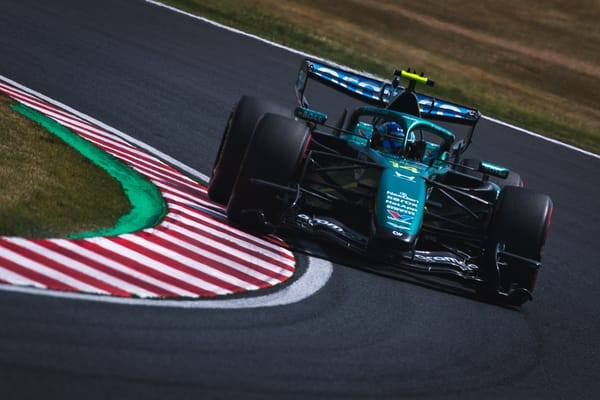
This cannot be said for Lance Stroll's Honda-powered Aston Martin. For one thing, he restarted the process (which, when backing off the throttle, sounded so odd it was almost like a misfire), but when that car sits there for seven seconds, it is crackling and popping so much, on top of a low, guttural exhaust.
It's like the engine has a cold and though some of this will reflect a genuinely distinct-sounding engine it also surely reflects how unrefined the Honda is compared to other engines that have logged a lot more real-world running.
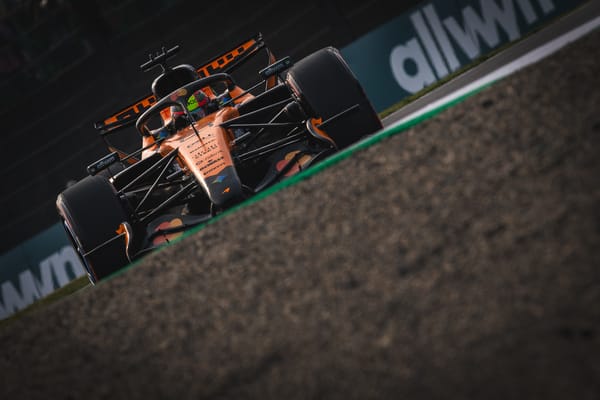
It contrasts sharply with the McLaren, which has an eight-second hold on the throttle, sounds extremely clean (in the circumstances) and has the best bite-point find and rpm consistency of any of the car/engine combinations we got to hear.
The shortest launch process we watched was Liam Lawson's in the Red Bull-powered Racing Bulls. The hold was only six seconds, but it was all a bit messy - revs rising and falling, causing a pitch of the very distinctive, mean Red Bull engine sound to fluctuate, culminating in a slightly flat launch.
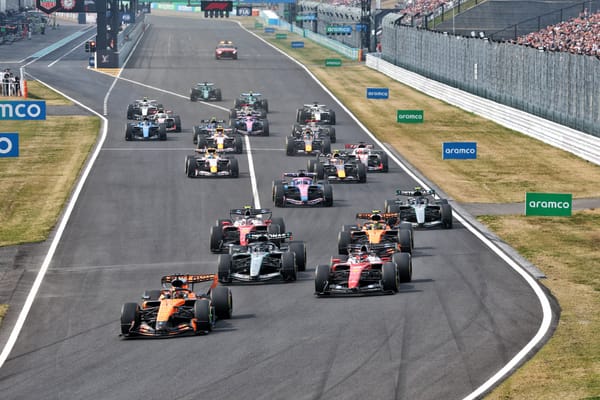
Bearman also fluffed a pull-away - interestingly after just six or so seconds on the throttle - when we were watching a different start, and a couple of others weren't particularly clean either. That's before even factoring in how differently the cars react when the 350kW from the MGU-K kicks in. So it served as an interesting set of case studies for how long, how complex and how inconsistent the starts are at this stage of testing.
"It's a lot more complicated and a bit more inconsistent, that's for sure," says Bearman.
"Now we have to spend a lot longer doing the wait phase prior to doing the actual start and it's really on a knife-edge to get it right.
"It's really a matter of milliseconds, if you're too late or too early by half a second then it doesn't work.
"So it's complicated and so far we haven't been consistent at all with the practice starts, which is a bit worrying, but I think we start to understand why and as we understand the engine more things will get easier.
"It's not as easy as a throttle position equals a certain power from the engine. And then of course you have the transition to MGU-K at a certain speed as well, which is proving challenging to implement properly.
"It's tough for everyone, that's for sure. You see everyone sitting on the grid for 20 seconds with their rpm all over the place and it shows that we're not the only ones struggling with that."
What connects them all is they are loud, aggressive in a way, and disconcerting mainly because it's so unfamiliar. That goes for the drivers, too. One told me that they almost feel bad doing it, because it is so counterintuitive, and that they are wincing a little bit for fear of the engine going bang. It won't, or it shouldn't, because it is built with a very high tolerance, but it speaks to how irregular the whole thing is.
It will become more normal in time, and it may not be something broadcast viewers notice much given the picture choice and where the audio is drawn from for the world feed in those moments before the lights come on probably doesn't need to feature cars at the front of the grid revving their engines weirdly early.
Unless anything changes there, it's just a 2026 idiosyncrasy they need to get used to and accept - as do all of us watching.