The car that looks most difficult at F1 testing
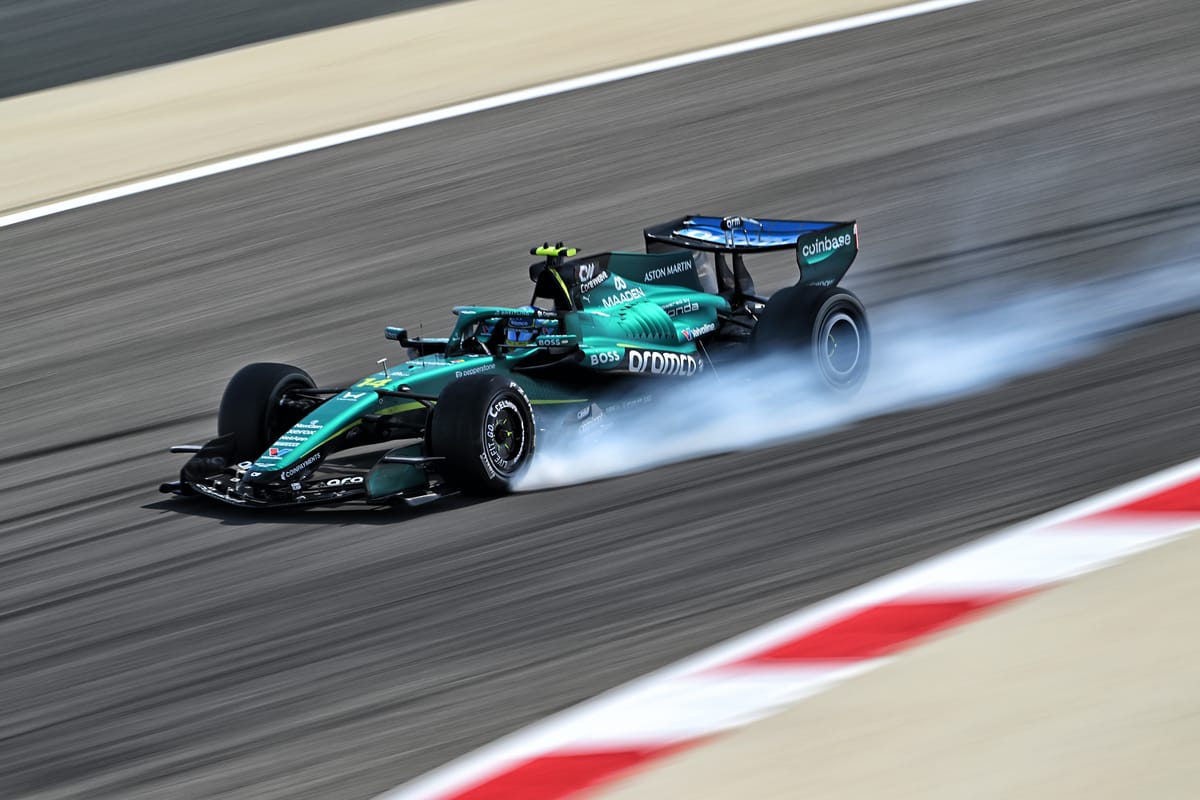
Aston Martin’s tough start to Formula 1 testing with Honda is laid bare when watching the car trackside.
In the hands of Lance Stroll and even the great Fernando Alonso, it looks the most difficult of all 11 cars on track. At its best the AMR26 is constrained and slow, and at its worst it looks plain bad.
No drivers seem to be consistently grappling with the same problems like the Aston Martin pair. The concentration of lock-ups – and big lock-ups, too – into Turn 10 was remarkable even by the standards of this test, in which several drivers have been caught out by the off-camber left-hander.
For regular trackside insight throughout F1 testing, join The Race Members' Club - claim a free 7-day trial here
What is hard to discern is how much of this is car, and how much is engine. The two parts of the package are more co-dependent than ever due to the increased demands of the engine’s energy recovery system, and how that impacts the behaviour of the car under braking and on throttle.
On the first morning of the test, Stroll locked up three times in four laps entering Turn 10. The front of the car looked very stiff, and sensitive to the bumps, which suggested the car’s mechanical set-up could be more to blame.
This continued early on day two, now with Alonso in the car. Three laps in a row, three lock-ups – one particularly massive one that ended in Alonso aborting the corner entirely. After regrouping, his next two push laps featured rear locking, one time midway into the braking phase and the other just at the apex.
When the rear locking occurred, it sounded as though there was silence from the engine for a split-second – a sound (or silence!) that anyone who has locked the rear axle of a kart or rear-wheel-drive car might be familiar with. Whatever this was, to be clear, it is not normal to hear in an F1 car…
The question is the cause. Is the car’s mechanical platform so stiff, and awkward, and maybe heavy, that it is prone to front locking and then the rear locking occurs because the brake balance is being moved backwards, or the engine braking is being increased? Or is this linked to the performance, or lack thereof, from the Honda engine?
Asked by The Race how downshifting impacted the car’s behaviour, Stroll replied tellingly: “It's not great at the moment, that's for sure.”
Later on in the day, Alonso could be seen locking up yet again at low speed and catching snaps at higher speed, so there is not one isolated area of trouble. Rather it looks like a package that is further than any other from being refined and is surely the furthest from its potential. It could become a good F1 car, maybe even a very good one, but it doesn’t look like that right now.
This is not to say the Aston Martin is F1’s slowest car. And others are not great either, and have their own ills.
At low speed the Audi looks awfully unstable as the drivers mash through the gearbox all the way into first. The Williams appeared quite a handful, early on Thursday evening at least, and Carlos Sainz didn’t seem to be having a good time at all.
Meanwhile, newcomer Cadillac – as sure-fire a team likely to be behind Aston Martin as there is right now – just looks grip-limited front and rear, and is simply a slow car by F1 standards.
Every team is working through issues to some degree, and every team is on a different programme with massive swings in performance possible. So the times are still hard to read into, even if Alonso’s end-of-day deficit of four seconds was bang on how far away Stroll hypothesised Aston Martin is at the moment.
But how the car looks on track tallies with the initial driver feedback that there’s a lot to improve.