What we've learned about what 2026 F1 cars are actually like
We have been fed both scare stories and unbridled optimism about Formula 1's 2026 rules revolution for months now.
But with the first pre-season test now in the bag, we have finally been able to get some proper insights from the drivers about how the cars really behave.
Here are 10 fascinating things we've been told about F1's new generation of cars - some of which you may like, and some of which you probably will not.
Lift and coast could happen in qualifying
It is widely accepted that F1's super-powerful 2026 cars are going to be energy-starved, because they cannot charge the batteries as much as needed to go flat-out all the time.
But while many thought this would be a race-only problem, it has emerged that this could be a headache in qualifying too - which means the fight for pole could involve some lift-and-coast tactics.
According to Esteban Ocon, early qualifying simulation laps at the Barcelona shakedown showed that the fastest laptime was delivered if drivers backed off on corner entry.
It is all a consequence of needing to harvest as much battery power as possible.
"If you stay full throttle, you are basically putting the handbrake at the end of the straight," said Ocon. "If you lift and coast, it's not that much. So you feel quicker if you lift off."
Mercedes driver Kimi Antonelli said that lifting and coasting in qualifying, where drivers are normally on the limit, would take some getting used to.
"It is a bit more unnatural to do, because obviously in qualifying you just think to go as fast as possible," he said.
"It's something that we will have to learn, especially because the battery is so sensitive to the driving style as well."
Following in corners may be more difficult...
The overhaul of the chassis rules for 2026 was fuelled by two clear motives: to help reduce drag to better suit the new power units, and to improve the ability of cars to follow each other to help the racing.
That second step prompted the move away from full-on ground effect machinery, and a lot of work has gone into eradicating the dirty air problems that eventually marred the old ruleset.
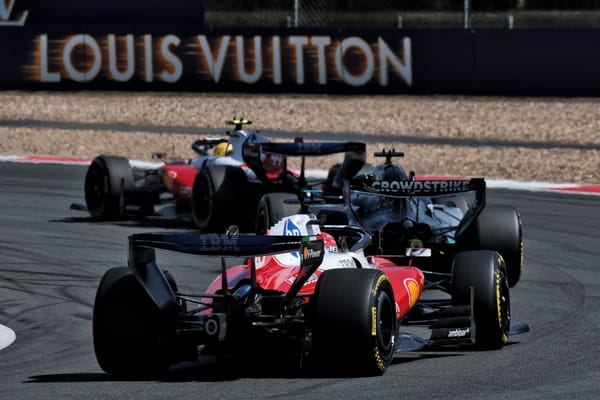
But first impressions from Barcelona suggest that these new cars may not be any better at racing in another's wheel tracks. In fact, they could be worse.
Haas driver Ollie Bearman said: "It was a bit more challenging to follow. It picked up quite a big shift in balance compared to clean air, which seemed a bit more so than the previous generation of cars."
Team-mate Ocon said: "You seem to lose quite a lot of front load, a bit more maybe than before."
However, not all drivers felt that things were worse than last year, with Mercedes' George Russell sensing an improvement.
"Following definitely does seem easier, especially in the high-speed corners," he said. "It's firstly because you have less downforce, and you're going through the corners slower, so there is naturally less wake."
...but closing speeds on straights are huge
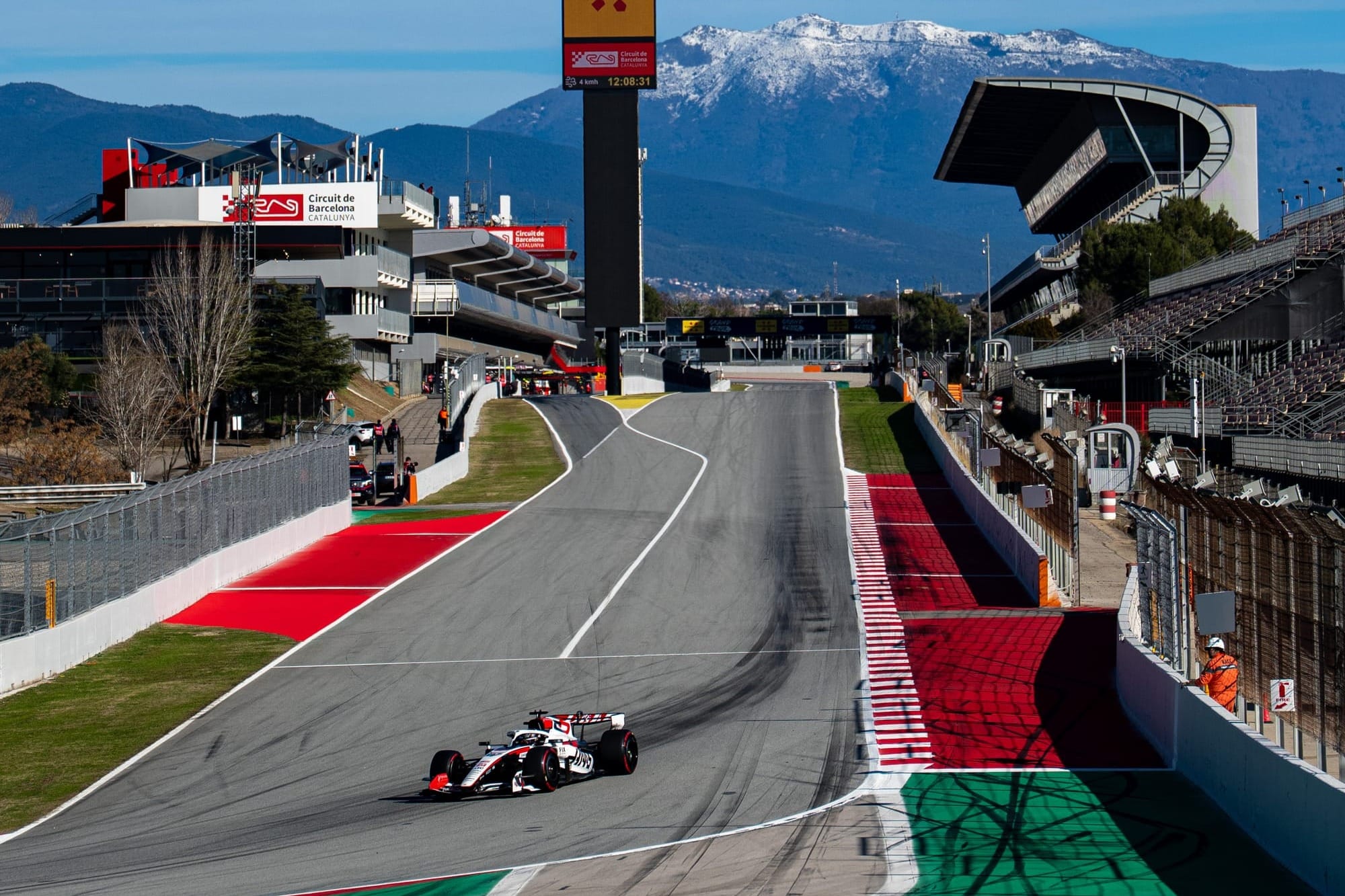
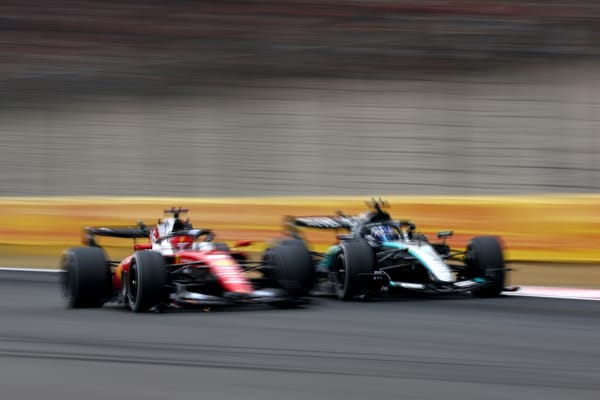
Even if the corners are a problem, early evidence of differences of car speeds on straights suggest that passing there could be more frequent.
Having watched the cars trackside, Mercedes boss Toto Wolff said: "George passed [Franco] Colapinto while Colapinto was doing his long runs – and it was a 50km/h straightline difference. That is super exciting. We are going to see much more overtaking."
But a 50km/h speed differential between cars does not come without risk - and Russell suggested it may become an issue in some instances.
"There are going to be some examples of major closing speeds," he said.
"I don't think that'll be a problem in dry conditions, but it would be a problem in low-visibility races. However, if there's low visibility, that obviously means it's wet. And if you're driving in the wet...because you're going around the corner so much slower and the braking distances are longer, you're reharvesting much more and you're spending much less energy."
Active aero is a missed opportunity
One of the most visible differences to the cars this year is active aero, with both the front and rear wings having different modes depending on whether a car is on a straight or in a corner.
But while the impression from the outside is that the use of active aero looks spectacular, the early feedback from the cockpit is that the tool is not as powerful as some hoped.
Ocon said he felt a bit disappointed that the end product had just basically added a front DRS over what they had before.
"It's more of an efficiency thing than really something that's giving us more tools to play with and stuff like that," he said.
"I would have preferred if we could set the front flap as we want for every corner, before we were driving. That's what I call active aero.
"The Pagani Huayra [road car] some years ago, that car had active aero on the front and it was setting it up for whatever corners you were taking and what you were needing in terms of balance."
Electric hit on straights feels 'brutal'
If there is one thing that became obvious from watching the cars at the Barcelona shakedown it was that they are pretty punchy coming out of the corners.
That is not just the result of the roughly 700kW, the equivalent of 1000bhp, on tap from the power unit. It is more that half of that power comes from the battery, so has loads of torque.
As Antonelli said: "We have got a lot more power from the electrical engine. The acceleration is quite brutal."
If you want to catch up on more content from Barcelona - and our trip to F1's behind-closed-doors test - The Race Members' Club is the place to be. Join today for a seven-day free trial
Ocon reckoned that drivers were hitting 350km/h on the run down to Barcelona's first corner, with the acceleration just keeping on coming.
"I never thought I would get to 350km/h that fast," he said. "We had an inconsistent deployment in one of the runs that we did and I had full deployment into the straight and I arrived at 355km/h in Turn 1 in Barcelona!
"The braking was very different to the laps before, but the way it climbs and the way you feel the speed climbing, it's something insane. Honestly, it's something I've never felt in Formula 1 or that I've never felt in any cars driving prior to that."
Cars feel lighter and more nimble
The reduction of the size and weight of the 2026 F1 cars might sound minor, but the drivers can already feel the difference it makes.
The wheelbase is shortened by 200mm and the width is down 100mm compared to last year's cars, while the minimum weight has dropped by around 30kg from the hefty 800kg of 2025.
"The best aspect is the car is a bit lighter, so in some places it feels a little bit more nimble," said Bearman. "And you still have an incredible amount of downforce."
Team-mate Ocon described the cars as feeling "more like the 2020s era, where it was less snappy and a bit more comfortable at high speed". In particular, he felt the difference in the sharpness of the change of direction.
"You definitely feel the weight reduction," he explained. "You feel how [noticeably] smaller the cars are as well.
"There isn't so much direction change, [there is] in Turn 1 and 2 but Barcelona had quite cold weather so the tyres are never feeling good. But Turns 10, 11, 12 you really feel when you change direction that it is pretty good on that side of things."
Antonelli felt the same thing, particularly when it came to turn-in and directional change.
"You feel the 30kg less and obviously the car being a bit smaller," said Antonelli. "You just feel it is more agile, especially in changes of direction and in slow-speed corners, which is a nice feeling."
Tyre degradation could be massive
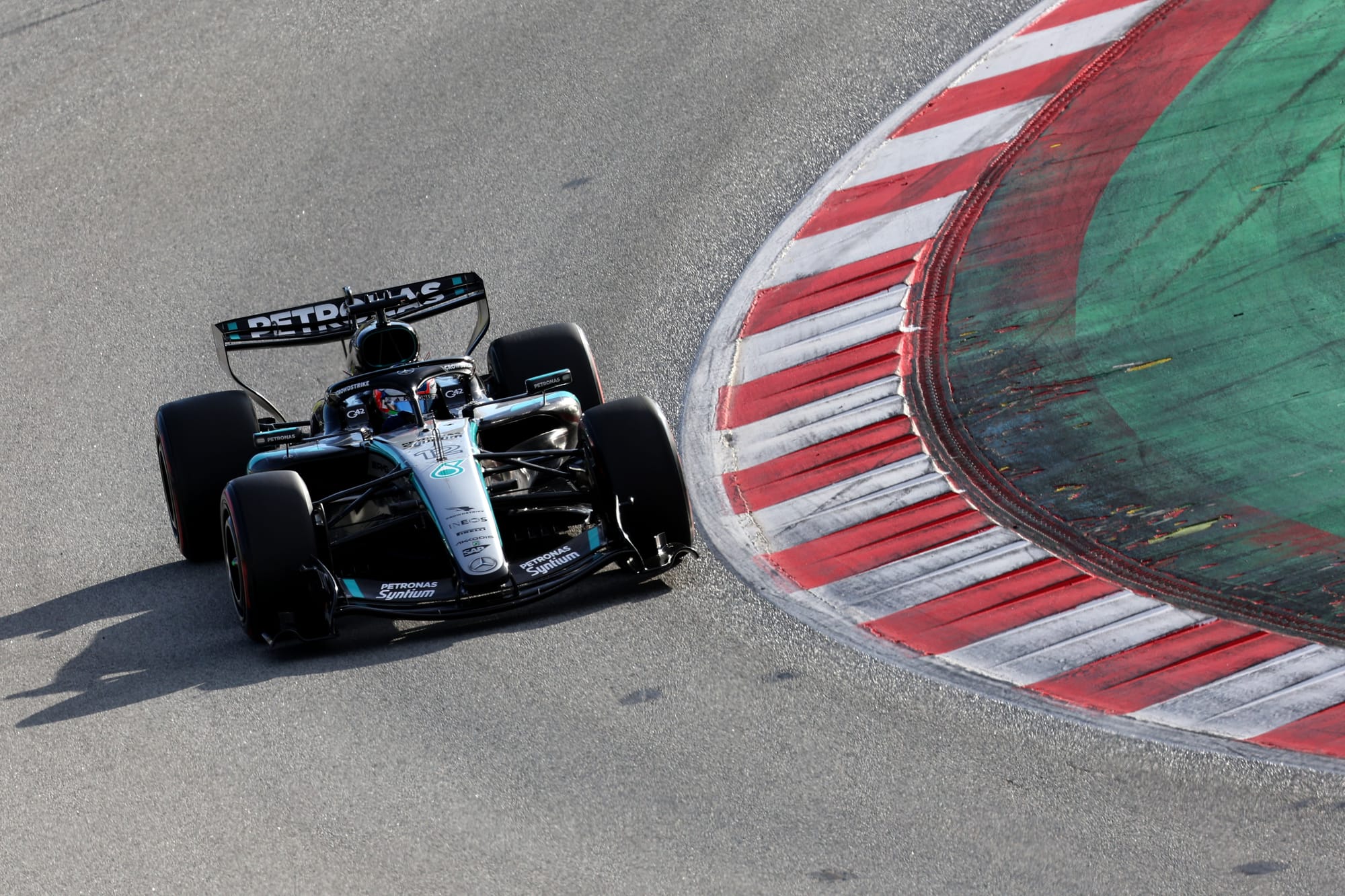
Given the prodigious power of these cars in the corner-exit phase, drivers found they had to be wary on the throttle at Barcelona.
And when you consider that tyres are 25mm narrower at the front and 30mm narrower at the rear, to make a drag-reduction contribution, it poses a bigger tyre-management challenge than last year.
"Smaller tyres, more power, degradation might be higher, especially for the rear tyres," warned Antonelli. "It might be more difficult to handle with the amount of power we get out of the corners."
Ocon found the same thing, adding "we need to be very careful not to kill the tyres completely", pointing to the cars having "less grip than we had in the last couple of years".
It's not all about the power unit
While the new power units - with the notional 50/50 power split between the internal combustion engine and the MGU-K - mean that energy harvesting, deployment and management are critical this year, these cars still take some driving.
Russell admitted that was a concern before he drove the Mercedes W17 in the real world, but fears were allayed by his experience of the real car.
"That was a question mark that I had going into the test, whether it would be like Formula E, [and] you need an engineer to drive the car rather than a racing driver," said Russell. "But it felt much more intuitive to drive than expected."
This means there's still scope for the driver to have an impact beyond simply acing the intellectual challenge of energy management.
This is especially true as technique has an impact on how much energy you can harvest in a lap up to the baseline maximum of 8.5MJ.
"It's still a race car," said Ocon. "I was expecting that we would have to work so much on the hybrid power and try to get everything correct, which is the case for sure.
"You need to get everything correct, otherwise the laptime is not there at all. But we are still adapting the balance of the car, working on tyre prep, all of this. It's still a very big part of that.
"I was a bit afraid that we would not touch the car for the whole year and we would only touch the engine side and the electronics. It's been actually all right."
Drivers are no longer being battered
The new regulations reduced the reliance on ground effect underfloors, and as expected the elimination of the venturi tunnels means these cars no longer run as low as possible and super-stiff.
That means there’s no problems with porpoising or mechanical bouncing, much to the delight of the Mercedes drivers.
"My back is having an easier time of things," said Russell.
Team-mate Antonelli suggested this means more flexibility when it comes to ride heights in cars that are now running rake, whereby the rear ride height is higher than the front.
This increases the angle of attack of aero surfaces and potentially means more downforce.
"We don't have bouncing anymore," explained Antonelli. "You have a bit more room as well to play with ride heights.
"Last year was all about putting it as low as possible without making it bounce, this year you can play a bit more with ride heights depending on the balance you have on the car."
But it is still F1
The cars may have changed dramatically, with the energy-management demands far beyond anything drivers have experienced before, but these are still stunningly fast cars in the finest tradition of grand prix machinery.
Asked by The Race whether these still felt like F1 cars, in the wake of concerns such as lifting and coasting in qualifying, Ocon said: "I think it is, because it’s still the fastest cars in the world.
"We have to optimise as drivers the tools we have to go as fast as we can. It's still enjoyable to drive and still an F1 car."
Russell shared that view, underlining that F1 cars have always changed and evolved, with the demands on the drivers shifting while retaining the underlying challenge.
"It definitely still is Formula 1," said Russell. "It still very much feels like a race car, and you're still very much pushing the limits. But you are driving it differently.
"If you look back to the late '80s and '90s and you look at Ayrton Senna's driving style, where he's blipping the throttle through the apexes to spin the turbo, that's also a unique way of driving.
"And also in the same way as when you went from a gearstick to paddles on the back of your steering wheel. It's just different and it changes."
The cars will also evolve rapidly, with the power unit performance and the grip levels set to rise relentlessly as this ruleset matures.
The consensus from the drivers so far is therefore that the worst fears from last year, when early simulator models drew so much criticism, have not been realised and that these are still cars they must push and race to the limit.