Where big Mercedes 2026 advantage really is
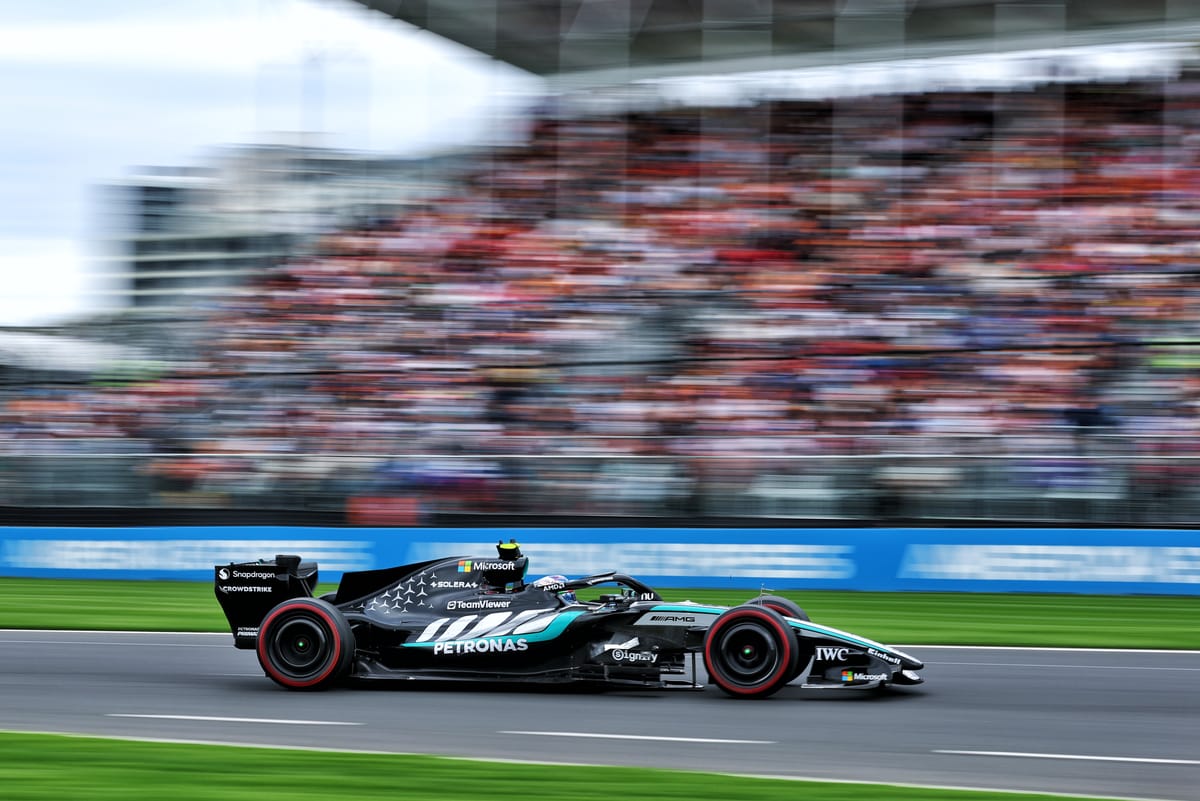
Qualifying proved the Mercedes W17 really is the class of the 2026 field. It also showed that F1 2026 has produced a very different kind of qualifying session or, one required what McLaren team principal Andrea Stella calls “a new language and a new way of thinking”. Understanding that is key to mapping out the reasons for Mercedes’ advantage.
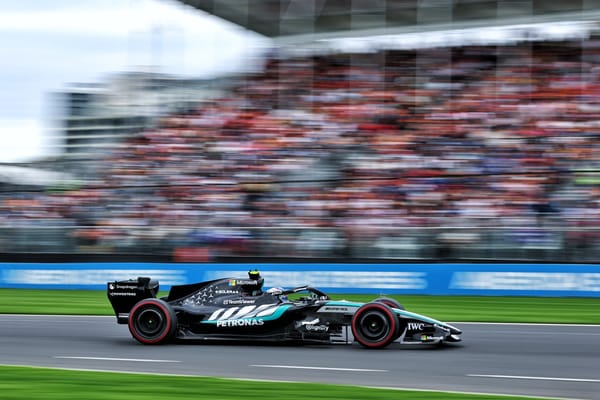
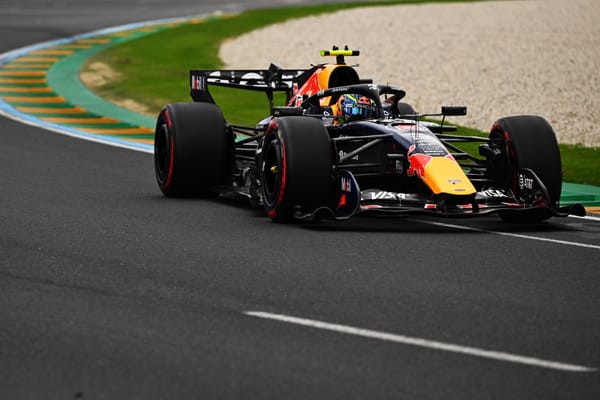
After bagging his eighth Formula 1 pole position with a lap a massive 0.785s faster than the closest non-Mercedes, Isack Hadjar’s Red Bull, George Russell stressed that its margin lies not only in the power unit, but also the quality of the chassis.
“We’ve got a really great engine beneath us,” said Russell. “However, we’ve also got a really amazing car beneath us and that probably hasn’t been highlighted enough in the press these past few weeks.
"The car from the off, Kimi [Antonelli] and I both said it felt great to drive.”
One misleading conclusion would be that, as Russell says, it really isn’t purely the power unit given his advantage over the lead McLaren-Mercedes of Oscar Piastri was 0.862s.
There are indicators that perhaps the Mercedes is the superior chassis, with Russell’s minimum speed in the majority of turns on his pole lap a little higher than that of the McLarens, but this is dwarfed by the deployment superiority. That manifests itself in terms of speed gained on the straights.
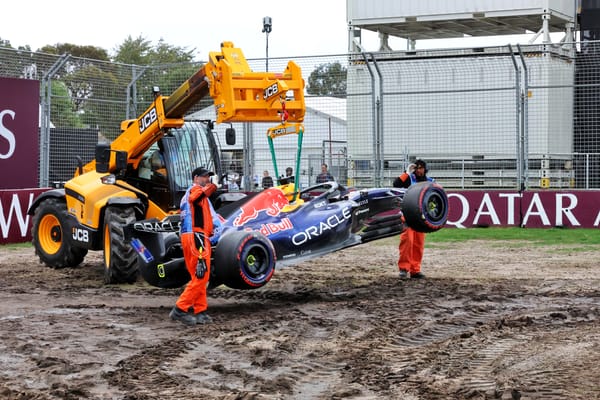
With the caveat that Max Verstappen was absent from Q3 after his earlier crash, and both Ferrari drivers complained of deployment troubles, breaking down Russell’s lap compared to the fastest cars from each of Red Bull, Ferrari and McLaren is revealing. What stands out is the deployment advantage on the back straight.
Based on the data available to The Race, there’s a point at the exit of Turn 8 when all four are at full throttle and travelling at similar speed - Russell and Charles Leclerc are at 290km/h, Isack Hadjar at 289km/h and Oscar Piastri 291km/h. At that point, Russell is up on all three of them with Leclerc 0.225s down, Piastri 0.252s down and Hadjar 0.332s down.
As they traverse the back straight, the speed traces diverge. First Leclerc and Piastri level off, and while Hadjar goes with Russell there is a gap between the speed of the Red Bull and Mercedes in favour of the latter. All four cars start to shed speed as they super clip, but Mercedes does it from a higher peak and starts to level off later.In the seconds since that point on the run out of Turn 8 and the cars arriving at Turn 9, Leclerc has lost another 0.234s, Hadjar 0.222s and Piastri a hefty 0.449s.
There’s a similar pattern on the run out of Turn 10. It takes an estimated 25 seconds for cars to get from the point at Turn 8 where the speeds were similar to Turn 11, but by then Leclerc has lost 0.650s, Hadjar 0.722s and Piastri 0.628s. That’s approximately 32% of the laptime, but accounts for 80% of Leclerc’s time loss, 92% of Hadjar’s loss and 73% of Piastri’s.
That last number is most striking, given Mercedes and McLaren share the same power unit. Yes, there are differences of aerodynamics, gear ratios and driving technique, but it's symptomatic of a fundamental superiority of the works team when it comes to its energy management.
“I don't know what the Mercedes lap looks like, but we were lifting and coasting three times a lap,” said Piastri. “We had two super clips through the lap. And in some corners we've got effectively 450 horsepower less.”
The question is, why? The regulations demand that the power unit specification and the available modes must be the same across works teams and customers, so there’s no advantage for Mercedes there. Where there is an edge is in terms of integration and, most significantly, preparation. It’s been clear since testing started that the works teams had the advantage when it comes to that, but even then McLaren has been surprised by the magnitude of its deficit on the straights.
“It took qualifying, to be all in the same condition on track, same power unit, to have enough of a reference to understand what is possible,” said Stella.
“From this point of view, being a customer team doesn’t put you on the front foot.“This doesn’t have to do with the hardware, this has more to do with learning about the hardware and identifying the best way to exploit it. We are certainly entering a new era of Formula 1 in which these factors become essential in terms of sensitivity to driver's input, the way you use your energy in the preceding straight to have the maximum deployment in the following straight, especially if it's a long straight. All these factors become essential.”
That’s the new language Stella referenced. Although he didn’t go into detail, it hints at the subtleties of energy strategy that have a profound impact on pace. A look at the run to Turn 6 shows a key difference that suggests Mercedes might well have reached that corner with a better state of charge. There, Russell’s speed levelled off before Piastri, meaning the McLaren made a small gain. However, with ostensibly small differences in battery level significant given the laptime benefit of the extra 350kW the MGU-K gives you, that led to a significant loss on the long flat out section that follows once they got through the flat-out Turn 8 kink.
This is just one subtle detail, but it’s reasonable to assume if McLaren re-ran qualifying, the approach to Turn 6 would be modified and that loss reduced. But not eliminated.
“It is true as well that Mercedes are quick in the corners, not only in the straights,” said Stella. “There's a few corners in which we can compete with them, but overall they are faster in the grip-limited sections. Mercedes are doing a better job than us at exploiting the power unit, but they have also done a better job than us in terms of overall grip in the corners. I guess in particular, this will have to do with the level of downforce.
"So for McLaren, there are two clear objectives. One is work together with our HPP partners to get more performance from the power unit, but at the same time we need to improve the aerodynamic performance of the car because we need to go faster in the corners as well.”
Ferrari, at a track where it’s smaller turbo was always going to be a slight disadvantage given there aren’t so many slow corners to capitalise on the low-end punch it provides, generally had to be a little more conservative in terms of deployment but performed well on the brakes, which was an area where Russell was also generally strong.
The Red Bull stood out in the high-speed corners, but also couldn’t quite match the deployment regime of the Mercedes. But currently, it’s the energy regime that’s the overwhelming factor in the competitive equation, although over time that should reduce and hopefully allow the underlying car characteristics to reveal themselves.
Looking at the rest of the lap, there is evidence that the Mercedes can at times be a bit more aggressive than the McLaren under braking and often carry a little more speed. But generally, those differences between the top four cars are a small part of the competitive equation.
So the Mercedes is certainly a strong car, but right now it also has the best power unit and, crucially, the best handle on how to extract the most from that power unit. That's to its credit because no matter what your position on the rules, it has done the best job. That pace should translate into victory on Sunday judging by the long runs earlier in the weekend.
How long this supremacy will last, particularly over a team like McLaren that has the same engine to exploit, is a question that we cannot currently answer.