The trick making Verstappen and Red Bull stand out from trackside
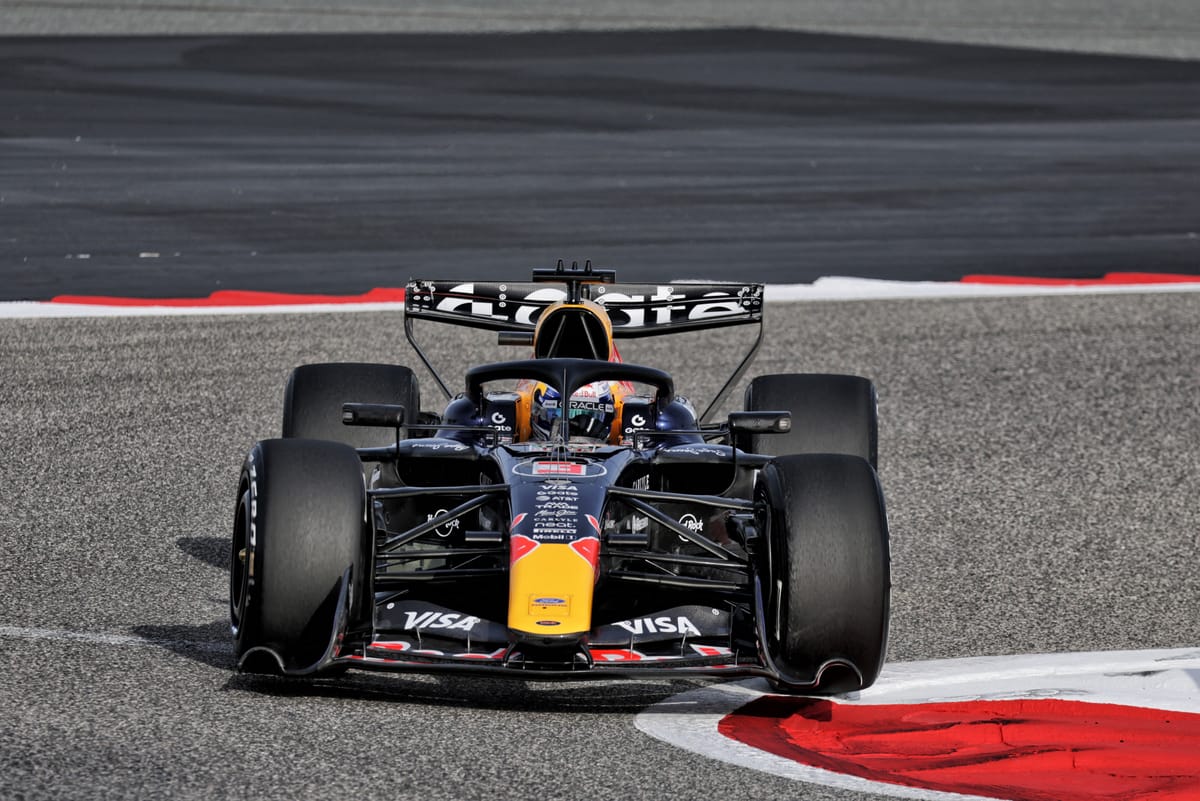
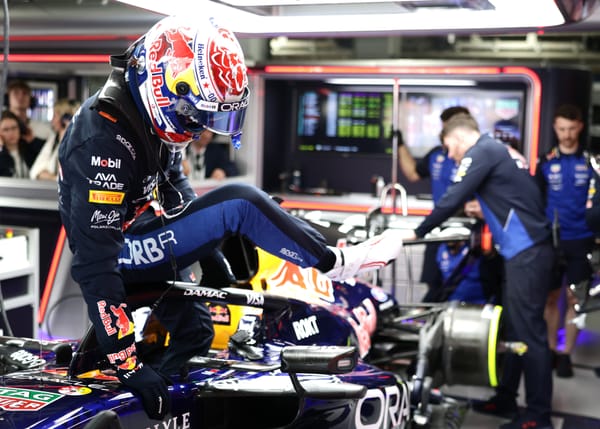
Early on the first day of Formula 1’s Bahrain test it was apparent Max Verstappen was doing something others were not.
Verstappen has been an early proponent of using an unorthodox downshifting technique that offered us the first real sign of potential tricks to use high-revving engines to help charge the batteries.
Nothing crazy has quite come to pass but throughout Wednesday’s running Verstappen was consistently using first gear where it would never normally be needed and where (initially) everyone else was using second gear.
Before this year, the slow Turn 10 left-hander would normally be taken in second gear – and by the majority, it still is. So the big spike in revs and the squirm under braking when Verstappen flashed into view on a push lap for the first time was striking.
For regular trackside insight throughout F1 testing, join The Race Members' Club - claim a free 7-day trial here
Verstappen downshifted to first gear while still doing a lot of the braking work, so the rev rise was significant - but obviously within the engine’s tolerances - and the car behaviour shifted a lot too.
Anyone who has driven a road car with a manual gearbox, or even done simracing of some kind, will be familiar with the uncomfortable lurch and/or locking that can occur when downshifting overenthusiastically.
It is a familiar impact even on an F1 car and it is counterintuitive for drivers, who need to pre-empt it to deal with it most effectively, and requires good pitch control and stability from the car itself to not react too aggressively.
Verstappen was driving like this right from the start, throughout the day, and on both push laps and sustained running. It became a technique adopted or experimented with by a couple of others as the day progressed but feels like something that Red Bull is deploying as a deliberate tactic the most, and to the best effect, and Verstappen already seems relatively at ease in terms of mastering.
These approaches are all about the 2026 engines and the need to recharge the battery as much as possible in order to feed the much more powerful MGU-K. There are different ways of doing this, like more extreme lifting and coasting to what has become the norm of late to recover energy at the end of the straights, but harvesting energy from the rear axle under braking.
Another specific pattern, for example, was Verstappen seemingly downshifting in pairs as he moved down the gearbox – for example, doing fifth-to-fourth-to-third as a double downshift, then a slight pause, then third-to-second-to-first very quickly again.
What Verstappen was doing all day in the Red Bull, Audi switched to quite early late in the morning having initially started in the more conventional manner. Both Gabriel Bortoleto in the morning and Nico Hulkenberg In the afternoon didn't look particularly comfortable with what the car was doing. It seemed a lot more disruptive and uncomfortable to deal with.
By comparison, the Red Bull looked relatively neat and tidy. There were a few slides, especially into Turn 10. That is a particularly tricky corner, coming from Turn 9, and there's a lot of wind there which caught a lot of cars out through the day. There was nothing particularly problematic, though, and it felt a world away from 12 months ago, where Verstappen was obviously displeased with the awkwardness of the car.
This is an entirely new generation, though, and the techniques that we are seeing are a great example of that. It might turn out to just be a period of experimentation over the course of this incredibly steep learning curve that all the teams and drivers are on, and the Red Bull technique might not be the same on Friday as it is today.
Other teams might change what they're doing, too, as Red Bull will not be the only team and engine manufacturer that knows ‘if we downshift aggressively we can charge the battery’. But on Wednesday it was an area in which Verstappen and his car looked and sounded at odds with others.
The Ferrari, for example, is completely conventional (and not particularly planted). The same goes for its customer teams. The Mercedes engine cars seem to be eschewing this downshifting technique as well, although Alex Albon was maybe experimenting with first gear at Turn 10 early in the evening.
That's what it sounded a little bit like, but nowhere near as notably as Verstappen or the Audi drivers were, so it might have been a late downshift, closer to the apex – by which point the engine is further down the rev range so the downshift is less destabilising but also the less useful it'll be in terms of that extra bit of recharge.
It’s not going to be the silver bullet for why Red Bull's engine seems to be quite encouraging in terms of how much it can recharge and therefore deploy the maximum of down the straights.
More from testing
- The first clues from Bahrain F1 test day one long runs
- McLaren tops first day of Bahrain F1 test but Red Bull shines
- What's behind Hamilton's sudden 2026 F1 cars criticism
- Mercedes claims Red Bull a second faster on straights
- Where new F1 cars are already troubling drivers in Bahrain
However, given Red Bull was making noises about the potential for extreme, high-revving tactics for nearly two years, it could be that the entire foundation of its engine design and energy recovery philosophy has been rooted in a high tolerance for aggressive treatment.
Maybe it will prove to be something others cannot replicate, maybe it is a different way of achieving exactly the same result.
Right now it is mainly just interesting to observe early on that it seems to be going down this route, and that Verstappen seems to have adjusted to it well.