The questions Norris's F1 title answers - and those it doesn't
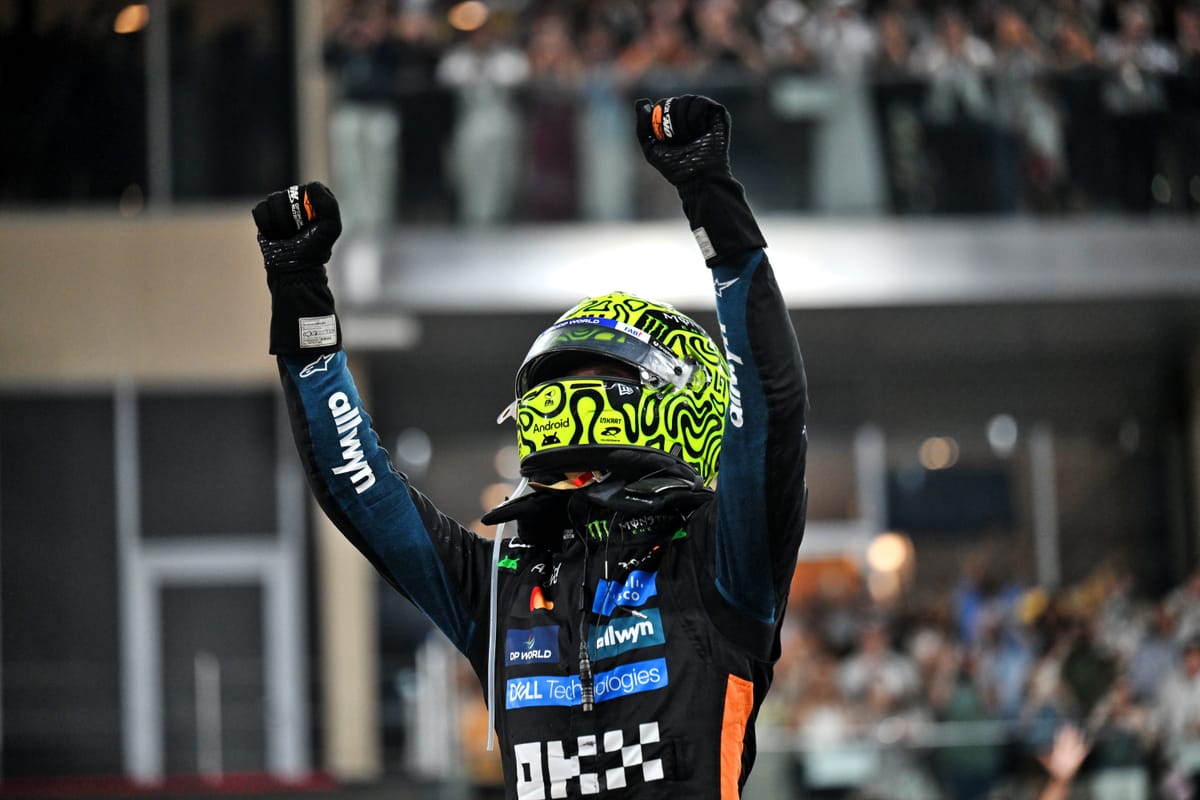
In his darkest moments, Lando Norris must have feared the 2025 Formula 1 world championship was beyond him.
That’s an inevitable consequence of the zero-sum game that is elite sport, where it feels like it’s either total success or abject failure and no middle ground. Intellectually, Norris will always have understood there will be other years and new opportunities, but emotionally the feeling will have been all or nothing.
Professional sport is not life and death, but in the bizarre environment in which high-profile athletes operate it feels indistinguishable. These scenarios, particularly in individual competition – and when it comes to the drivers’ championship that’s what F1 is even if it is simultaneously a team sport – test you in unimaginable ways.
Norris insisted ahead of the weekend that whatever the result “it doesn’t change my life”, but how could it not? Achieving - or narrowly missing out on - your life’s goal can’t fail to change things and there’s no doubt that the experience of this season has changed him, and would have done regardless of the result.
In terms of his technical skills and artistry behind the wheel, Norris is largely the same driver he was a year ago. There will be the marginal gains that anyone in their seventh season will make, but it’s long been established he’s a driver of tremendous feel and sensitivity, capable of incredible speed. But the conditions of the championship fight forced him to evolve.
It has not been anything like a perfect campaign, and even the all-time greats rarely produced those. But put yourself in Norris’s position at the start of the season; you’ve got the best car in the field, either you or Oscar Piastri should be champion, but you are struggling. The latest mechanical step, necessary for aerodynamic performance, has numbed your feel. You’re still fast, but you can no longer dance on that narrow peak so comfortably, so too often slip off it. And at times you over-reach striving for the perfection you crave.
Saudi Arabia encapsulated that experience for Norris. He was clearly the fastest driver in Jeddah but couldn’t resist reaching for the extra entry speed Piastri carried into Turn 4, even though he was already quicker overall through and off the corner sequence, and shunted in qualifying.
There were criticisms of his mental frailty and perceived psychological weakness early in the year. Was he too ‘soft’, not ruthless enough, too willing to admit to weaknesses? Much as his make-up is perhaps not typical of world champions, it’s important to note there are outliers in that group and such simplistic arguments disregard how that mental battle intertwined with the technical challenge. That's why the first half of the season was erratic. When he was good – Australia, Monaco, Austria – he was great, but there were also occasions his underlying speed was strong but he failed to execute, and others where he just plain struggled. The struggle for confidence was obvious.
The change in front suspension geometry in Canada in June gave him improved feel, and that played a part in his improvement. By the time Norris reached the high-water mark of the season with back-to-back wins in Mexico and Brazil just over four months later, he looked utterly in control.
The fightback after the Zandvoort engine failure at the end of August appeared to simplify the task for him. It took time and he still had his ups and downs, but he became better at dealing with those. That’s what allowed him to recover from 35 points behind, never over-celebrating the successes or taking the failures as hard as he did earlier in the year.
"There are certainly some periods that were much tougher, which I’ve worked hard to avoid as much as possible," said Norris. "I certainly think my mentality and just general emotion, in a way, has gone down, that’s a good thing for me. Not that I'm an emotional person, but I care. So in terms of removing some of those cares, it has helped.
"I certainly feel like I can deal with a lot more now than what I was doing at the beginning of the season, but I was also dealing with a lot more difficulties at the beginning of the season than I am now. So it's difficult, but I always say I'm in a much better space than I was back then for many different reasons. It's all part of learning.
"Do I wish I could have changed some things? Maybe. But would I be as good now as if I didn't learn those things back then? Probably not. It's all part of learning and time and making mistakes."
The minor wobbles in Las Vegas, where he lost the lead to a mistake at the first corner, and in Qatar, where he got slightly untidy at times as he took on a resurgent Piastri, proved he’s still not immune to making errors in high-stress situations. The underlying weaknesses are still there, but he’s come through that and won the title when many others - most even - would have fallen down and not found the fight to pick themselves back up.
Do not underestimate what it takes to do that, even if you are driving a 2025 McLaren, for the history of grand prix racing is littered with very good drivers who wasted similar or even better opportunities to win the title than Norris. World championships simply do not come easy and Norris is, without doubt, a worthy champion.
Norris isn’t the finished article, but that’s usually the case for first-time world champions. Max Verstappen’s 2021 campaign was a superb one, as regardless of how it ended he was marginally the strongest driver across the year, but he's become even better since.
So what’s next for Norris now he can be more secure in his place and abilities now? Will he be a Jenson Button character, satisfied to have won one title and at ease with his standing in F1 as he racks up more wins but never another crown? Will he become a relentless Michael Schumacher or Lewis Hamilton-style title accumulator? Might he struggle to go again at the start of next year, as Mika Hakkinen did?
You could say he’s ‘completed’ F1, as all he can do now is climb the same mountain again. His appetite for doing so will reveal much. Will he forever remain a driver who is brilliant when things are right but can a little too easily slip out of that window? Or will the lessons of this year change that? The odds are that he will take another step, but how big a stride, and how many more he will make remains to be seen.
Whatever questions Norris still has to answer, he’s answered the big one. He’s one of only 35 drivers to have won the world championship in three-quarters of a century, an incredible achievement for any driver whatever the circumstances.
When the celebrations are over and as he comes to terms with fulfilling his life’s ambition he must answer the question: what’s next? How he does that will shape his legacy as a grand prix driver, but what happened in 2025 means whatever happens he will have a significant one.