The brutal Mercedes contrasts behind Russell's 'rubbish' pace

A confused George Russell lacked answers for his “rubbish” pace at the United States Grand Prix, which contrasted brutally with his championship-bound Formula 1 team-mate Kimi Antonelli.
Russell finished eighth and 54 seconds behind race winner Antonelli, who is now all but guaranteed to become F1 world champion in next Sunday’s Mexican Grand Prix.
It was unlikely that Antonelli would seal the deal in Austin but such was the difference in fortunes between the Mercedes drivers he very nearly pulled it off.
Russell’s final margin and his lowly position was exaggerated by the consequences of a five-second penalty that meant he got stuck behind McLaren’s Oscar Piastri in the second half of the race, but as he bluntly told Sky Sports F1: “The pace was just rubbish today, that’s the long and short of it.
“The five seconds probably cost me two or three positions. But the pace was not good enough when it needed to be.”
Russell was particularly alarmed by a poor opening stint that cannot even be explained satisfactorily by being in traffic, because he slipped back a few seconds behind Isack Hadjar’s Red Bull as it progressed.
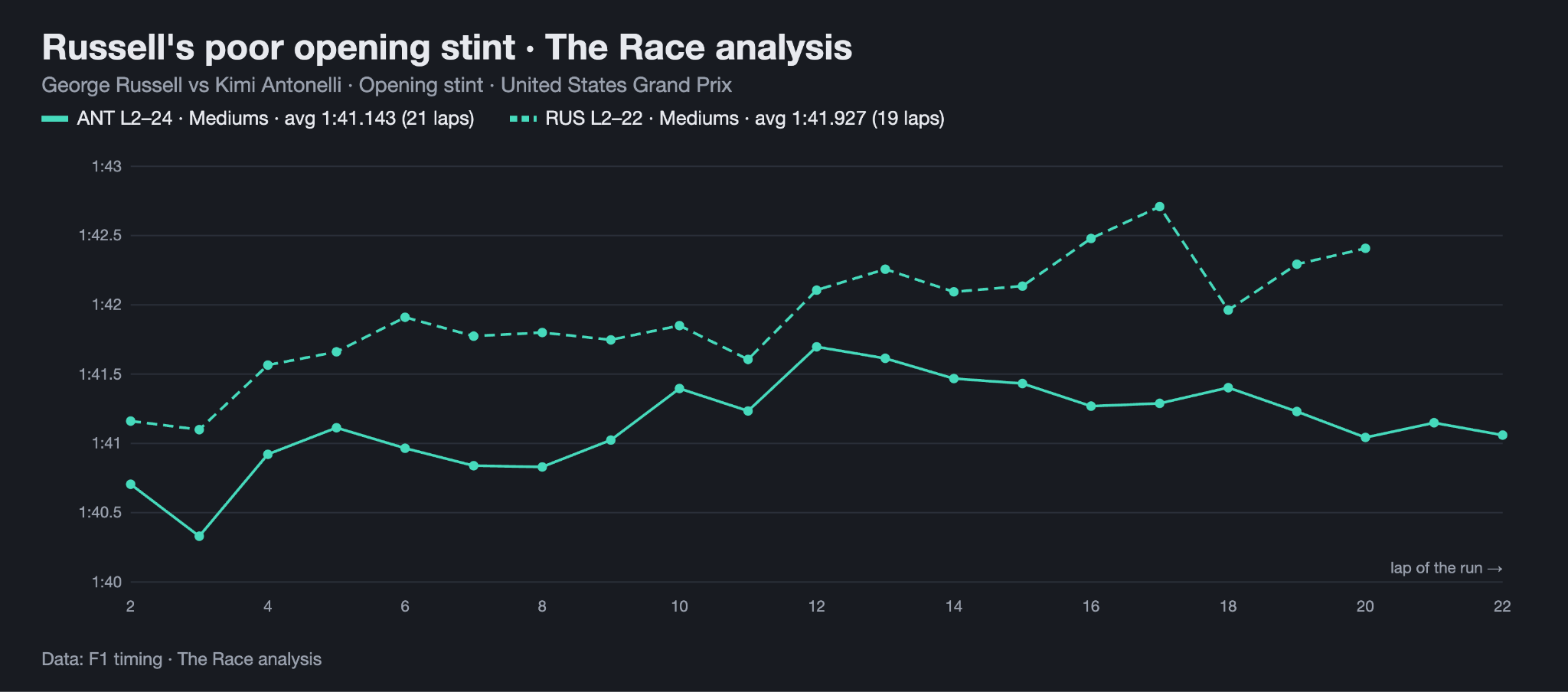
There would have been some dirty air effect here, but not nearly enough to explain why Russell was eight tenths a lap slower than Antonelli on average and drifted so far away that early two-stoppers Max Verstappen and Charles Leclerc had caught and re-passed him before Russell finally came in.
Russell called it strange to be so far off, and when he spoke to media including The Race shortly afterwards he had no answers, admitting: “I need to give myself 24 hours to think clearly”.
That first stint is a large part of why Russell summed his race up as “six good laps, 50 bad laps”. The start of his second long stint on hards - before catching Piastri - the only relative bright spot, but even then he seemed around a tenth or two slower than Antonelli: closer, but still slower, and this is a comparable part of the stint because while Russell was catching Piastri, Antonelli was catching Leclerc.
“The pace wasn't good on the first stint, but when I came out of pits on the hard, I probably did six laps where I was lapping the same pace as Kimi,” Russell said. “But then I caught Oscar and I just couldn't overtake.”
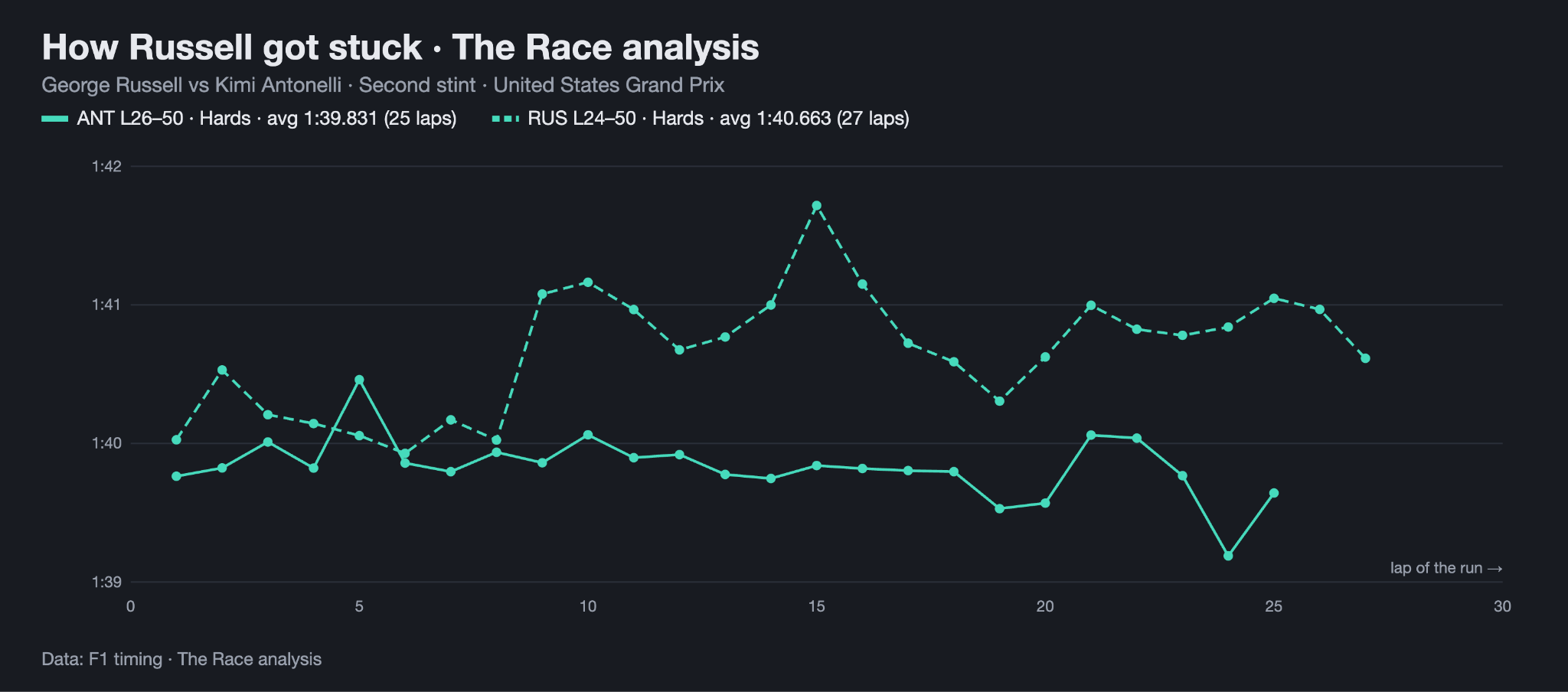
Piastri’s defence - and/or Russell’s surprising difficulty in making a move, with only a single attempt on lap 37 rebuffed - did indeed kill Russell’s race. He was stuck at Piastri’s pace as McLaren made a stretched one-stop work, and so a direct comparison with Antonelli’s pace was not possible.
Russell’s focus was elsewhere, though, hence stressing: “I want to understand why the pace was so bad on the first stint”. But to compound the confusion he added: “I need to dig deep with my team because it's difficult to understand when you're so far off.”
All there are, for now, are theories. Antonelli proved that the upgraded Mercedes does have a wonderful peak, but Russell may be suffering from the narrow balance window that has been talked about.
There’s also the way they simply drive these cars and engines. It cannot be a coincidence that Russell and Piastri, the two chief strugglers of this generation of car among the leading teams, received a pasting from their team-mates this weekend.
Some of that must be in how comfortable they are manipulating the car in slow corners. Russell was there with Antonelli in the faster turns in qualifying at Austin, but consistently losing out elsewhere.
Antonelli definitely seems happier living with the rear moving around and is more precise in balancing how much to push that without over-stressing the tyres – but in Austin he was also, generally, willing to sacrifice a little bit of corner entry speed to maximise his exit.
As the below trace shows, charting the loss from Turn 12 to 15, the delta falls and rises based on their different entry speed approaches and runs off the corner, but it culminates in Antonelli eventually having a decisive advantage by the end of the sequence.
This is where Antonelli was particularly strong versus other cars too, whereas Russell has gradually lost control of rear tyre temperature ever since a small error way back before this sequence at Turn 11.
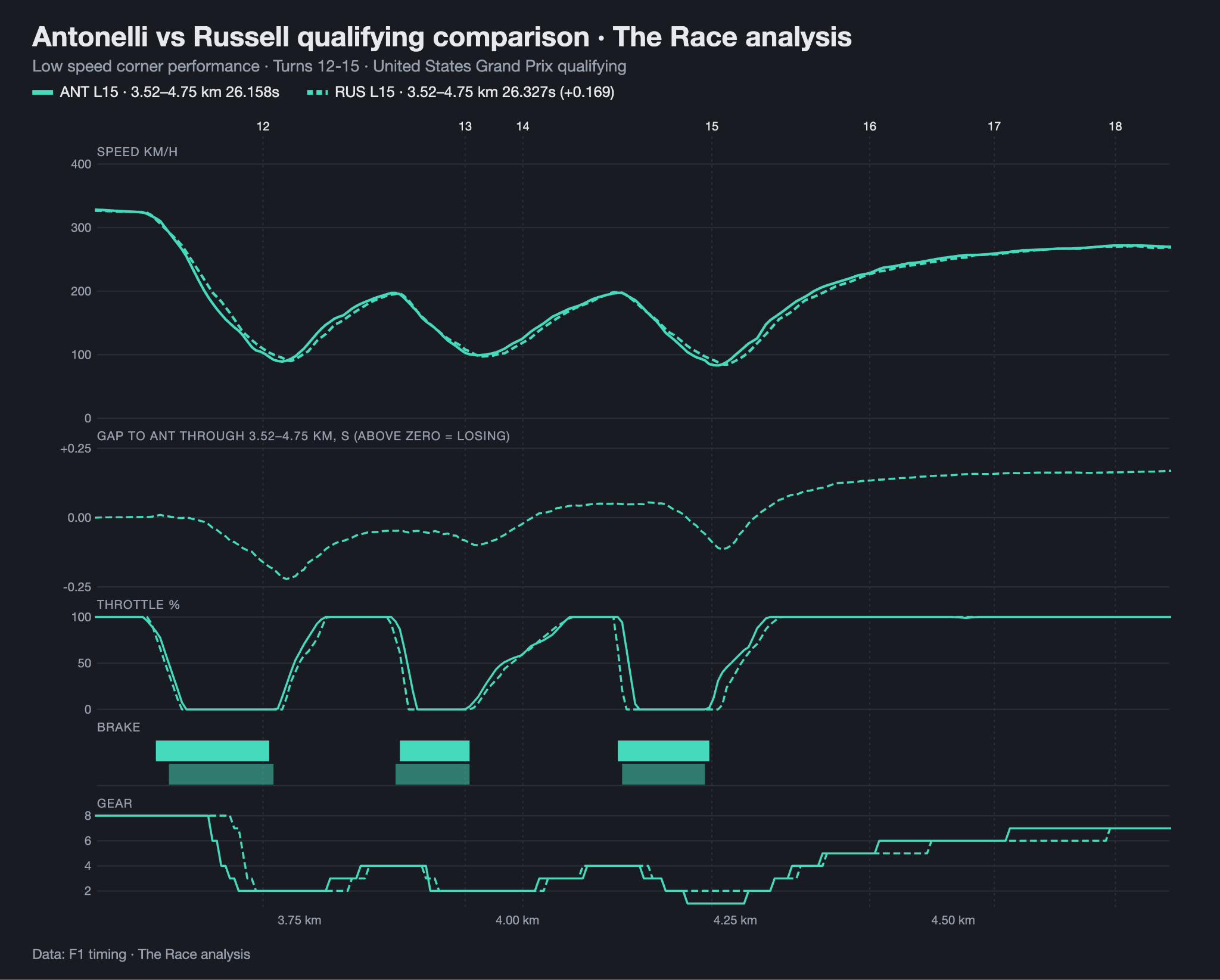
Russell was slower than Antonelli on every prominent slower corner exit in qualifying, and these usually lead into the main deployment zones too.
There could be a double whammy here, with Antonelli carrying more speed off the corner and onto the straight, but also being inherently more efficient in how he is often sharper onto full throttle. Whereas Russell potentially spends more time in an inefficient throttle range.
Mercedes team boss Toto Wolff theorised that Russell has been strongest when Mercedes has started weekends on the front foot but suffered more when it has found things tougher - if the upgrade’s characteristics can exaggerate that discomfort, this could have been the first real example of it.
“When we land the car in the way that suits him, he's absolutely fast,” said Wolff. “But when it drops out of that operating window, he struggles. And he struggles more than maybe Kimi. And that is on us.
“ We just have to work it out with him how there can be such a difference in driving in performance because George is not half a second slower, three tenths slower than Kimi. It's just absolutely not the case.
“So what is it that he doesn't like? What is it that we need to do in terms of modifying the car, setting it up in a different way for him to go fast?”
That these questions are still being asked deep into the season is not great given the recent progress Russell seemed to have made, chipping away at the worst of his deficit to Antonelli that emerged through the middle of the season.
But it’s also worth stressing that Antonelli was magnificent at Austin, and therefore presented Russell with an especially harsh contrast. For all of the head-scratching over Russell’s form, Wolff has admitted that Mercedes didn’t see such a big step from Antonelli this season coming either, with this being the latest example of what a high-quality driver he has evolved into.
Antonelli excelled in qualifying to wring the neck out of the car in its strongest parts around the lap, namely the medium and high speed Esses in the opening sector, and control the rear tyre slip excellently to mitigate where it had been weakest all weekend in the slow-speed Turns 12, 13 and 15.
And in the race, aided by cars squabbling behind and giving him a two-second buffer early on, he immediately neutralised any threat he might have faced from those on softs to his mediums by maintaining a steady advantage.
Then he executed a one-stop without any hint of fuss, despite unfamiliarity with the hard tyre and the strategy being locked in mid-race after the first stint. Even his tendency to flirt extensively with track limits seemed totally under control when it counted.
“On Kimi's side, the main headline is that, for me, the best race that he's delivered so far,” Wolff said. “The race of a champion who isn't the champion yet, but exceptional.”
That is a big claim in a season of extremely high standards that includes a tremendous showing in Monaco and, most famously, Antonelli’s win from 19th on the grid at Monza. Perhaps what was most impressive about Antonelli was the ease with which he produced this.
There is no pressure to secure the title, because it has been effectively a foregone conclusion for a while, but he has been relentless even through his biggest mistake of the season - crashing in qualifying in Azerbaijan - and Mercedes’ subsequent wobble with its car upgrade.
That is another example of the contrast between the two drivers. Russell’s fighting harder for the good moments and falls into the bad ones more easily and dramatically. For Antonelli, this is all so natural, and comes across as effortless, allowing him to repeatedly scale new heights - hence his agreement this topped Monza in terms of the job he and the team did.
“Monza, we clearly had the fastest car,” said Antonelli. “We were just super quick, so of course it was incredibly special coming from the back, but it was also a track where it was relatively easy to overtake, and we were so quick.
“Definitely, Monza was a super special one, and one that I will remember forever. But, this one probably, in terms of execution, was better, because the way we built up and the way we built the performance throughout the weekend was very good.”