US GP struggled before. Now Austin is the image of F1's growth

The United States Grand Prix and the lead-up to the race in Austin is a case study in Formula 1’s now-unshakeable foundation in North America.
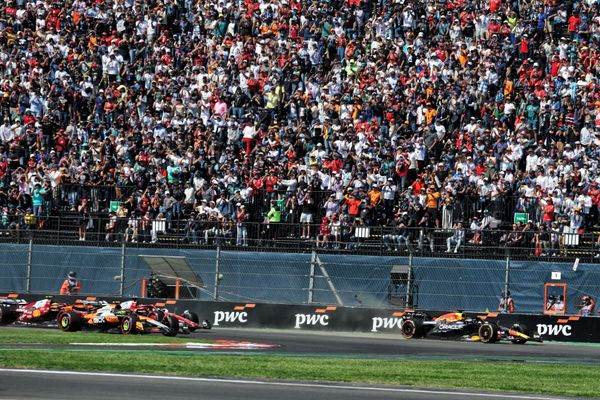
Packed grandstands and a three-day attendance of 467,000 are of course proof of that. But it was the bevy of announcements pre-Austin that underlined why the US GP and F1 are in the rudest health they’ve ever been, even amidst ongoing threats of global market shocks.
New US team Cadillac brought on Houston-based energy company Fronteiras, while Audi announced AI-forward software company Elastic will be on the team’s books from 2027 and showed off its activations with Revolut that will land in Sao Paulo.
Mercedes announced a partnership with fintech platform Stripe from 2027 onwards, with the team principal and CEO Toto Wolff joining Stripe cofounder John Collison on his Cheeky Pint podcast. The team also brought astronaut Reid Wiseman on as an ambassador and took on a new look to publicise Mercedes-Benz personalisation wing Manufaktur.
McLaren announced its partnership with pharmaceutical company AbbVie, Williams with tech company Klaviyo, Racing Bulls with cybersecurity company ThreatLocker, and Aston Martin tweaked its livery to celebrate five years of its Cognizant partnership.
The Race had its own role in the maze of partnership announcements as it held the ‘Formula One’s Premium Playbook’ event with Axios, where Adobe and Alpine’s 2027 partnership was announced - with Pierre Gasly and Adobe’s Marissa Dacay joining The Race’s CEO Fabricio Drumond to delve into the partnership.
Liberty Media’s CEO and president Derek Chang spoke with Axios Media Correspondent Sara Fischer about F1’s past and future in the US in an enlightening conversation that also included timely insight about F1’s Apple TV deal.
MotoGP had an amplified presence throughout the weekend at COTA - and APEX CEO and founder Antonio Cacorino’s analysis was resonant as he spoke on the future of Liberty Media’s flagship properties.
It was Darren Cox who spoke to Cacorino for that segment - and it is therefore over to him to shine a light on the whirring machinations of F1 in the States.
How much does F1 owe to US GP?
Darren Cox
The debate about bringing V8s back to Formula 1 has got me thinking deeply about the visceral nature of our sport and how much that visceral experience drove my love of it.
Standing on spectator banks as a kid I felt and smelled the cars as much as I watched them. That came back to me on Friday in Austin. As soon as the historic Formula 1 cars fired up in the pitlane, something clicked. I wanted to get outside and experience them.
When the current cars are running, I’m quite happy to carry on a business conversation in our Race Media suite.
But the noise I’ll remember from the 2026 Austin Grand Prix, even above the DFV V8 engines, is the sirens.
Police motorcades escorting what must have been the highest concentration of black SUVs ever assembled in one place. Inside them, the VIPs of Formula 1’s teams, partners and their associated hordes of agency staff.
We spend a lot of time trying to measure the commercial health of this sport. Perhaps we should just count the black SUVs.
Austin has become a commercial powerhouse for Formula 1. And Formula 1 has become a pretty useful business for Austin.
You could barely move around town without coming across a partner activation. The range stretched from Liam Lawson playing guitar to something a little more highbrow at our Axios x The Race event, where Adobe and Alpine used the platform to explain, in depth, what their partnership is about.
That matters. You’ve got the right people in the room, with enough time to explain an idea properly. That’s where the impact is delivered.
Austin provides both. People want to be there, and so do the people they want to meet. The race gives everyone a reason to put the same weekend in the diary.
But it wasn’t always so. After the rain-hit 2015 event, falling attendance and a reduction in state funding, the race’s future was uncertain. In 2016, the organisers brought in Taylor Swift as part of their response. Keeping the grand prix going took passion and perseverance. Grit.
So Austin deserves to be thanked for keeping the lights on in America.
Would we be in the same position today if it hadn’t? If Formula 1 had disappeared from the United States again, how much harder would the next attempt have been?