Why F1's 2026 mule car test will have a speed limit
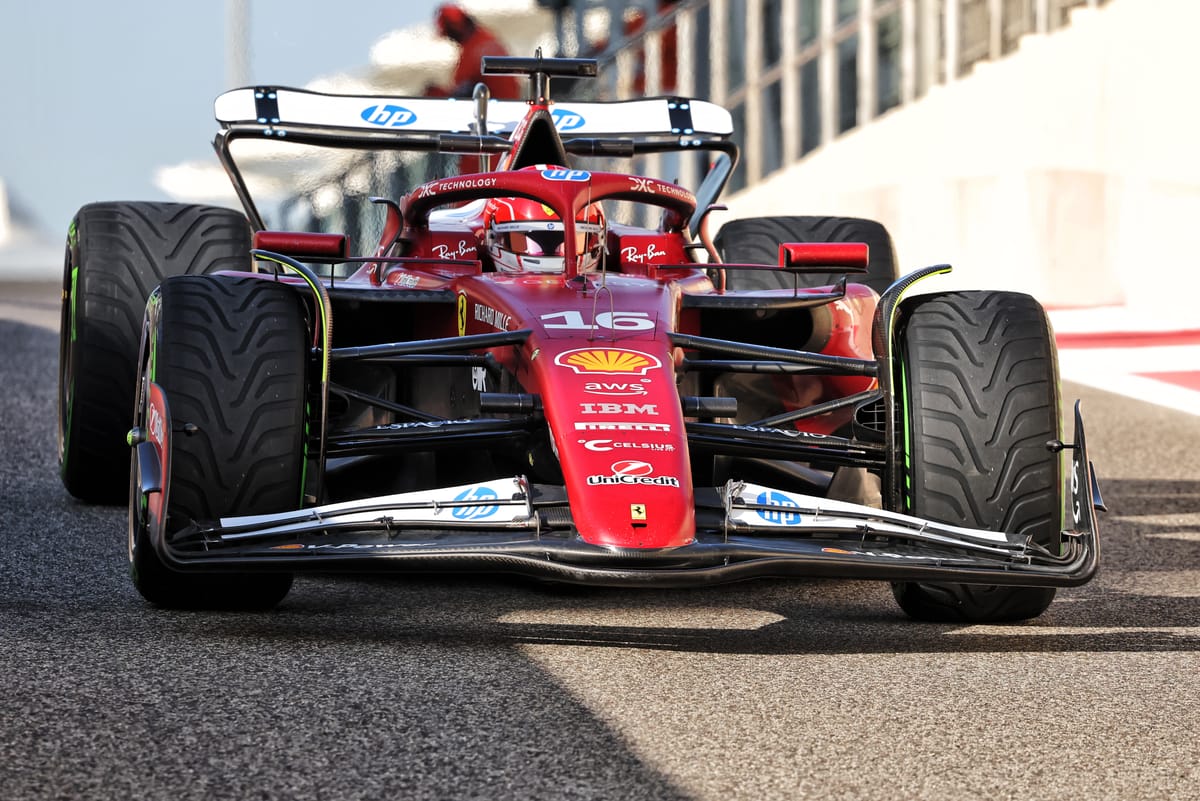
Formula 1's 'mule car' test in Abu Dhabi on Tuesday will impose speed limits on the straights and four DRS zones to further simulate the performance of the 2026 cars.
All 10 current teams will participate in the Pirelli tyre test portion of the traditional post-season day of running at the Yas Marina circuit.
It is a chance for them to sample the majority of the compounds that Pirelli has decided to homologate for 2026 before a December 15 deadline specified in the technical regulations.
Pirelli will homologate five types of tyre for 2026 from C1 to C5 with all except the C1, the hardest in the range, to be used in Abu Dhabi on Tuesday.
The teams will field two cars - one regular 2025 car that will be driven by a 'young driver' (someone who has not started more than two F1 races) and one mule car that has been adapted specifically for Pirelli's 2026 tyre development work and will be driven by a team's race driver.
Pirelli specifies the use of Monza front and rear wing levels on the mule car to simulate the reduced downforce and drag of the very different 2026 cars, and there are small adaptations to accommodate the cars running on slightly narrow tyres too.
The mule car programme affords a rough approximation of the straightline and cornering loads expected, and Pirelli's development and validation work alongside virtual simulations with increasingly advanced modelling and load estimates from the teams' own 2026 car development programmes.
But there are other factors that have been taken into consideration when deciding how to operate the test beyond the cars themselves.
Pirelli has implemented a speed limit of 300km/h (186mph) for the mule cars, for example.
This is because the 2026 cars will have active aerodynamics on the front and rear wings, so when they back off into low-drag mode there will be significantly reduced load on both axles.
But the mule cars only have the usual drag reduction system on the rear wing so, when that is activated, there is a disproportionate amount of load on the front axle.
This means the tyres are put through a load and temperature regime that is even further from the real 2026 cars. The speed limit helps balance out the load more between the front and rear axles because the faster the current ground-effect cars travel the more aggressive the loading is.
While it may seem trivial on the straights, tyre temperatures can change a huge amount. In Baku for example, on the long run from the final real corner to Turn 1, front tyre temperatures drop more than 30C - and this will be even greater with the 2026 active aerodynamics on the front wing.

And the rules around the 2026 active aero mean there will be no DRS zones as have been known for the last 15 seasons. Instead, drivers will have to activate straightline mode in all parts of the track that are not traction limited.
To partly simulate this in the test, the DRS that exists on the mule cars will be activated more often than on a normal race weekend.
Instead of being restricted to the zones on the two long back straights, the DRS will also be used on the start-finish straight, and on the run from the exit of Turn 2 to the Turn 5 hairpin.
This is similar to how Pirelli has managed the mule car programme so far in conjunction with the teams throughout 2025.
"We had to talk to the teams and try to understand, together with them, which was the best approach," Pirelli motorsport boss Mario Isola told The Race.
"That was not easy at the beginning. First of all, because the regulations were under discussion, it was not completely defined.
"We don't have an active aero package now. We have the DRS that is working in a similar way to next year, but you have nothing on the front.
"So obviously you release the load on the rear, but you overload the front.
"For that reason, we said, 'OK, let's consider that it is better to run with lower downforce in general', and also to avoid this overload on the front to put the speed limit on.
"So, if you look at the laptime, it's probably not fully representative. But it's consistent. At least we have the consistency across different tests to also compare the results."
This year's mule car programme has comprised 12 two-day sessions across Barcelona, Jerez, Fiorano, Monza, Paul Ricard, Silverstone, the Hungaroring and Mexico City's Autodromo Hermanos Rodriguez.
Other test items may be planned at Pirelli's discretion in Abu Dhabi but unlike during the rest of the tyre tests, the teams will have freedom to conduct their running however they like whereas usually it is completely prescribed by Pirelli.