Rake, drag, driving styles - what F1 teams revealed about 2026 cars
Formula 1 teams haven’t given much away about their new cars so far, but there have been indications of what to expect based on what we’ve heard rather than seen.
Some teams have put forward technical personnel to answer questions, and they have discussed some of the key characteristics and demands of the cars ahead of the start of pre-season testing. They’ve also hinted at the unknowns that only track running, and in some cases racing, will shed more light on.
Here’s what that’s told us about key aspects of the new cars.
The return of high rake
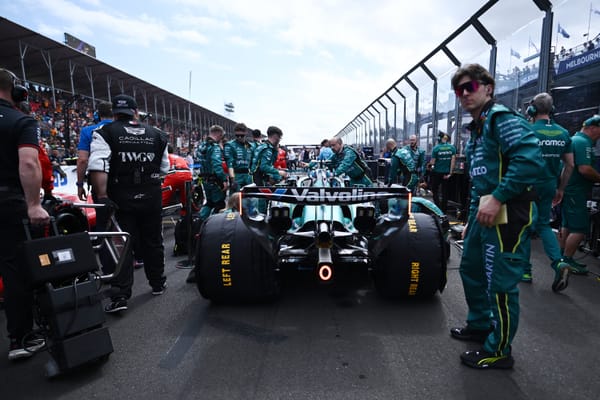
Running low and stiff was the key for the previous generation of cars. Ride heights are higher this year and that means the return of rake, whereby the rear is higher to effectively ‘point’ the car towards the ground. This can increase the angle of attack of wings and create more downforce.
The expectation is that the rear ride heights will be somewhere between what we saw last year and in the final year of the previous rules set, when high rake was popular (although not universally, as Mercedes was successful running low rake).
However, it could be that the rake increases as this rules set matures teams work out ways to do so while keeping the floor at the rear working as hoped at high ride heights - although this remains to be seen as there are other compromises and factors at play and it’s never about a single approach.
“The amount of rake you run on the car is really going to depend on your aerodynamic package and where your peak CLR [the mathematical curve plotting downforce generated in varying conditions, such as ride height] is,” said McLaren chief designer Rob Marshall.
“The intention of these regulations was to try and force the rear ride heights up, and our feeling is that will be the case.
“How high they go, we don't really know yet. How low you can go, we don't really know yet. There's a big, big journey to go on next week in Barcelona to try and find out where best to operate the car.
“Running high rake is traditionally when you get a bit of free angle of attack on your wings, and if you can get the aerodynamics to hold on, then it's great. It offers you the opportunity to have more suspension travel as well as other sort of tertiary benefits.
"But ultimately, you're chasing the peak of aerodynamic performance and you want your rear end to follow it. That might be high rake, might be low rake. I don't think it'll be low rake, but it might be less high than people think, or we might be higher than I think. I don't know. Ask me in a week's time.”
What is clear is that there will be a wider window in which these cars can run in terms of ride height and work aerodynamically.
“It’s probably all about the aerodynamic characteristics,” said Alpine technical director David Sanchez when asked by The Race about rake and whether he anticipated increasing it would become a key objective in the development war.
“It's not as extreme as the previous cars, and that means for the driver you have a little bit of a wider window to finetune the mechanical side of the car. You’re not anymore [dealing] with a car which has an aerodynamic peak really narrow and you have to be there, even to the detriment of how the car is running. These new cars are a bit more adaptable, and that should be more comfortable.”
McLaren performance technical director Mark Temple adds that this should allow the set-up variations required to better fine-tune the cars for each circuit.
“You don't have the extreme sensitivity to ride height that we had in the previous years,” said Temple.
“There will be a little bit more freedom to manipulate the car attitude to suit, to affect the handling without just simply making the car go slower.
"It will be interesting to see what that does. I think it will give us a little bit more freedom to tune the car to suit a particular handling through-corner.”
How active aero impacts car design
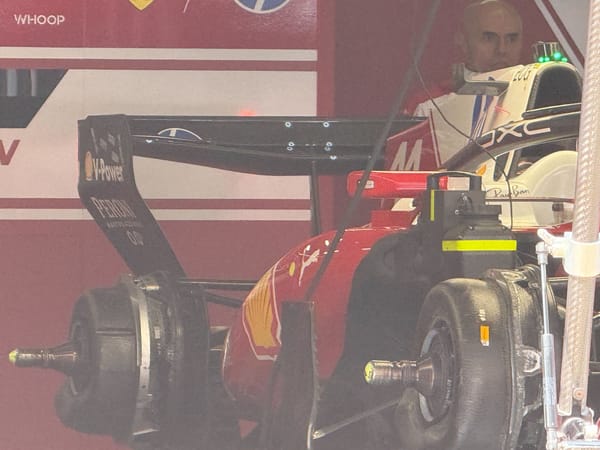
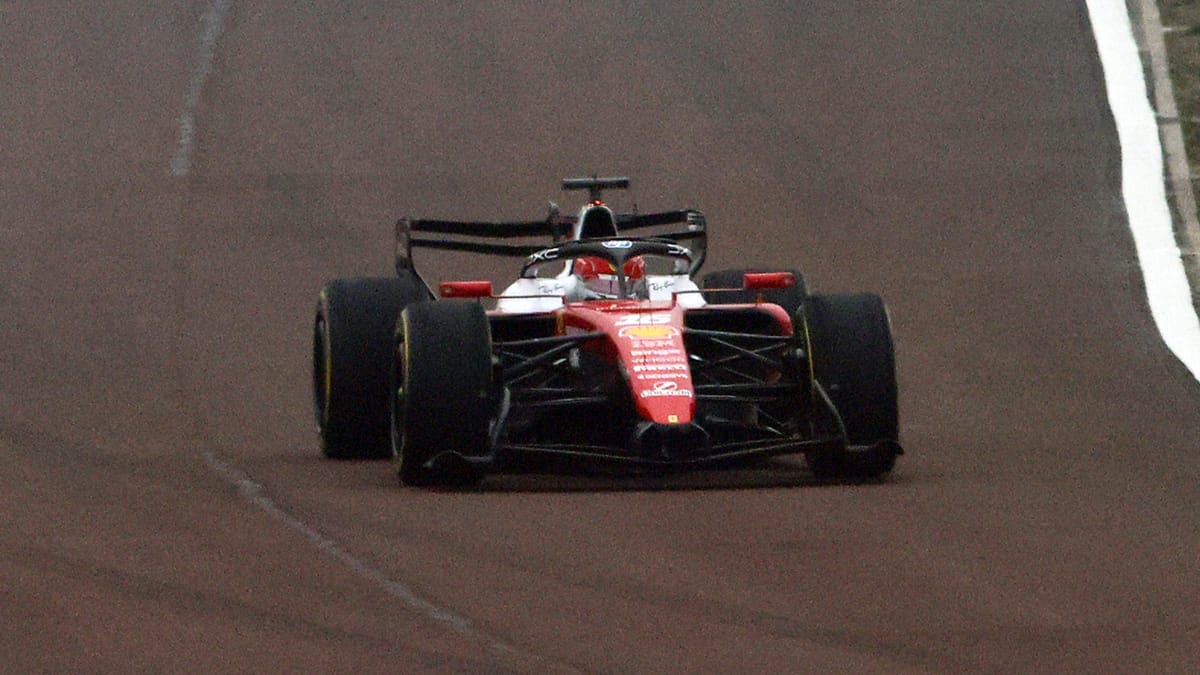
Ferrari showed us the first glimpse of active aero in motion, although the way it’s used will be straightforward enough. When you are in the permitted zones, you will be in straight line mode (SLM as it’s called) then outside of it you will be in corner mode.
However, this has a fascinating impact on the aerodynamic design parameters in terms of drag levels you can work to thanks to being able to shed some of that in corners. It also places a premium on maximising the drag reduction, while maintaining the best corner performance and how that compromise plays out.
“It’s a good question because the floors are less powerful than they were,” said Audi technical director James Key when asked how active aero changes the car concept.
“In fact, the rear wing becomes a really powerful device in these cars. It’s quite constrained with geometry, but you want to make sure that you're squeezing as much out of it as possible. And typically, the higher load you get from the rear wing, the more drag it dumps when you do the SLM. So it is a bigger development item.
“We’re going to see that developing, as everyone gets to see where everyone is and look at other geometries and stuff, we'll get to see that. So conceptually on the car, yes, maybe there is a bigger impact of making sure the rear wing is well supplied with a healthy onset flow.
"But other than that, it's really been a mechanical exercise. Getting the front and the rear wing to operate in the way we want them to.”
The presence of active aero doesn’t mean aerodynamic efficiency isn’t important, but it does add an extra dimension to the calculations. What’s more, it creates another means for performance swings depending on how much SLM is available at different tracks.
The FIA will define this and notify teams four weeks before each race.
“Efficiency is still very much the most important thing aerodynamically, but there's a change because the straight mode increases the, or rather reduces the, drag of the car significantly,” said Temple.
“So it then becomes more about the amount of downforce you have in corner mode versus the drag that you have in straight mode as a general rule.
“If you look at the season as a whole, there are some tracks where you have more straight mode than others. So, as an example in Belgium, because of the nature of the back of the circuit, you don't have straight mode all the way back up the hill to the bus-stop, that's in corner mode. Then the drag in corner mode becomes more important.
"But a circuit like Monza, where you have straight mode on all of the straights, then actually that's less important.
“There’s an extra dimension to deciding how to set your car up. But if we think about the cases where circuits are dominated by straight mode, then you will see cars carrying larger rear wings and more of the total available downforce that they have. But then at other tracks like Belgium, it will be perhaps closer to what we've seen in previous years.”
How energy management will impact drivers
There’s been much talk about the extent to which the drivers must be mindful of the state of charge of the battery.
With a total of 8.5MJ harvestable per lap, or 9MJ if you have override mode available, but the battery capacity effectively 4MJ (this is defined as the permitted difference between the maximum and minimum state of charge at any time the car is on track) there will be huge demands.
There will be an opportunity for drivers to make gains through their intelligence in how they factor this demand into their approach to races, particularly in battle. What’s less clear is the extent to which their driving styles may be limited by it.
While cars in themselves should allow a wider range of driving styles than last year, it may be that the need to maximise energy-harvesting means there is an optimum way to drive the car into and through the corners.
During the Alpine launch, I asked Pierre Gasly how much room there is for the ‘more traditional driving skills’ to make a difference and if it becomes second to the energy demands and if that gives less scope to express himself as a driver.
While he couldn’t give an answer, that in itself hints that the worst fears about how much drivers might be limited are not off the table. Doubly so, given he prefaced his answer with a grin that hinted he perhaps suspects that will be the case.
“It's a fair question, but at the moment I don't have a fair answer,” said Gasly. “I can't really tell. We’ve just got to be open-minded and be aware that it might be different.”
This question is at the heart of how successful the new rules will be. If there are ideal braking approaches and downshift strategies that limit the car dynamically - and it’s already expected that lower gears will be used at times to maximise harvesting - then there could be some very frustrated drivers.
“The energy harvest and recovery in the braking zones and into the corner creates a new challenge,” said Temple.
“How that affects what the driver has to do and also what they need from the handling of the car, we don't know for sure yet, and that's something we'll learn from testing.
"Understanding that and understanding how we can exploit it is going to be really important for us.”
Pushrod versus pullrod suspension
This is always a design decision that attracts significant attention, primarily because it’s so visually obvious.
In the simplest terms, a pushrod has the inboard suspension parts mounted high on the chassis and the outboard components low and the pullrod vice versa.
This does have packaging and centre of gravity impacts, but the decision is primarily aerodynamic in terms of both positioning of the various suspension legs and how you can use the shrouds to condition airflow.
“Various cars had push or pullrod last year and for the previous years,” said Marshall. “It really comes down to an aerodynamic choice on what front suspension set suits your new front wing, and obviously the new front wings are all new.
"So it's really aerodynamically driven. Both are quite easy to do mechanically.”
The pushrod configuration is the most popular at both ends of the car, based on what we’ve seen so far. The outliers when it comes to front suspension so far are Alpine and Cadillac.