Visiting F1's new Rwanda track - everything we learned
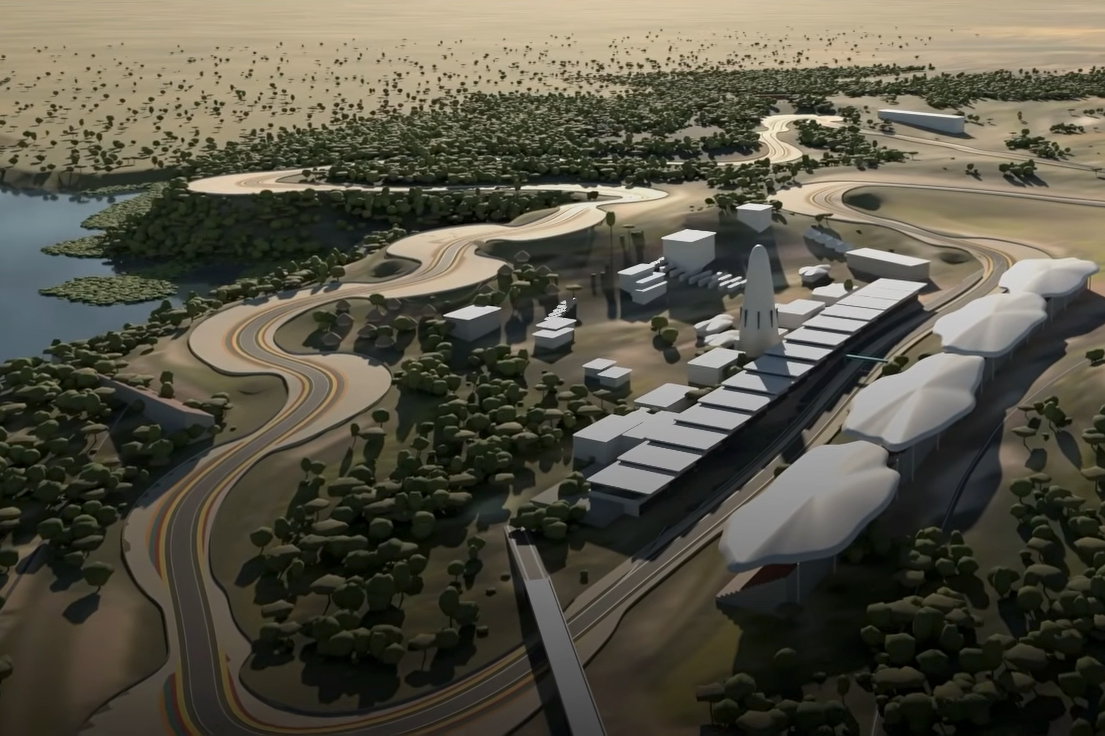
Formula 1's announcement of its return to Africa after more than three decades away was hailed by F1 CEO Stefano Domenicali as "one of the most significant days" in its history.
The Race was among a select group of media to attend the launch in Kigali, see the new Rise Motordrome track at nearby Bugesera, and find out what's behind the race name and the track, and the motivations behind the project.
Here's what we learned seeing the location for ourselves and hearing from those at the heart of the circuit.
It will be F1's biggest 'rollercoaster'
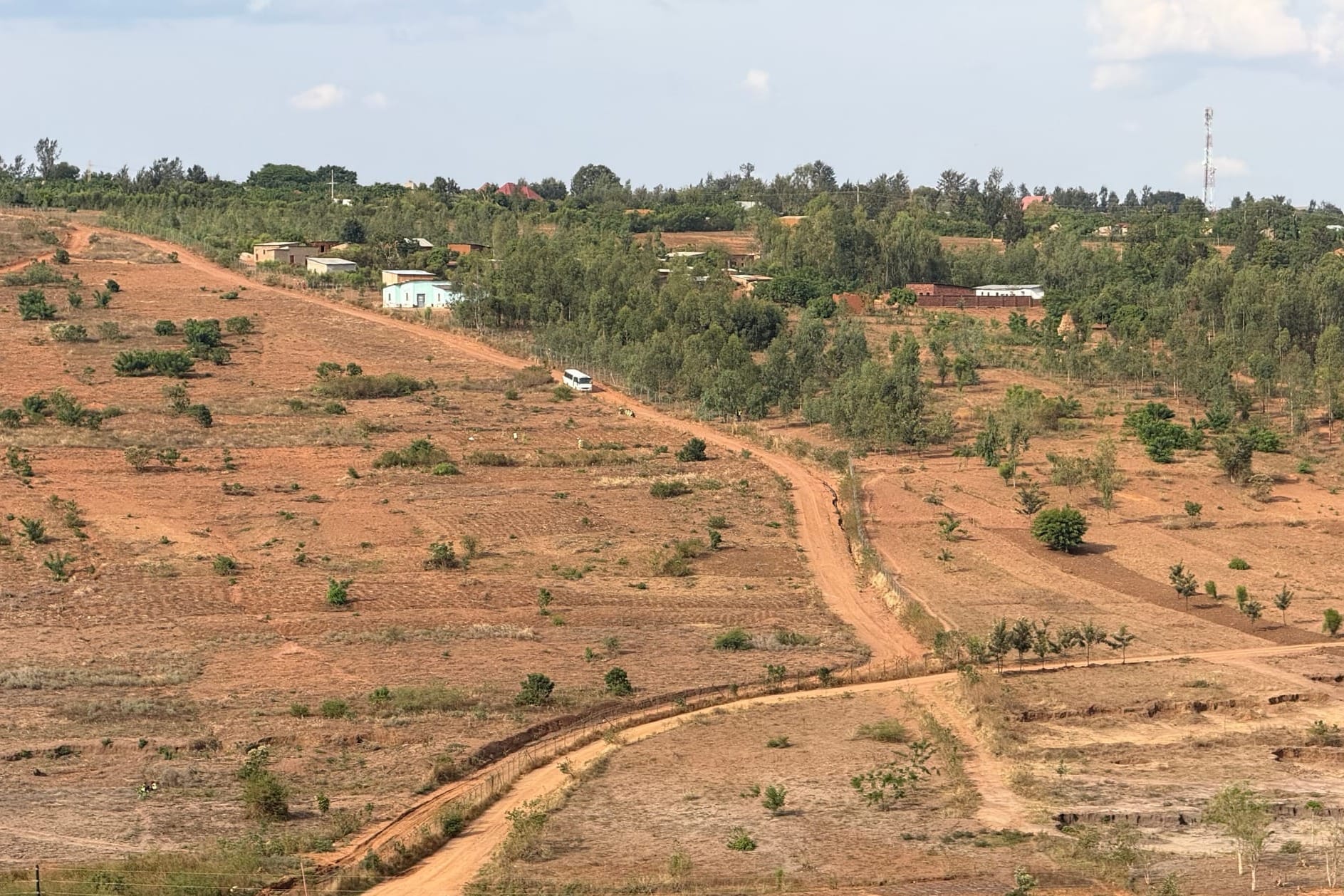
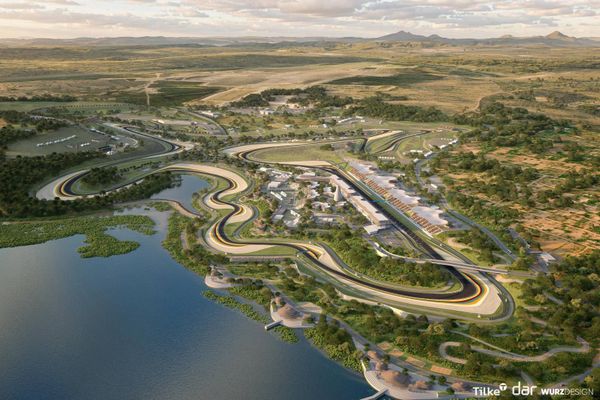
One of the standout features of this circuit is the local landscape and how the track is designed to work with that - not demand a huge earthworks project to level everything.
"I said, guys, there's only one location this circuit should be because it doesn't need us to design it," said former F1 driver and track designer Alex Wurz about choosing the site for it.
"The nature designed already the perfect topography. It's two hills with the lake below. That means we can drive up and down the beautiful landscape."
Circuit architect Carlsten Tilke said it has "everything you dream of when you design a track" and it was evident from The Race's first-hand experience at the site just how significantly it will rise and fall.
One of the circuit’s straights will have an elevation change than Eau Rouge at Spa, and the overall elevation changes around the lap - close to 15% in some places - will collectively be the most extreme on the entire calendar.
"This is why we also have a lot of elevation changes," said Tilke.
"So when you look at one lap, the elevation gain is 197 metres per lap, which is record-breaking for the calendar.
"It really is a rollercoaster track with a lot of banking. It's really making use of this topography."
That means it has massive potential to break away from the homogenous nature of modern F1 circuit additions, where the proliferation of new street tracks have led to 'generic sweeps between concrete barriers' even if the races themselves are set against very different scenery.
This should have one of the most spectacular backdrops of all - so as a driving experience, and an aesthetic addition to the calendar, it may add some much needed variety.
Designed to make racing possible
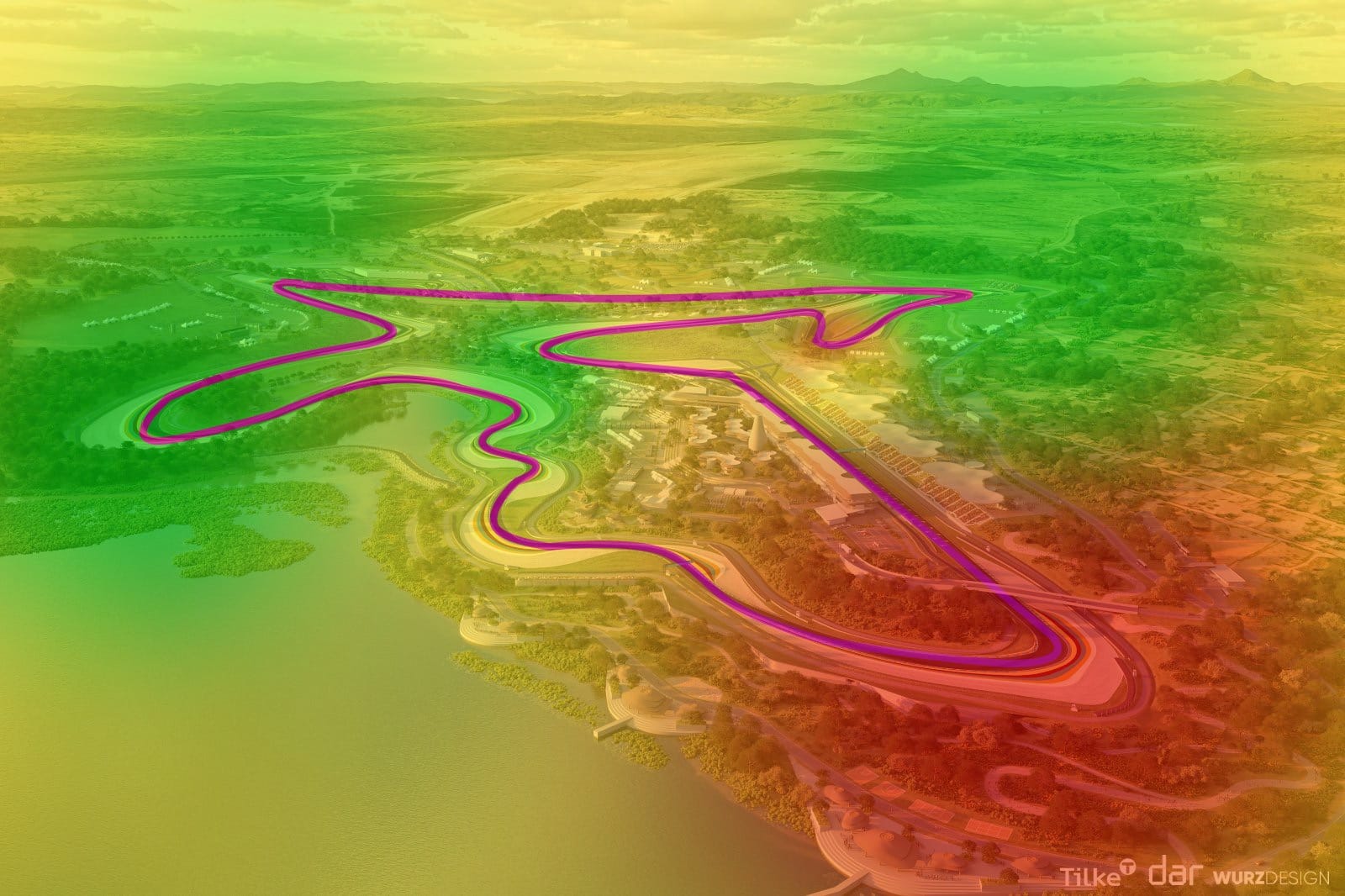
What's been released is not the final version of the track - the layout is in principle done, but tweaks could still be made - and there's only been a limited view of the render so far.
Some have picked up on the prominence of sweeping corners and an apparent absence of obvious big braking zones and overtaking places. (Though it does have these braking zones, they just aren't obvious from the render, which hides the back straight.)
Combined with track designer Wurz stressing just how much fun this circuit is intended to be for drivers, that could raise a red flag about how well-suited it will be for racing.
After all, some of the best driving experiences on a qualifying lap correlate poorly for the racing spectacle - see Monaco and Suzuka as two very different extremes for that.
But the designers are adamant that there's more to the planned circuit than you might initially see. The potential for overtaking, and different strategies, has been a key consideration in plotting the layout and is being rigorously tested in the simulator.
"We need to create overtaking points," said Carlsten Tilke.
"We need to make sure different strategies are possible on that track and so on, so that we have a nice qualifying, but also a nice race.
"The other thing very important for us in the focus was always the spectator. Spectators must be close to the track, must feel the track, must be part of it."
Wurz has done "thousands of laps" of the circuit on the simulator to "ensure we leave nothing for chance" - and joked he's the lap record holder as a result - in trying to stress-test the design.
"That's for the driving sensation, that's for the riding sensation on bikes, and for the battling and overtaking," he said.
Wurz has also sought counsel from many of the top-level drivers he knows very well including drivers with, he aaid, a combined 12 world championships.
Why it's the African GP
One of the surprises about Rwanda's announcement that it has secured a deal to host F1 in the 2030s is that its event is going to be known as the African Grand Prix.
It is an intriguing choice and inevitably prompted some questions around it - like was this an F1 edict or was this an attempt by Rwanda to head off other African nations from hosting races?
The answer is that it was Rwanda's initiative. But not because it was trying to keep everything for itself. It is the opposite in fact.
FIA president Mohammed Ben Sulayem praised Rwanda for not being "selfish" with the name and instead "sending a message".
Rwanda hopes having the African GP can attract interest and investment from other nations on the continent and open the door for them to have races too.
Speaking at the official announcement, Rwanda president Paul Kagame said: "What we want is for the African Grand Prix to pave the way for other races to be hosted on the continent."
Jean-Guy K Afrika, the CEO of the Rwanda development board, said: "We want to make it bigger than just Rwanda. We want to make it the moment when the sport came back to Africa and then never left.
"That's why we felt that calling it Kigali Grand Prix, Rwanda Grand Prix, would have felt slightly exclusive. It's much easier if you call it an African Grand Prix to approach partners in this wider effort.
"We foresee a future where we look back at this moment, and we see a critical juncture from where multiple races eventually end up happening in Africa, and then you would have this virtuous circle of races happening across the continent."
Kagame believed that maximising the spotlight on Africa with a major international sporting event like F1 offered a chance for the continent to capitalise in ways it does not currently.
Rather than seeing other countries benefit from African sporting excellence, the grand prix is a chance to make sure investment came home and fed into the economy.
"For decades, African athletes have been a pillar of the global sports economy, adding significant commercial value to top leagues in the continent, but receiving almost nothing in return," he said.
"Partnerships like the one we are building help break this cycle, because they serve as a catalyst for infrastructure development.
"This is not just about building things. It's about creating a sustainable economic model where different revenues, revenue streams across hospitality, tourism, and entertainment are generated and anchored into local communities."
When it will join the calendar
When F1 announces new races, it is normally quick to get the events on the calendar.
While doing this is potentially easier at street venues that do not need building from the ground up, even Abu Dhabi went from empty land to an F1 circuit in less than three years.
The African Grand Prix is not expected to be on the calendar until 2030 at the earliest - and it could even be later.
So why such a big gap between announcement and first race?
Part of the reason is related to the Rise Motordrome circuit being part of a major new construction effort for the new international airport being built at Bugesera, about 40km from Kigali.
The $2billion investment, jointly funded with Qatar, will include hotels and entertainment facilities, all of which will be needed to host fans and personnel attending the race.
The airport is due to be finished by 2028, but the green light for the F1 race will depend on everything being ready around the venue.
This includes accommodation, access roads and that everything is fit for purpose to host the 300,000 people who would be extended to attend over a race weekend.
The uncertainties over when all this will be completed is why there is no defined date for the race just yet, so it could slip from 2030 to 2031.
But another reason as to why the Rwanda announcement has come so early is that the country wanted the deal in place so it had firm commitment that helps in the chase for investors.
Domenicali spoke at the launch about a "chicken and egg" scenario for the deal. Rwanda wanted the announcement in place to help boost investment interest, but a deal could not be properly done without the right investment there.
In the end, F1 has gone for it because of the huge benefits that having the championship back on the African continent brings.
In terms of when the race will fit in the calendar, much will depend on which of the current events falls off and how best it fits in with races around it.
The best window potentially is June to September, when it is dry season, with average temperatures in the high 20°Cs.
It'll be F1's second-highest track
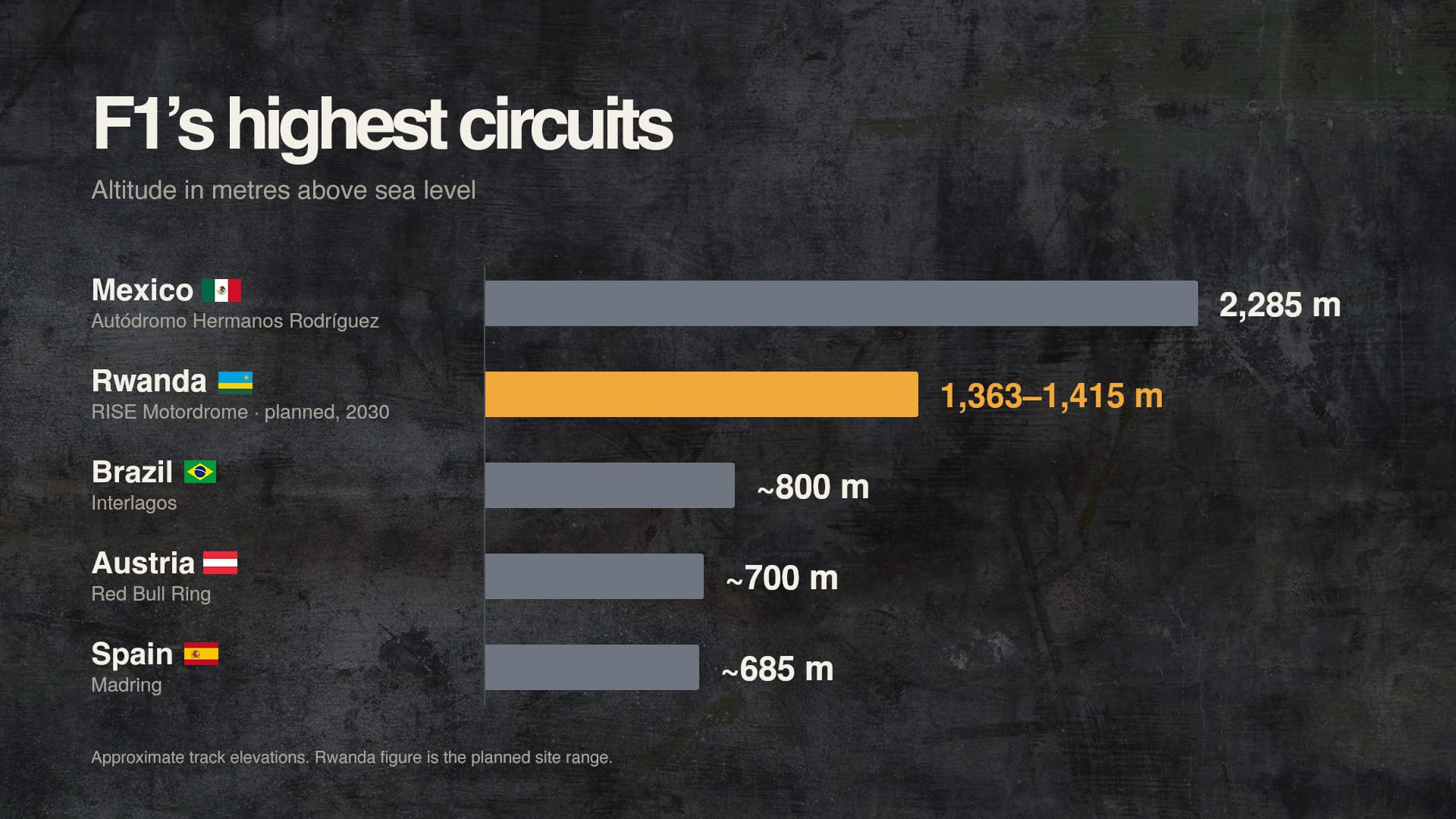
As well as the topography playing into the design of the circuit itself, this race will be extreme in another sense as it clocks in at around 1400 metres above sea level.
That would put it only behind Mexico's infamously high-altitude Autodromo Hermanos Rodriguez, and well above Interlagos and the Red Bull Ring.
This means a different kind of challenge for the teams given the impact that change in air density has on aerodynamics, cooling and engine performance.
And it's been factored into the track layout, too.
"We have less pressure in the air, that means also less grip from aerodynamics," said Wurz.
"So we can counter that with some of the cambers. We go over 12% on some corners. We don't have off-camber corners - it maybe looks like this on the render perspective.
"I can tell you it's going to be a drivers' and riders' track. It's going to be one classic of a track immediately."
What role could Hamilton play?
Lewis Hamilton has long been pushing Formula 1 to get back on the African continent.
He has spoken many times in press conferences about how, if F1 was truly a world championship, it needed to be racing on the African continent.
"I've always said that we need to have a grand prix in Africa. It is, for me, the most important continent, to be honest, and the most beautiful [continent]," he said.
Hamilton has kept the pressure on F1 CEO Stefano Domenicali about racing in Africa, and spoke last year about being involved in discussions with projects in South Africa.
It is thought, however, that he has not been a part of the Rwanda effort, which has been pulled together at a high level between the country, the FIA and F1.
However, Rwanda is very open to working with Hamilton in the future, especially because it shares a desire for the F1 event to help deliver a better future for the country.
Nelly Mukazayire, Rwanda minister of sports, spoke about the potential to work with Hamilton.
"It's true he has been a very strong voice about F1 in Africa," she said. "We are open to collaboration with anyone who is really fostering this initiative.
"We are open to partnership with everyone to make it happen and make it sustainable and impactful."
More than just F1 targeted
The commitment to building a brand-new facility is a departure from the majority of new F1 races of late.
While circuits like Jeddah required an awful lot of work, Miami was built up around existing infrastructure and the Las Vegas race is a street track (though it had a brand new pit building constructed too).
This is a different undertaking: planned from the start to be a new, long-term permanent home for top-level motorsport and other events throughout the year.
So it's no surprise to hear the organiser already suggesting that it could become a home for races in MotoGP and the World Endurance Championship alongside F1.
The grand prix is going to be what's described as the "key asset" but there is a "wider masterplan" so the facility can host all sorts of events - there's talk of a kart track being added, and non-racing ideas such as exhibitions, car presentations, off-road facilities, road safety training and so on.
"This is all done to connect with the grassroots motorsport, to enable the future African stars to learn how to race, how to mechanic, how to engineer - here in Rwanda," said Wurz.